
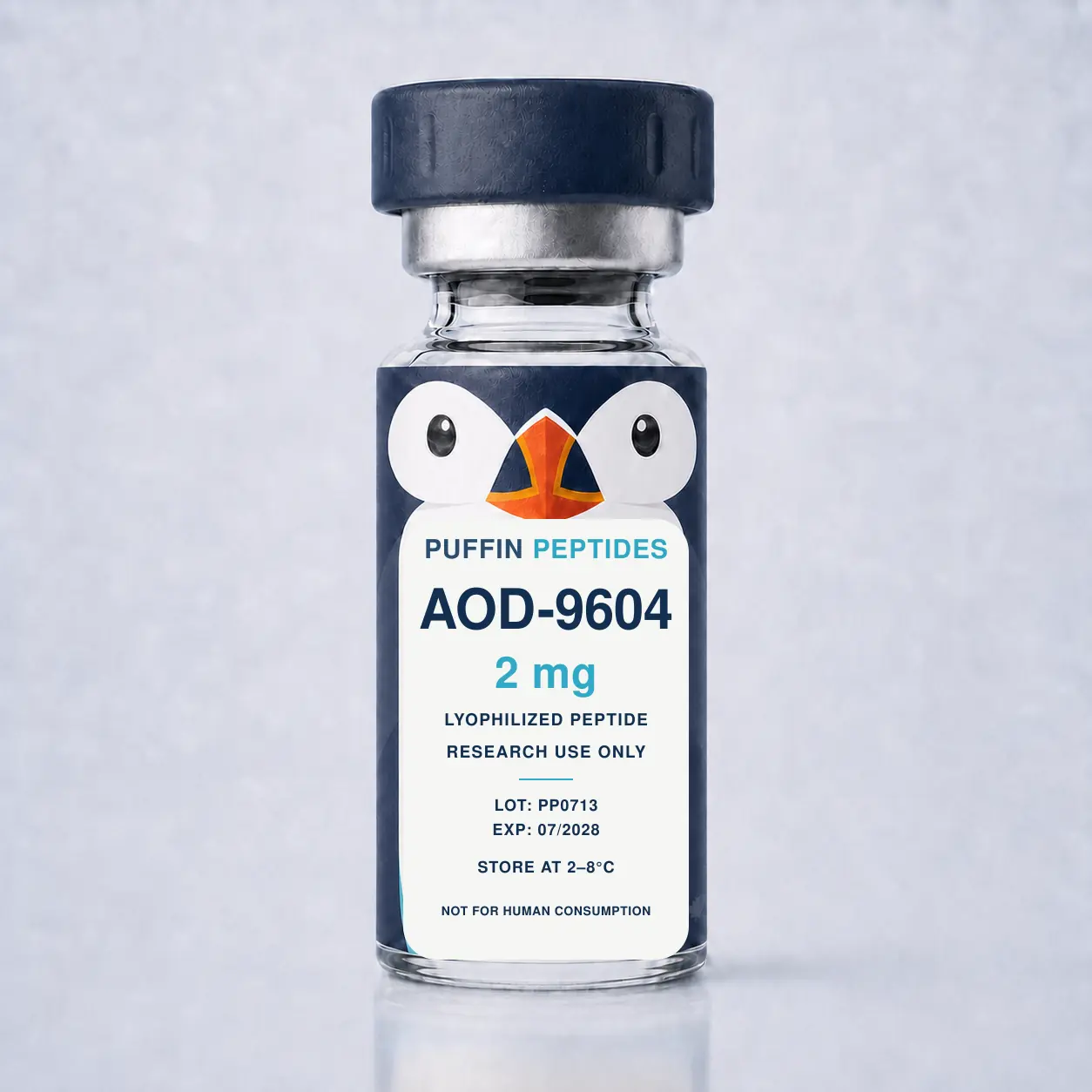
 Catalogue preview · final packaging and presentation may vary if stocked
Five choices across your ballotUse votes only for compounds you would consider ordering
One vote per compoundEach candidate can be selected once on this browser
Flexible interest signalRemove or reassign a vote whenever you like
AOD-9604
AOD-9604 is a modified peptide based on the C-terminal 176–191 region of human growth hormone, with an added tyrosine. It was developed to explore lipid-related effects without reproducing the full growth-promoting activity of HGH.
Loading your saved choices…
AOD-9604 is currently being evaluated through customer voting and is not available to order. Final product specifications and batch documentation will be published only if it joins the catalogue.
This page records catalogue interest only. If AOD-9604 is selected for supply, Puffin will publish the confirmed format, batch documentation, and laboratory preparation information on the product listing.
Storage and handling requirements depend on the final supplied format. Confirmed instructions will be provided with the batch details if this candidate is added to the catalogue.
Understanding AOD-9604
Explore the science, research focus, and key information behind this compound.
What is AOD-9604?+
AOD-9604 is useful when researchers want to isolate a modified C-terminal growth-hormone fragment from full-length HGH.
What Researchers Study+
Researchers examine GH-fragment comparisons, Lipid-signalling models, and Metabolic-pathway research.
How AOD-9604 Works+
Preclinical work proposed that the C-terminal fragment could influence lipolysis and fat accumulation through pathways distinct from the full growth-hormone receptor programme. In plain language, it isolates one proposed metabolic region of HGH rather than acting as replacement HGH.
Research at a Glance+
The obesity programme did not produce an approved medicine. AOD-9604 advanced beyond basic laboratory work, but clinical development did not establish a regulatory-approved weight-loss treatment. That negative or inconclusive history is part of the evidence. A fragment is not low-dose HGH. AOD-9604 contains only the C-terminal region plus a modification. It should not inherit growth, IGF-1, recovery, or safety claims from full-length somatropin. A discontinued efficacy programme still tells us something. When a candidate reaches human testing without becoming an approved therapy, that development history is more informative than repeating only its favourable preclinical rationale.
If this candidate is added to the catalogue, it would be offered for controlled laboratory research only. It is not for human consumption and is not represented as a medicine, treatment, supplement, or substitute for an approved product.