
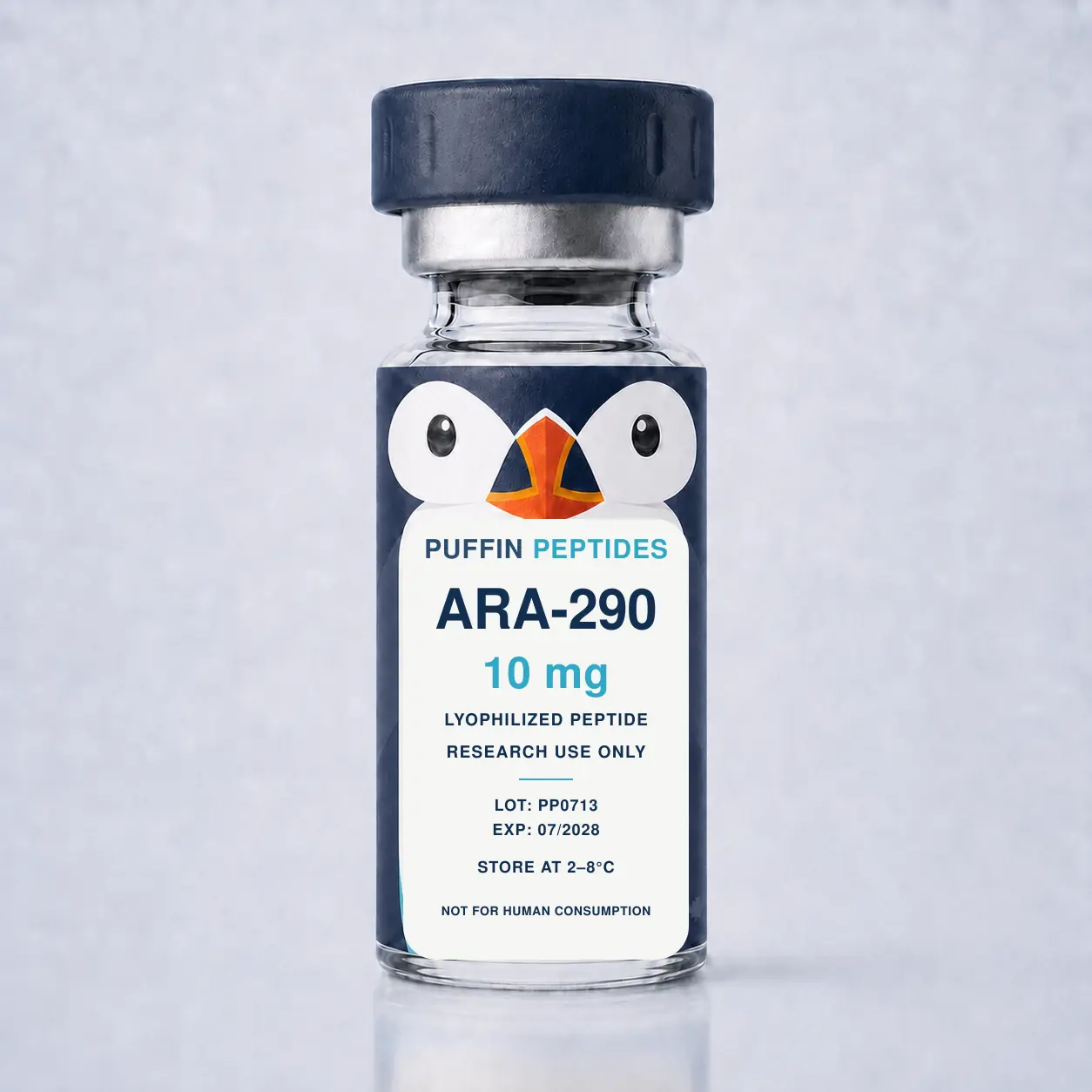
 Catalogue preview · final packaging and presentation may vary if stocked
Five choices across your ballotUse votes only for compounds you would consider ordering
One vote per compoundEach candidate can be selected once on this browser
Flexible interest signalRemove or reassign a vote whenever you like
ARA-290
ARA-290, also called cibinetide, is an 11-amino-acid peptide derived from the three-dimensional structure of erythropoietin. It was designed to study tissue-protective signalling without stimulating red-blood-cell production.
Loading your saved choices…
ARA-290 is currently being evaluated through customer voting and is not available to order. Final product specifications and batch documentation will be published only if it joins the catalogue.
This page records catalogue interest only. If ARA-290 is selected for supply, Puffin will publish the confirmed format, batch documentation, and laboratory preparation information on the product listing.
Storage and handling requirements depend on the final supplied format. Confirmed instructions will be provided with the batch details if this candidate is added to the catalogue.
Understanding ARA-290
Explore the science, research focus, and key information behind this compound.
What is ARA-290?+
ARA-290 is useful when researchers want an EPO-derived peptide without making full-length EPO the centre of the model.
What Researchers Study+
Researchers examine Innate-repair receptor research, Inflammatory signalling, and Tissue-response models.
How ARA-290 Works+
Cibinetide is proposed to activate an innate-repair receptor complex involving EPOR and CD131, rather than the classical EPO receptor arrangement that drives erythropoiesis. In plain language, it tries to separate EPO’s repair-related signals from its red-cell signal.
Research at a Glance+
Small trials reported signals in neuropathy models. Phase 2 studies in sarcoidosis-associated small-fibre neuropathy reported changes in selected symptoms and nerve measures. Sample size, endpoints, and replication limit broad conclusions. Repair signalling is proposed to be non-erythropoietic. The central design goal is to avoid red-cell production while retaining tissue-response activity. Blood indices remain useful controls when testing that claim. EPO evidence does not automatically transfer. Cibinetide is a short structural mimic with a proposed receptor distinction. Approved epoetin outcomes and dosing are not evidence for ARA-290.
If this candidate is added to the catalogue, it would be offered for controlled laboratory research only. It is not for human consumption and is not represented as a medicine, treatment, supplement, or substitute for an approved product.