
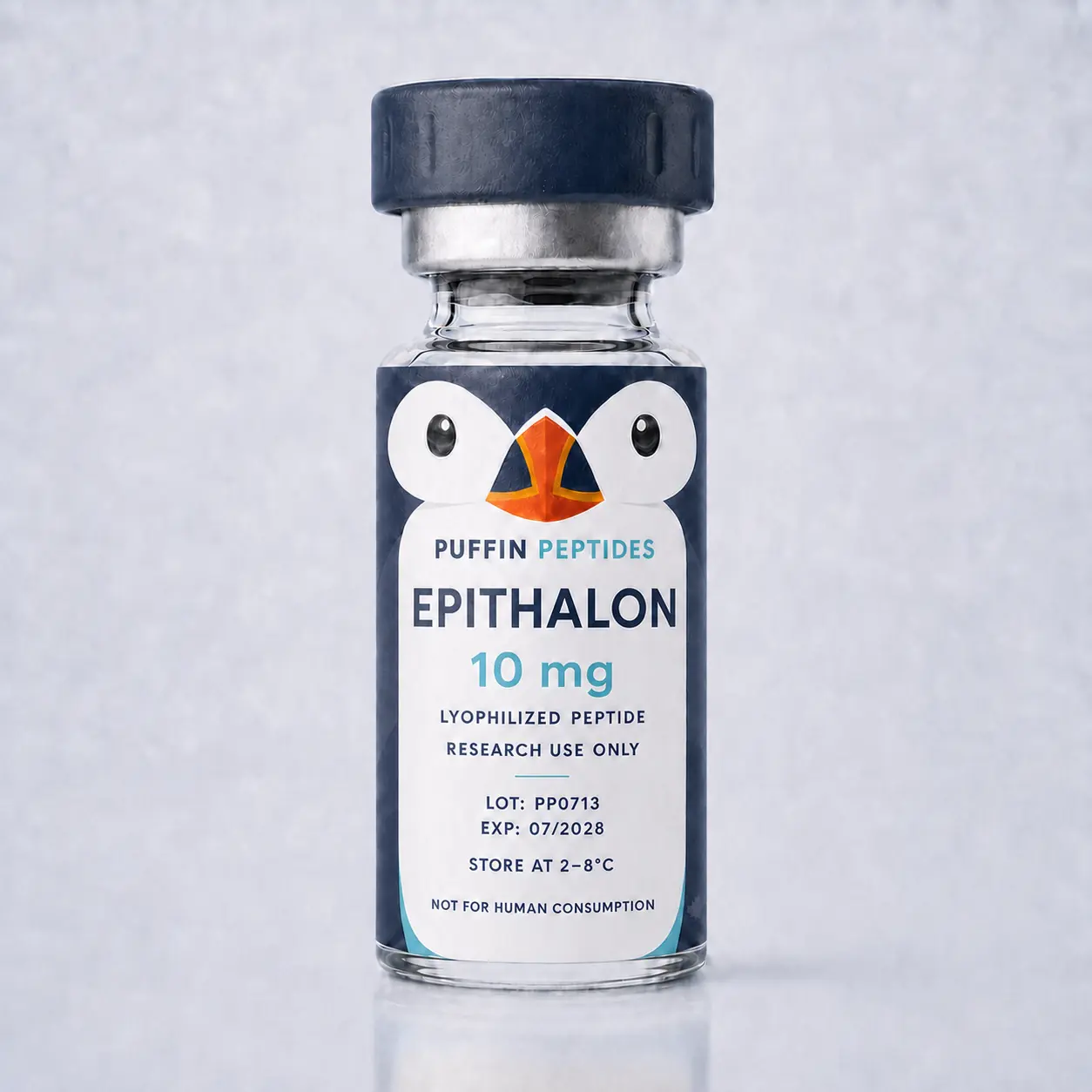
 Catalogue preview · final packaging and presentation may vary if stocked
Five choices across your ballotUse votes only for compounds you would consider ordering
One vote per compoundEach candidate can be selected once on this browser
Flexible interest signalRemove or reassign a vote whenever you like
EPITHALON
Epithalon—also spelled epitalon—is the synthetic tetrapeptide Ala-Glu-Asp-Gly. It is studied in cell-ageing, gene-expression, chromatin, and telomere-related models, but most of the evidence comes from preclinical or small regional studies.
Loading your saved choices…
EPITHALON is currently being evaluated through customer voting and is not available to order. Final product specifications and batch documentation will be published only if it joins the catalogue.
This page records catalogue interest only. If EPITHALON is selected for supply, Puffin will publish the confirmed format, batch documentation, and laboratory preparation information on the product listing.
Storage and handling requirements depend on the final supplied format. Confirmed instructions will be provided with the batch details if this candidate is added to the catalogue.
Understanding Epithalon
Explore the science, research focus, and key information behind this compound.
What is Epithalon?+
Its compact tetrapeptide structure makes Epithalon a focused tool for exploratory ageing and gene-expression models.
What Researchers Study+
Researchers examine Cellular-ageing models, Telomere-biology research, and Gene-expression pathways.
How Epithalon Works+
Some experiments report changes in telomerase activity, telomere length, or gene regulation after exposure to the peptide. In plain language, those findings suggest cellular pathways worth testing; they do not show that the peptide reverses ageing in a whole person.
Research at a Glance+
Telomerase and proliferative changes have been reported in culture. Human-cell studies from a limited research network reported telomerase activation and telomere-related changes. Replication, cell context, genomic stability, and long-term consequences remain essential questions. A telomere signal is not a proven lifespan effect. Cellular ageing markers are useful experimental endpoints, but they do not establish whole-organism longevity, improved function, or clinical benefit. Epithalon and epithalamin are not interchangeable. One is a defined four-amino-acid peptide; the other is a pineal-derived mixture. Their findings should remain attached to the material actually studied.
If this candidate is added to the catalogue, it would be offered for controlled laboratory research only. It is not for human consumption and is not represented as a medicine, treatment, supplement, or substitute for an approved product.