
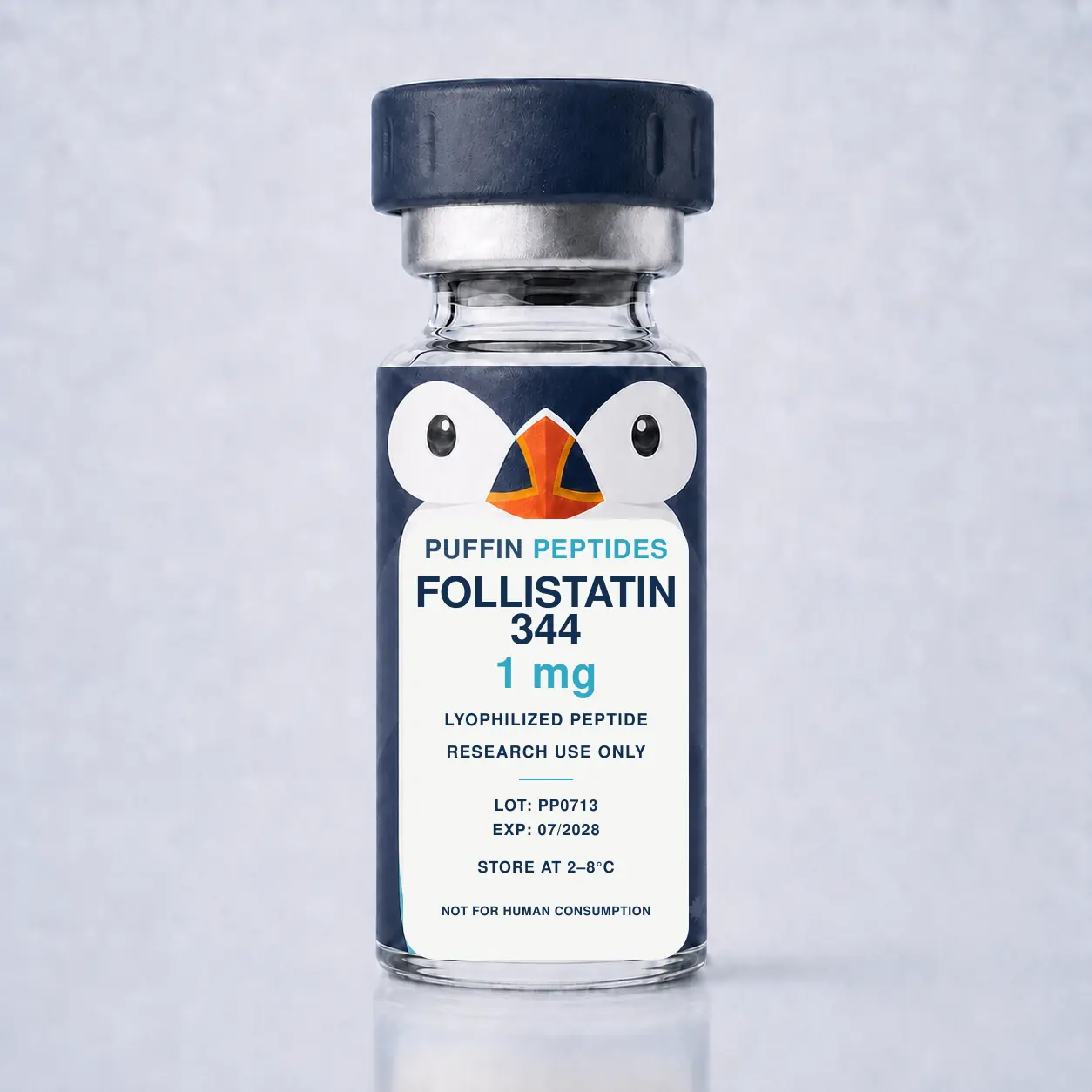
 Catalogue preview · final packaging and presentation may vary if stocked
Five choices across your ballotUse votes only for compounds you would consider ordering
One vote per compoundEach candidate can be selected once on this browser
Flexible interest signalRemove or reassign a vote whenever you like
FOLLISTATIN 344
Follistatin 344 is a secreted binding-protein isoform that can bind activins and related TGF-beta-family ligands, including myostatin. It is a regulatory protein—not a receptor-selective myostatin inhibitor.
Loading your saved choices…
FOLLISTATIN 344 is currently being evaluated through customer voting and is not available to order. Final product specifications and batch documentation will be published only if it joins the catalogue.
This page records catalogue interest only. If FOLLISTATIN 344 is selected for supply, Puffin will publish the confirmed format, batch documentation, and laboratory preparation information on the product listing.
Storage and handling requirements depend on the final supplied format. Confirmed instructions will be provided with the batch details if this candidate is added to the catalogue.
Understanding Follistatin 344
Explore the science, research focus, and key information behind this compound.
What is Follistatin 344?+
Follistatin 344 is a direct research reference for ligand binding across activin- and myostatin-related systems.
What Researchers Study+
Researchers examine Activin binding, Myostatin-pathway models, and Skeletal-muscle signalling.
How Follistatin 344 Works+
Follistatin wraps around certain ligands and prevents them from reaching activin type II receptors. In plain language, it can remove several signalling messages at once, which is why muscle-related effects and off-target reproductive or endocrine effects must be considered together.
Research at a Glance+
Blocking activin-family ligands can change muscle phenotypes. Animal and genetic studies show that higher follistatin activity can increase muscle mass in selected models. The same broad ligand binding can affect reproductive and other systems. Follistatin binds more than myostatin. Activins and related ligands contribute to endocrine, reproductive, inflammatory, and tissue biology. A muscle endpoint alone can miss important pathway effects. Protein, gene therapy, and endogenous levels are not equivalent. They produce different location, duration, folding, and exposure. Evidence should stay attached to the exact experimental format.
If this candidate is added to the catalogue, it would be offered for controlled laboratory research only. It is not for human consumption and is not represented as a medicine, treatment, supplement, or substitute for an approved product.