
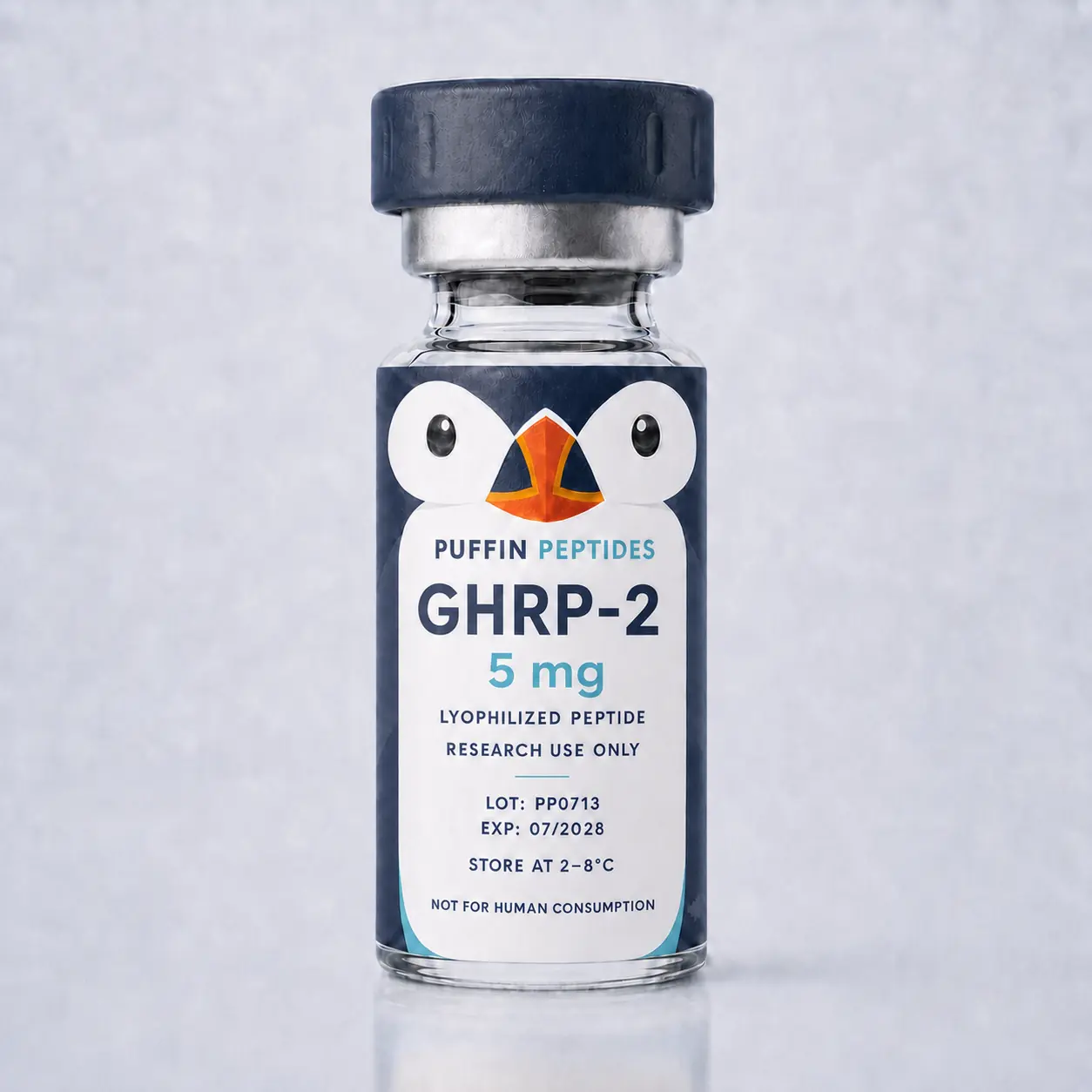
 Catalogue preview · final packaging and presentation may vary if stocked
Five choices across your ballotUse votes only for compounds you would consider ordering
One vote per compoundEach candidate can be selected once on this browser
Flexible interest signalRemove or reassign a vote whenever you like
GHRP-2
GHRP-2, also known as pralmorelin, is a synthetic ghrelin-receptor agonist that stimulates pituitary growth-hormone release. It is studied as a GHSR-pathway reference and is not a GHRH analogue.
Loading your saved choices…
GHRP-2 is currently being evaluated through customer voting and is not available to order. Final product specifications and batch documentation will be published only if it joins the catalogue.
This page records catalogue interest only. If GHRP-2 is selected for supply, Puffin will publish the confirmed format, batch documentation, and laboratory preparation information on the product listing.
Storage and handling requirements depend on the final supplied format. Confirmed instructions will be provided with the batch details if this candidate is added to the catalogue.
Understanding Ghrp-2
Explore the science, research focus, and key information behind this compound.
What is Ghrp-2?+
GHRP-2 is a direct research reference for ghrelin-receptor-driven release pathways.
What Researchers Study+
Researchers examine Ghrelin-receptor activity, Pituitary-response models, and Growth-hormone release signalling.
How Ghrp-2 Works+
GHRP-2 activates the growth-hormone secretagogue receptor, the same receptor family used by ghrelin. That signal can promote GH release and may also affect appetite, ACTH, cortisol, and prolactin depending on exposure and model.
Research at a Glance+
GH-release activity is established in endocrine studies. Controlled human studies have shown acute GH responses to GHRP-2. Those studies support a secretagogue mechanism, not long-term claims about muscle, fat, recovery, or ageing. GH may not be the only hormonal response. GHRP-2 can influence ACTH/cortisol and prolactin in some settings. Measuring only GH can hide an endocrine effect relevant to the experiment. Regional diagnostic use is not a general approval. Pralmorelin’s diagnostic role in Japan concerns a defined product and protocol. It does not establish anti-aging, performance, or clinical use for a catalogue vial.
If this candidate is added to the catalogue, it would be offered for controlled laboratory research only. It is not for human consumption and is not represented as a medicine, treatment, supplement, or substitute for an approved product.