
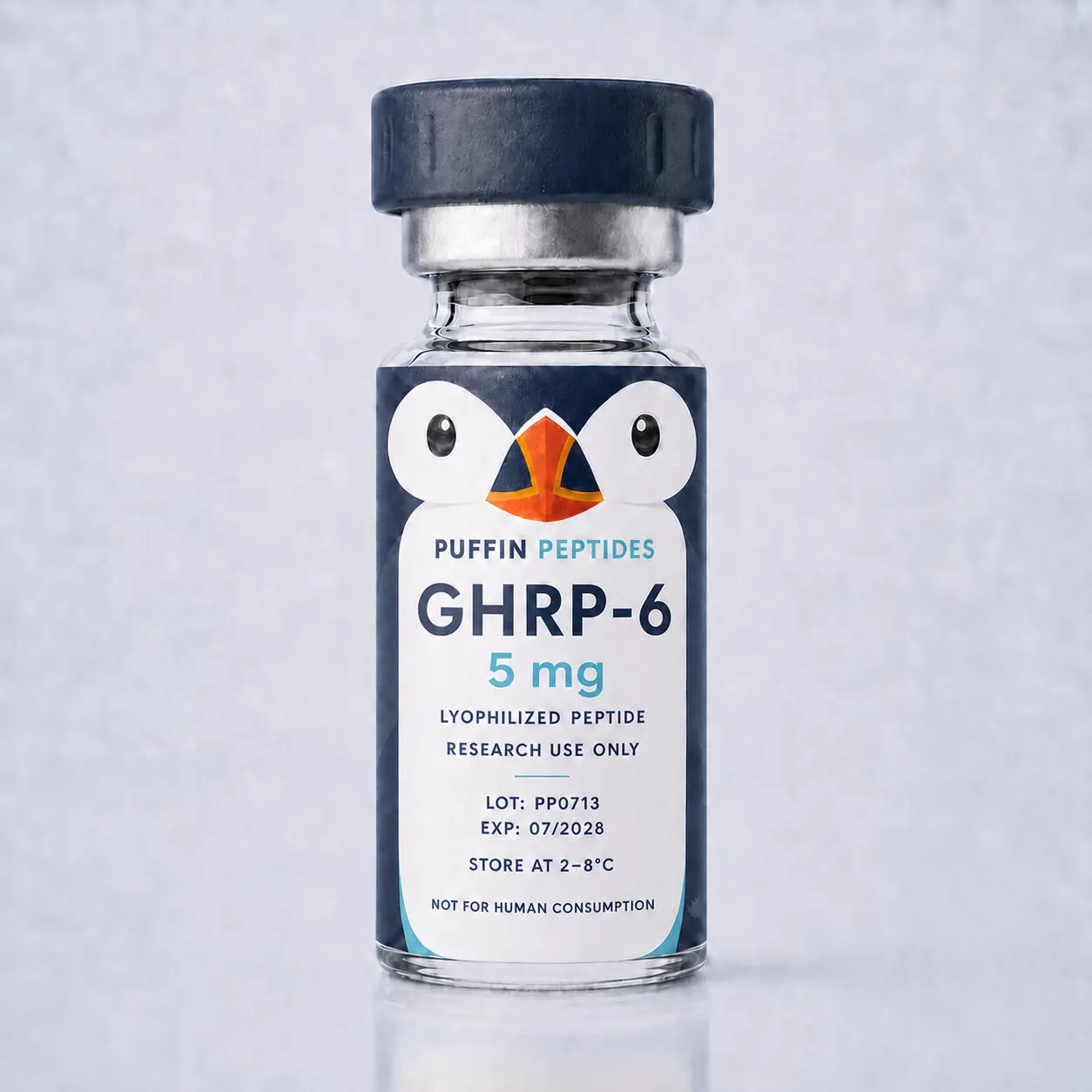
 Catalogue preview · final packaging and presentation may vary if stocked
Five choices across your ballotUse votes only for compounds you would consider ordering
One vote per compoundEach candidate can be selected once on this browser
Flexible interest signalRemove or reassign a vote whenever you like
GHRP-6
GHRP-6 is a synthetic ghrelin-receptor agonist studied in growth-hormone release, appetite, and gastrointestinal-signalling models. It shares a receptor pathway with GHRP-2, hexarelin, and ipamorelin but not an identical response profile.
Loading your saved choices…
GHRP-6 is currently being evaluated through customer voting and is not available to order. Final product specifications and batch documentation will be published only if it joins the catalogue.
This page records catalogue interest only. If GHRP-6 is selected for supply, Puffin will publish the confirmed format, batch documentation, and laboratory preparation information on the product listing.
Storage and handling requirements depend on the final supplied format. Confirmed instructions will be provided with the batch details if this candidate is added to the catalogue.
Understanding Ghrp-6
Explore the science, research focus, and key information behind this compound.
What is Ghrp-6?+
Researchers compare GHRP-6 when both pituitary and appetite-related ghrelin signalling matter to the model.
What Researchers Study+
Researchers examine Ghrelin-receptor activity, Appetite-signalling models, and Pituitary-response research.
How Ghrp-6 Works+
By activating GHSR1a, GHRP-6 can stimulate pituitary GH release and engage appetite-related neural and peripheral signals. In plain language, it uses the ghrelin route, which connects endocrine release with feeding biology.
Research at a Glance+
Acute GH and appetite responses have been observed. Small controlled studies support GHSR-mediated endocrine and feeding effects. They do not answer long-term safety, effectiveness, or body-composition questions. Same receptor family does not mean same selectivity. GHRP-2, GHRP-6, hexarelin, and ipamorelin differ in potency, endocrine spillover, and development history. Direct head-to-head design is more reliable than class-wide assumptions. Appetite can change downstream metabolic endpoints. A GHRP-6 study that measures body weight or nutrient handling should track food intake so a feeding response is not mistaken for a direct tissue effect.
If this candidate is added to the catalogue, it would be offered for controlled laboratory research only. It is not for human consumption and is not represented as a medicine, treatment, supplement, or substitute for an approved product.