
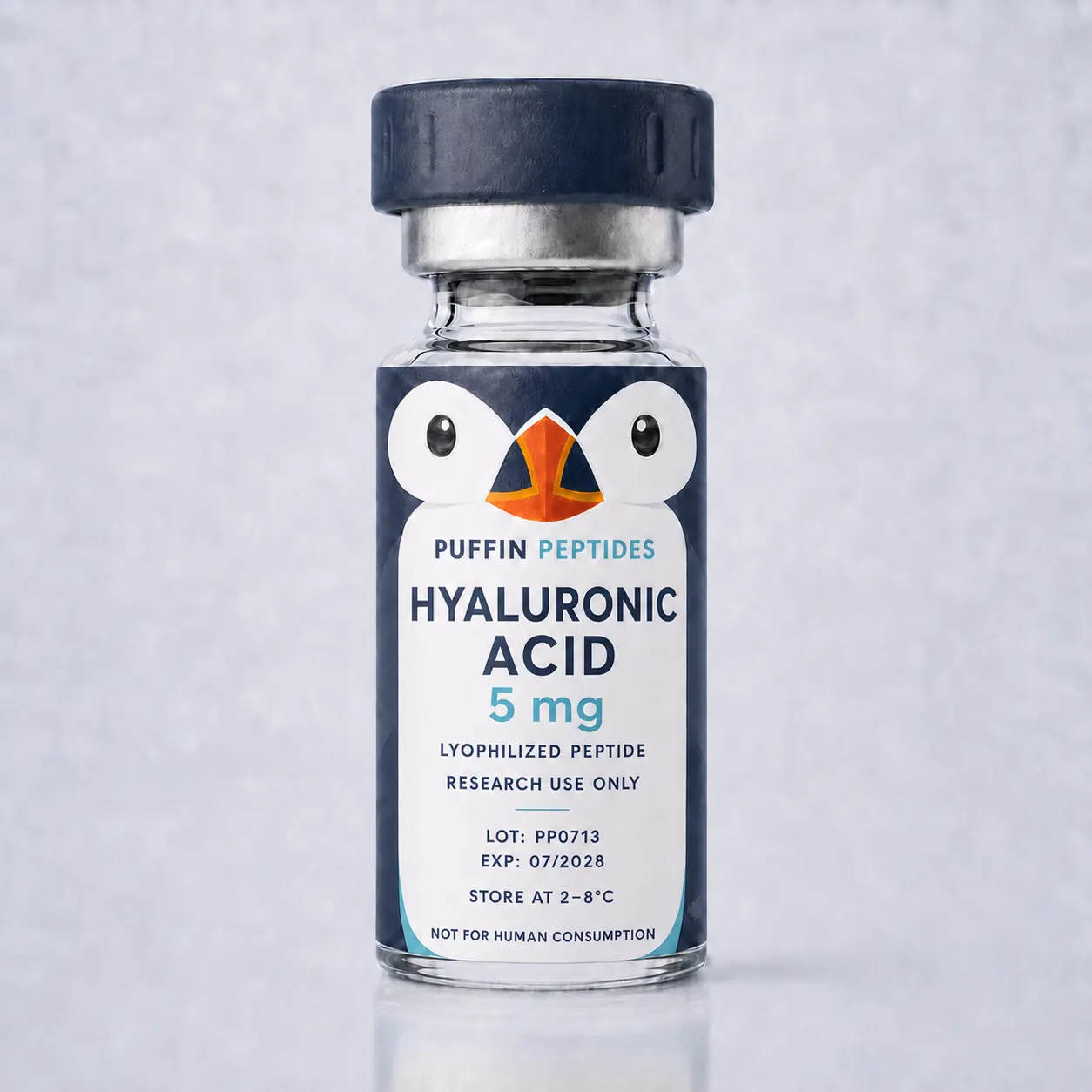
 Catalogue preview · final packaging and presentation may vary if stocked
Five choices across your ballotUse votes only for compounds you would consider ordering
One vote per compoundEach candidate can be selected once on this browser
Flexible interest signalRemove or reassign a vote whenever you like
HYALURONIC ACID
Hyaluronic acid is a large sugar polymer found throughout the extracellular matrix; it is not a peptide. Researchers study its water-binding, viscoelastic, cell-matrix, and molecular-weight-dependent signalling properties.
Loading your saved choices…
HYALURONIC ACID is currently being evaluated through customer voting and is not available to order. Final product specifications and batch documentation will be published only if it joins the catalogue.
This page records catalogue interest only. If HYALURONIC ACID is selected for supply, Puffin will publish the confirmed format, batch documentation, and laboratory preparation information on the product listing.
Storage and handling requirements depend on the final supplied format. Confirmed instructions will be provided with the batch details if this candidate is added to the catalogue.
Understanding Hyaluronic Acid
Explore the science, research focus, and key information behind this compound.
What is Hyaluronic Acid?+
It is a straightforward reference material when matrix behaviour, hydration, or viscoelastic properties are central to the study.
What Researchers Study+
Researchers examine Extracellular-matrix models, Hydration and viscoelasticity, and Cell-matrix interaction.
How Hyaluronic Acid Works+
Long chains of hyaluronic acid hold water and help shape the physical environment around cells. Chain length also matters biologically: high- and low-molecular-weight fragments can produce different receptor and inflammatory signals. In plain language, “hyaluronic acid” describes a family of sizes, not one uniform molecule.
Research at a Glance+
Molecular weight changes the research question. High-molecular-weight polymer, short fragments, and crosslinked gels can behave very differently. A study result should stay attached to the exact size range and formulation tested. Approved products do not validate every vial. Hyaluronic acid appears in regulated ophthalmic, joint, dermal, and device contexts. Those products have route-specific manufacturing and performance controls that do not transfer to generic research material. This is a polysaccharide—not a peptide. Keeping the chemistry straight helps researchers choose the right identity tests, concentration methods, and controls.
If this candidate is added to the catalogue, it would be offered for controlled laboratory research only. It is not for human consumption and is not represented as a medicine, treatment, supplement, or substitute for an approved product.