
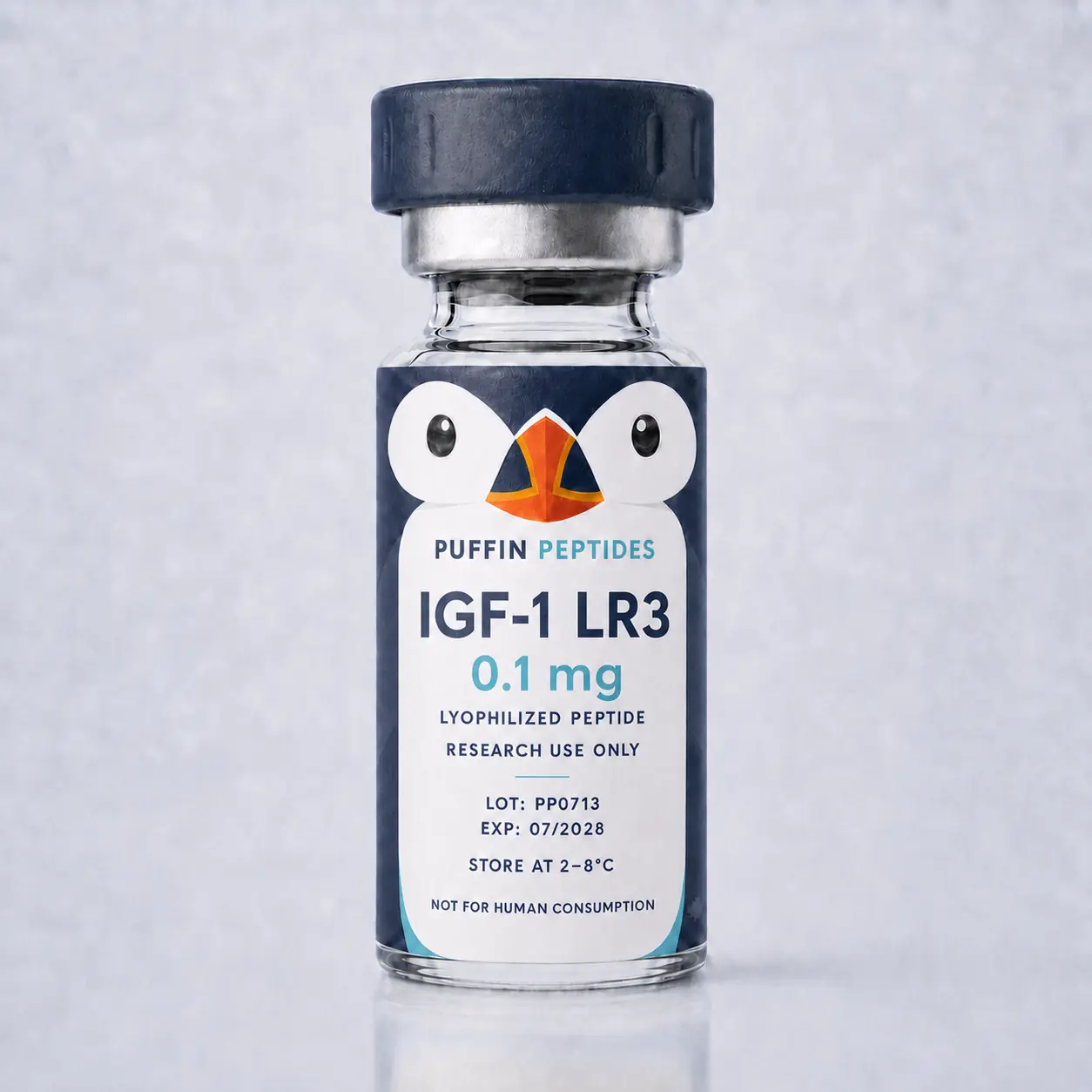
 Catalogue preview · final packaging and presentation may vary if stocked
Five choices across your ballotUse votes only for compounds you would consider ordering
One vote per compoundEach candidate can be selected once on this browser
Flexible interest signalRemove or reassign a vote whenever you like
IGF-1 LR3
IGF-1 LR3 is an engineered 83-amino-acid IGF-1 analogue with an N-terminal extension and an Arg substitution at position 3. It was designed to retain IGF-1-receptor activity while binding less strongly to IGF-binding proteins.
Loading your saved choices…
IGF-1 LR3 is currently being evaluated through customer voting and is not available to order. Final product specifications and batch documentation will be published only if it joins the catalogue.
This page records catalogue interest only. If IGF-1 LR3 is selected for supply, Puffin will publish the confirmed format, batch documentation, and laboratory preparation information on the product listing.
Storage and handling requirements depend on the final supplied format. Confirmed instructions will be provided with the batch details if this candidate is added to the catalogue.
Understanding IGF-1 LR3
Explore the science, research focus, and key information behind this compound.
What is IGF-1 LR3?+
The long-acting analogue is commonly compared with native and truncated IGF formats in receptor-response work.
What Researchers Study+
Researchers examine IGF-1 receptor activity, Cell-growth signalling, and Nutrient-response models.
How IGF-1 LR3 Works+
Reduced interaction with IGF-binding proteins can leave more analogue available to engage IGF-1 receptors in some experimental systems. In plain language, LR3 changes how the signal is carried and buffered; it is not simply native IGF-1 with a longer clock.
Research at a Glance+
Lower binding-protein affinity changes experimental availability. LR3 was developed as a potent IGF-1 analogue for laboratory and bioprocess applications. Its behaviour depends heavily on IGF-binding proteins, receptor abundance, and the surrounding matrix. Mecasermin evidence does not transfer to LR3. Approved recombinant human IGF-1 is a different molecule and drug product. Clinical dosing, safety, and outcomes for mecasermin are not evidence for long-R3 IGF-1 material. Media composition can reverse an apparent comparison. Serum and IGF-binding proteins change how much LR3 or native IGF-1 is freely available. Potency rankings should stay attached to the exact assay conditions.
If this candidate is added to the catalogue, it would be offered for controlled laboratory research only. It is not for human consumption and is not represented as a medicine, treatment, supplement, or substitute for an approved product.