
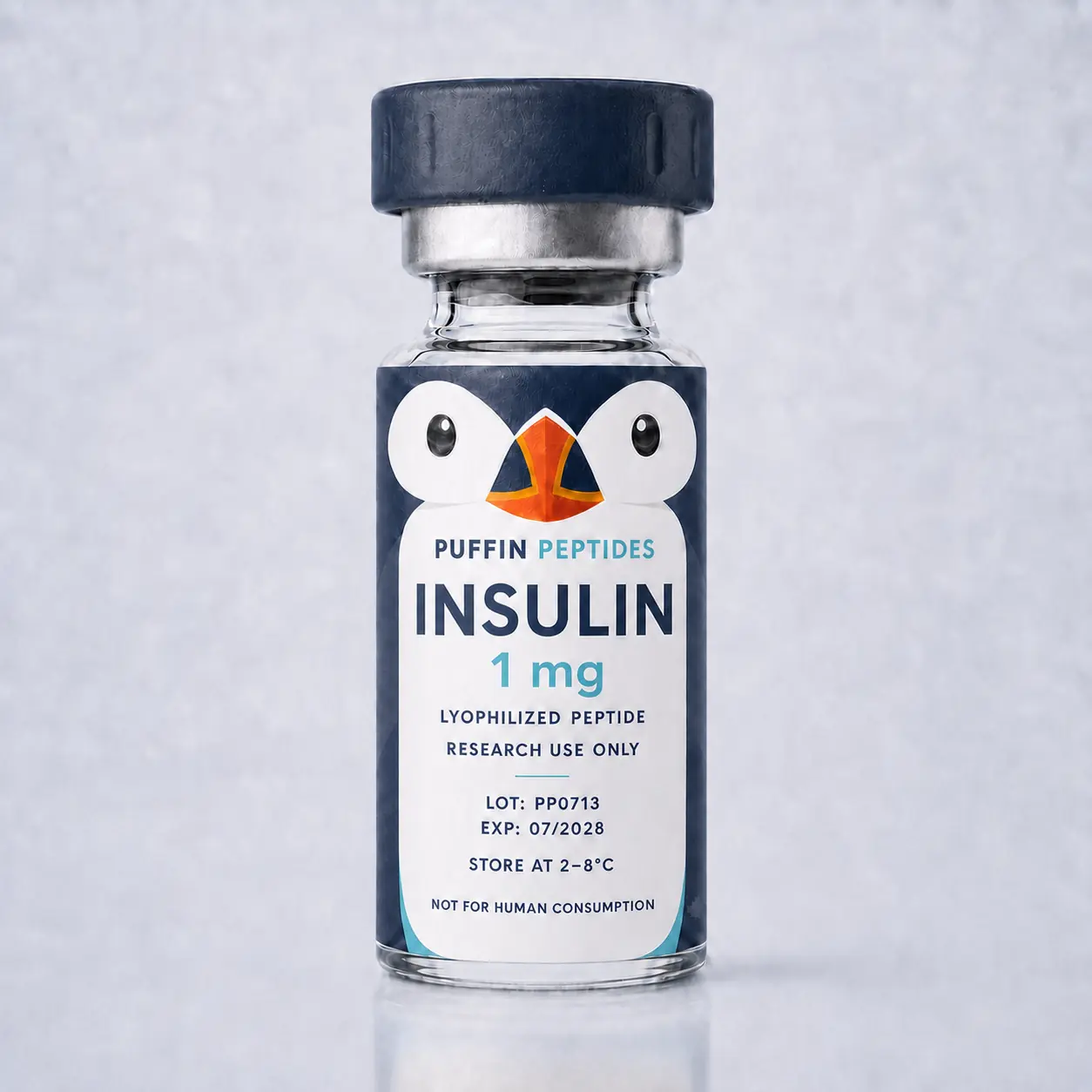
 Catalogue preview · final packaging and presentation may vary if stocked
Five choices across your ballotUse votes only for compounds you would consider ordering
One vote per compoundEach candidate can be selected once on this browser
Flexible interest signalRemove or reassign a vote whenever you like
INSULIN
Insulin is a two-chain peptide hormone central to glucose and nutrient signalling. Researchers use it to study insulin-receptor activation, glucose transport, glycogen and lipid metabolism, and growth-related pathways.
Loading your saved choices…
INSULIN is currently being evaluated through customer voting and is not available to order. Final product specifications and batch documentation will be published only if it joins the catalogue.
This page records catalogue interest only. If INSULIN is selected for supply, Puffin will publish the confirmed format, batch documentation, and laboratory preparation information on the product listing.
Storage and handling requirements depend on the final supplied format. Confirmed instructions will be provided with the batch details if this candidate is added to the catalogue.
Understanding Insulin
Explore the science, research focus, and key information behind this compound.
What is Insulin?+
Insulin is a core reference compound for studies of receptor activation, glucose transport, and metabolic regulation.
What Researchers Study+
Researchers examine Insulin-receptor activity, Glucose-transport models, and Nutrient-signalling research.
How Insulin Works+
Insulin binds its receptor and starts a phosphorylation cascade that includes IRS, PI3K, and AKT signalling. In plain language, the signal tells responsive cells that nutrients are available and changes how glucose, fat, protein synthesis, and gene expression are managed.
Research at a Glance+
Insulin biology and treatment are firmly established. A century of clinical and laboratory research validates insulin-receptor biology. It does not make every insulin-labelled material an approved or interchangeable medicine. “Insulin” is not one pharmacokinetic profile. Rapid-, short-, intermediate-, and long-acting products use formulation or sequence changes to alter timing. Research copy should name the exact molecule rather than borrowing claims across analogues. Serum and nutrient conditions can reshape the signal. Insulin responses depend on cell type, receptor abundance, glucose, amino acids, serum, and exposure time. Those conditions belong in every meaningful comparison.
If this candidate is added to the catalogue, it would be offered for controlled laboratory research only. It is not for human consumption and is not represented as a medicine, treatment, supplement, or substitute for an approved product.