
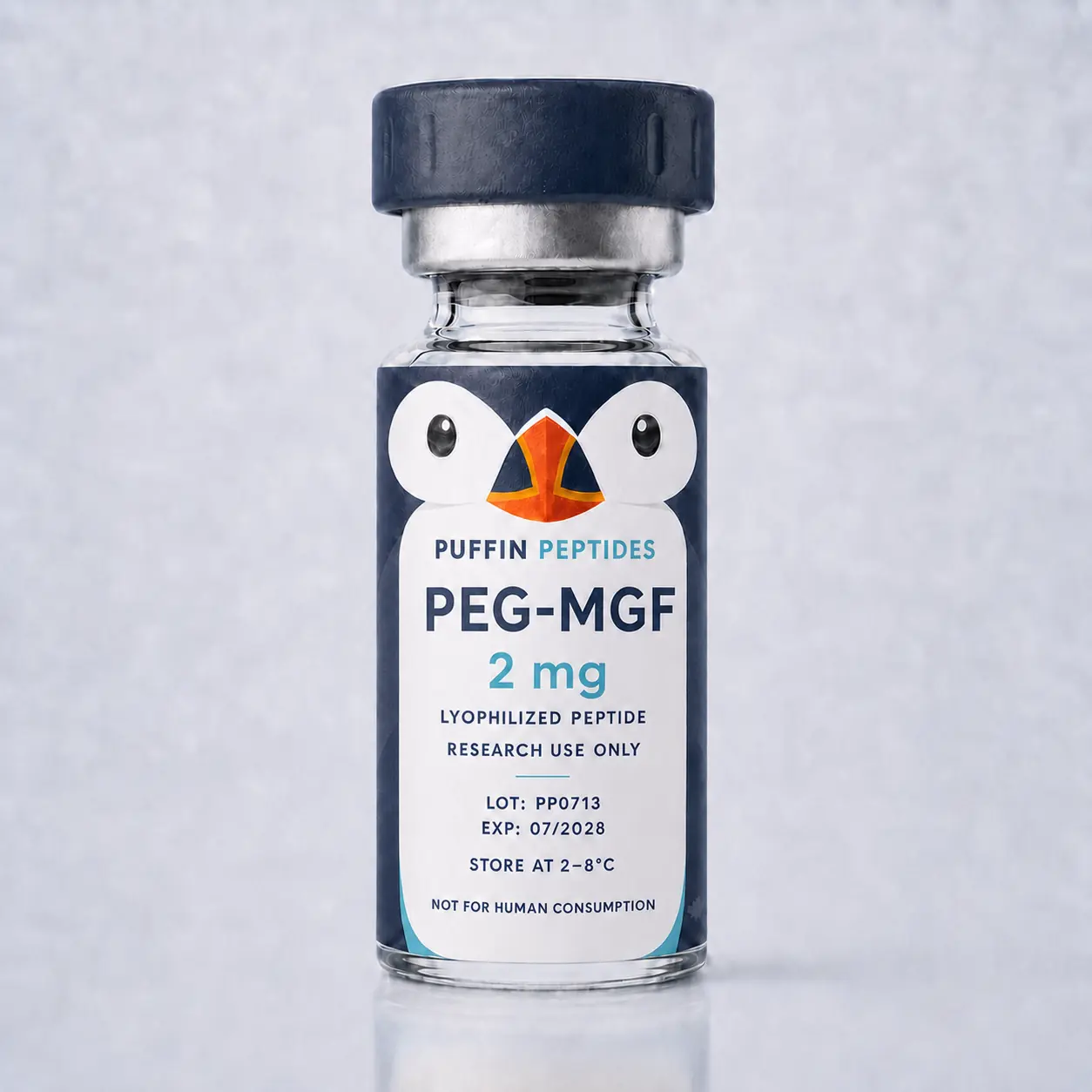
 Catalogue preview · final packaging and presentation may vary if stocked
Five choices across your ballotUse votes only for compounds you would consider ordering
One vote per compoundEach candidate can be selected once on this browser
Flexible interest signalRemove or reassign a vote whenever you like
PEG-MGF
PEG-MGF is a pegylated MGF-related analogue. Adding polyethylene glycol is intended to change physical and pharmacokinetic behaviour, but it also creates a distinct research material whose findings cannot be assumed from unmodified MGF.
Loading your saved choices…
PEG-MGF is currently being evaluated through customer voting and is not available to order. Final product specifications and batch documentation will be published only if it joins the catalogue.
This page records catalogue interest only. If PEG-MGF is selected for supply, Puffin will publish the confirmed format, batch documentation, and laboratory preparation information on the product listing.
Storage and handling requirements depend on the final supplied format. Confirmed instructions will be provided with the batch details if this candidate is added to the catalogue.
Understanding PEG-MGF
Explore the science, research focus, and key information behind this compound.
What is PEG-MGF?+
The pegylated format makes it useful for comparing analogue stability and signalling behaviour with non-pegylated MGF.
What Researchers Study+
Researchers examine Pegylation and stability, IGF-related signalling, and Growth-response comparisons.
How PEG-MGF Works+
Pegylation can slow clearance or improve stability by increasing apparent molecular size and shielding a peptide from some forms of degradation. In plain language, PEG-MGF asks two questions at once: what the MGF-related sequence does, and how the attached polymer changes exposure and activity.
Research at a Glance+
Pegylation changes more than half-life. Polymer attachment can alter solubility, steric access, assay recovery, tissue distribution, and biological potency. A result for an unmodified peptide is therefore only a starting hypothesis for a PEG conjugate. Direct product-specific work is the missing piece. The strongest experiment verifies the exact PEG-MGF construct and tests it beside unmodified MGF. Without that control, a difference cannot be assigned confidently to the peptide, the polymer, or the conjugation chemistry. PEG size and attachment site matter. Two products called PEG-MGF can differ in polymer mass, branching, conjugation site, free peptide, and distribution of species. A shared name is not proof of a shared molecule.
If this candidate is added to the catalogue, it would be offered for controlled laboratory research only. It is not for human consumption and is not represented as a medicine, treatment, supplement, or substitute for an approved product.