
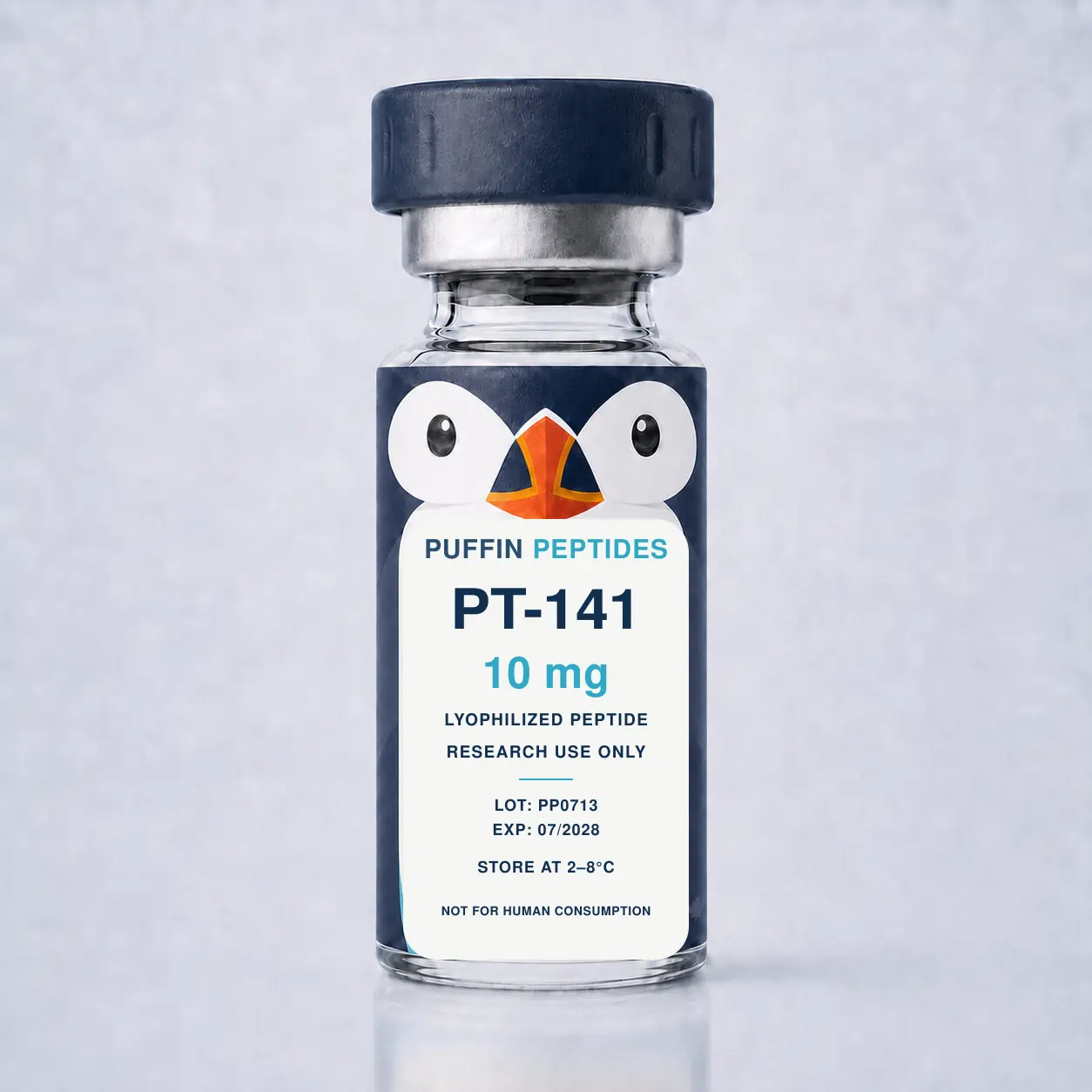
 Catalogue preview · final packaging and presentation may vary if stocked
Five choices across your ballotUse votes only for compounds you would consider ordering
One vote per compoundEach candidate can be selected once on this browser
Flexible interest signalRemove or reassign a vote whenever you like
PT-141
PT-141 is the development name for bremelanotide, a cyclic melanocortin-receptor agonist derived from melanotan II. It is studied in central sexual-response signalling rather than as a direct vascular smooth-muscle drug.
Loading your saved choices…
PT-141 is currently being evaluated through customer voting and is not available to order. Final product specifications and batch documentation will be published only if it joins the catalogue.
This page records catalogue interest only. If PT-141 is selected for supply, Puffin will publish the confirmed format, batch documentation, and laboratory preparation information on the product listing.
Storage and handling requirements depend on the final supplied format. Confirmed instructions will be provided with the batch details if this candidate is added to the catalogue.
Understanding PT-141
Explore the science, research focus, and key information behind this compound.
What is PT-141?+
PT-141 provides a distinct melanocortin agonist for receptor-selectivity and central-signalling studies.
What Researchers Study+
Researchers examine Melanocortin-receptor activity, Central signalling models, and Neuroendocrine-response research.
How PT-141 Works+
Bremelanotide activates melanocortin receptors, particularly MC4-related pathways in the central nervous system. In plain language, it changes upstream neural signalling associated with sexual response; it does not work through the same nitric-oxide pathway as common PDE5 inhibitors.
Research at a Glance+
One bremelanotide product has an approved, narrow indication. Vyleesi was reviewed as a defined prescription formulation for acquired, generalized hypoactive sexual desire disorder in premenopausal women. That is not a general approval for sexual performance or for research vials. Review the official FDA application record. Central melanocortin signalling is not the PDE5 pathway. Comparing PT-141 with vascular drugs requires separate neural and haemodynamic endpoints; similar consumer goals do not mean similar pharmacology. Approved ingredient does not establish vial equivalence. Formulation, dose delivery, impurity controls, sterility, instructions, and population-specific evidence are part of the approved product—not just the active name.
If this candidate is added to the catalogue, it would be offered for controlled laboratory research only. It is not for human consumption and is not represented as a medicine, treatment, supplement, or substitute for an approved product.