
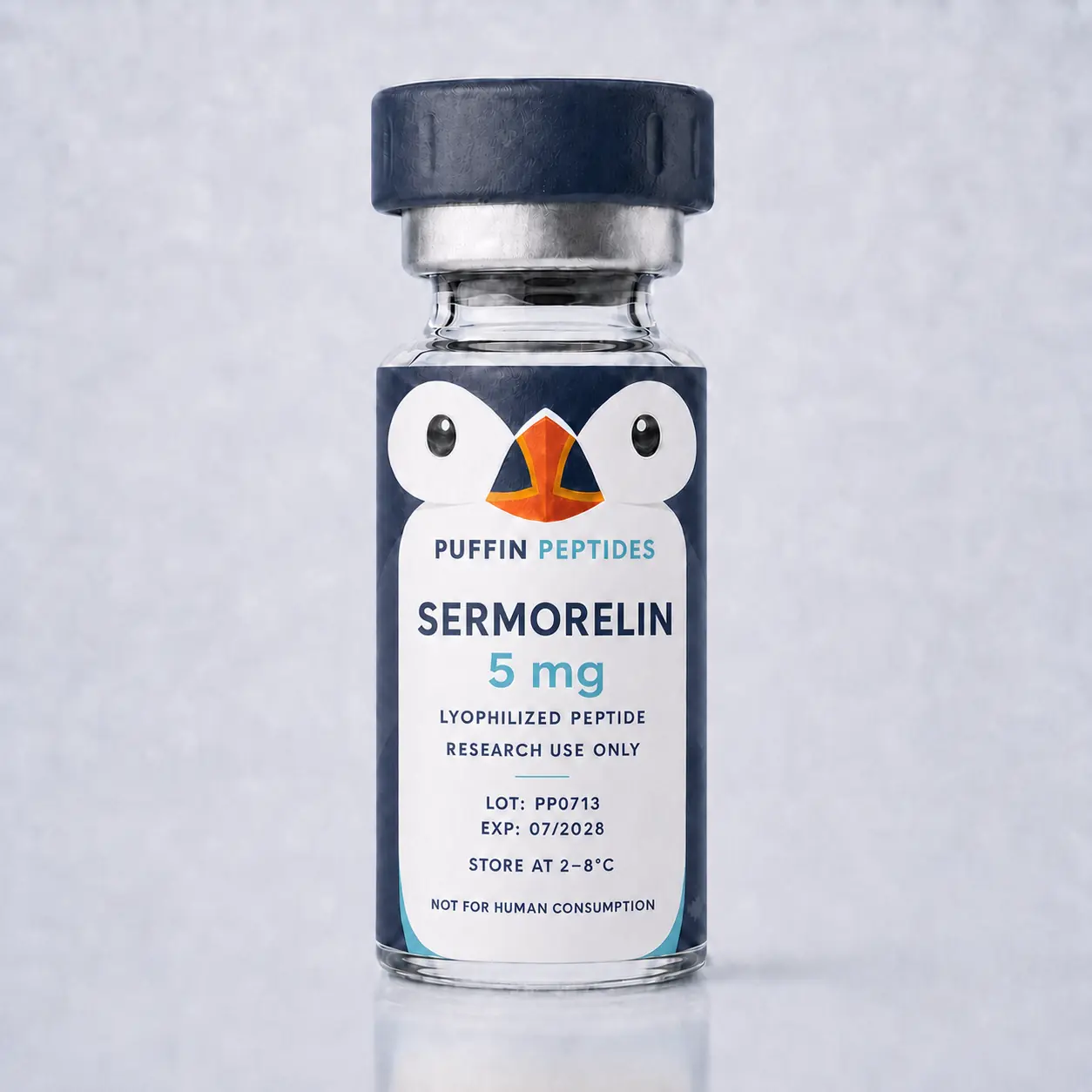
 Catalogue preview · final packaging and presentation may vary if stocked
Five choices across your ballotUse votes only for compounds you would consider ordering
One vote per compoundEach candidate can be selected once on this browser
Flexible interest signalRemove or reassign a vote whenever you like
SERMORELIN
Sermorelin is the first 29 amino acids of human GHRH—the shortest fragment that retains strong GHRH-receptor activity. It gives researchers a defined way to study the pituitary side of growth-hormone release.
Loading your saved choices…
SERMORELIN is currently being evaluated through customer voting and is not available to order. Final product specifications and batch documentation will be published only if it joins the catalogue.
This page records catalogue interest only. If SERMORELIN is selected for supply, Puffin will publish the confirmed format, batch documentation, and laboratory preparation information on the product listing.
Storage and handling requirements depend on the final supplied format. Confirmed instructions will be provided with the batch details if this candidate is added to the catalogue.
Understanding Sermorelin
Explore the science, research focus, and key information behind this compound.
What is Sermorelin?+
Its GHRH(1-29) structure gives researchers a focused reference for pituitary release-pathway studies.
What Researchers Study+
Researchers examine GHRH receptor activity, Pituitary signalling, and Growth-hormone release models.
How Sermorelin Works+
Sermorelin activates GHRH receptors on pituitary somatotroph cells, which can increase pulsatile growth-hormone release and downstream IGF-1 signalling. It works upstream of growth hormone, unlike somatropin, and through a different receptor from ghrelin agonists such as ipamorelin.
Research at a Glance+
GHRH(1–29) can stimulate pituitary GH release. Sermorelin’s core pharmacology is grounded in human GHRH physiology and historical diagnostic development. That supports its use as a pathway reference, not broad claims about rejuvenation or performance. Upstream stimulation is not direct HGH replacement. Sermorelin relies on a responsive pituitary and endogenous release machinery. Somatropin activates the growth-hormone receptor directly after administration; the two designs answer different research questions. Historical approval was narrow and product-specific. The discontinued branded product’s diagnostic and paediatric history does not establish current approval, anti-aging effectiveness, or equivalence for research material.
If this candidate is added to the catalogue, it would be offered for controlled laboratory research only. It is not for human consumption and is not represented as a medicine, treatment, supplement, or substitute for an approved product.