
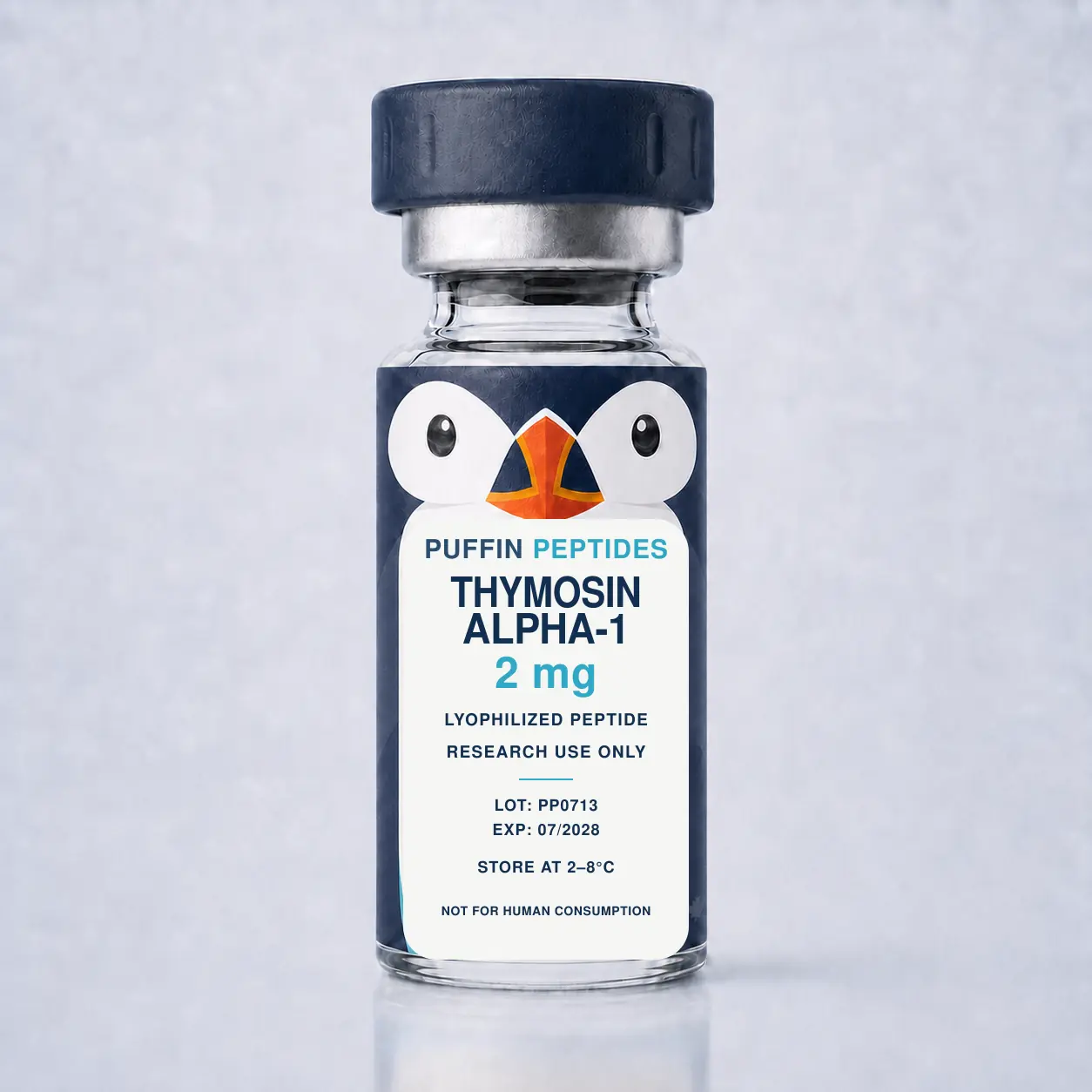
 Catalogue preview · final packaging and presentation may vary if stocked
Five choices across your ballotUse votes only for compounds you would consider ordering
One vote per compoundEach candidate can be selected once on this browser
Flexible interest signalRemove or reassign a vote whenever you like
THYMOSIN ALPHA-1
Thymosin alpha-1—also called thymalfasin—is a 28-amino-acid peptide derived from prothymosin alpha. It is studied in T-cell, dendritic-cell, innate-immune, and cytokine-response models.
Loading your saved choices…
THYMOSIN ALPHA-1 is currently being evaluated through customer voting and is not available to order. Final product specifications and batch documentation will be published only if it joins the catalogue.
This page records catalogue interest only. If THYMOSIN ALPHA-1 is selected for supply, Puffin will publish the confirmed format, batch documentation, and laboratory preparation information on the product listing.
Storage and handling requirements depend on the final supplied format. Confirmed instructions will be provided with the batch details if this candidate is added to the catalogue.
Understanding Thymosin Alpha-1
Explore the science, research focus, and key information behind this compound.
What is Thymosin Alpha-1?+
Thymosin alpha-1 is a focused research compound for connecting innate and adaptive immune signalling.
What Researchers Study+
Researchers examine T-cell response models, Innate-immune signalling, and Cytokine-pathway research.
How Thymosin Alpha-1 Works+
Rather than one exclusive receptor, thymosin alpha-1 appears to influence pattern-recognition, antigen-presentation, T-cell maturation, and cytokine networks depending on the model. In plain language, it is an immune-regulatory peptide, not a simple immune “booster.”
Research at a Glance+
Human studies exist, but conclusions vary by disease and regimen. Trials have explored hepatitis, infection, cancer-support, and immune settings. The heterogeneity makes a universal immune-benefit statement inaccurate. Immune regulation is more accurate than immune boosting. The peptide can alter several innate and adaptive signals. Direction and relevance depend on the starting immune state and the model being studied. Regional approval is not global approval. A regulator approves a defined product, manufacturer, indication, route, and label. The peptide name alone does not carry that status worldwide.
If this candidate is added to the catalogue, it would be offered for controlled laboratory research only. It is not for human consumption and is not represented as a medicine, treatment, supplement, or substitute for an approved product.