
At a glance
- AHK-Cu is the copper complex of the tripeptide alanine-histidine-lysine. It is studied mainly in dermal-papilla, hair-follicle, fibroblast, and extracellular-matrix models.
- AHK-Cu is not an approved injectable medicine or established hair-loss treatment. Ex-vivo follicle elongation and cell-proliferation findings do not establish safety, delivery, or effectiveness in people.
- Confirm whether the material is metal-loaded AHK-Cu or the uncomplexed AHK peptide.
- Use copper-only and peptide-only controls so an observed response is not assigned to the wrong part of the complex.
What AHK-Cu is—and what the name does not establish
AHK-Cu is the copper complex of the tripeptide alanine-histidine-lysine. It is studied mainly in dermal-papilla, hair-follicle, fibroblast, and extracellular-matrix models.
AHK can coordinate copper, creating a chemically distinct complex whose activity depends on metal loading, peptide identity, concentration, and the experimental system. The best-known work examines human hair follicles ex vivo and cultured dermal-papilla cells—not clinical hair-restoration outcomes.
Questions to settle before interpreting a result
A useful AHK-Cu study begins with material identity, a defined model, a relevant comparator, and an endpoint chosen before the result is known. Broad catalogue language cannot replace those controls.
- Confirm whether the material is metal-loaded AHK-Cu or the uncomplexed AHK peptide.
- Use copper-only and peptide-only controls so an observed response is not assigned to the wrong part of the complex.
- Keep ex-vivo follicle and cell-culture endpoints separate from clinical hair density or growth claims.
How to read the AHK-Cu evidence
These evidence snapshots summarize the most important distinctions in the published record. They do not combine unlike models or turn an experimental signal into a human-use claim.
Human tissue · ex vivo
- Design
- Follicle elongation and dermal-papilla cell responses were reported
- Finding
- A 2007 study used isolated human hair follicles and cultured cells. It did not administer AHK-Cu to people or establish a treatment effect.
- Read with care
- Keep the finding attached to the linked study’s exact material, design, population, exposure, and endpoint.
Identity control
- Design
- Copper loading is part of the test material
- Finding
- AHK, AHK-Cu, free copper, and another copper peptide should not be treated as interchangeable materials.
- Read with care
- This is an interpretation boundary, not a claim that a specific outcome has been established in people.
Translation boundary
- Design
- Cell response is not clinical regrowth
- Finding
- The available evidence does not establish injectable use, a safe exposure, or durable hair outcomes in people.
- Read with care
- This is an interpretation boundary, not a claim that a specific outcome has been established in people.
What the evidence does not establish
AHK-Cu is not an approved injectable medicine or established hair-loss treatment. Ex-vivo follicle elongation and cell-proliferation findings do not establish safety, delivery, or effectiveness in people.
Mechanism, cell, animal, observational, and controlled human evidence answer different questions. A positive result at one level cannot be silently promoted to another, and evidence for a sponsor’s defined product does not establish equivalence for an independently sourced research material.
Keep the publication and the vial separate
A published paper identifies its own sequence or chemical identity, formulation, manufacturing context, analytical controls, exposure, and test system. Matching a familiar name on a label is not enough to show that a catalogue vial is the same study material.
For practical research planning, verify the lot-specific identity and documentation, then write the model, comparator, endpoint, and stopping criteria before testing. This guide does not provide preparation, dosing, injection, or human-use instructions.
Sources
Links lead to the paper, official registry, regulator page, or product label used for this guide. Registry records describe protocols and status; they are not treated as positive results.
- The effect of tripeptide-copper complex on human hair growth in vitroPubMed-indexed publication · 2007
A 2007 study used isolated human hair follicles and cultured cells. It did not administer AHK-Cu to people or establish a treatment effect. The result remains tied to the exact study material, design, population, and endpoint.
- Think twice before injecting peptides bought online: unauthorized products can seriously harm youHealth Canada · 2026
Official Canadian advisory explaining that a research-use label does not establish authorization, safety, efficacy, or product quality for human use.
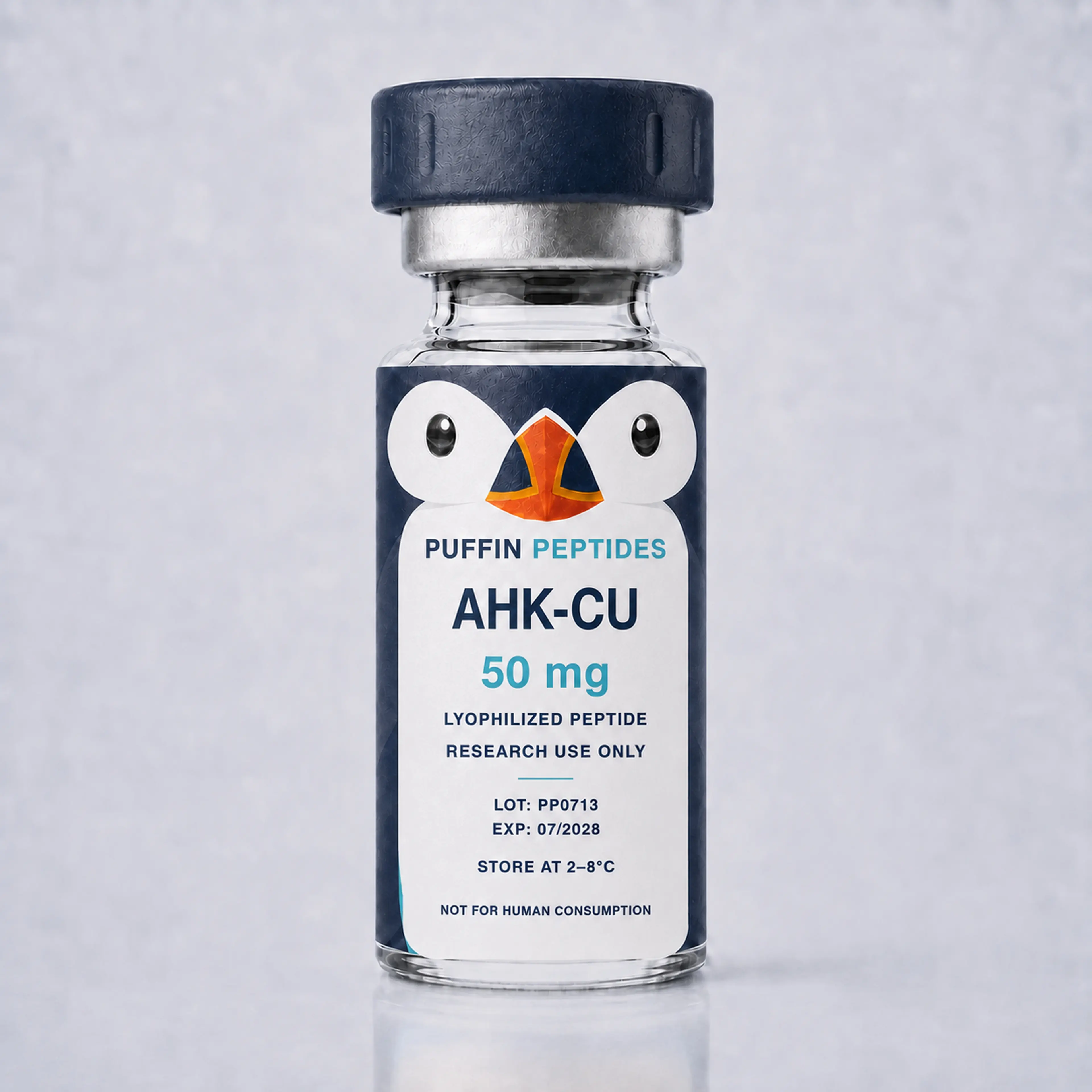
Explore AHK-CU
Review available strengths, pricing, stock status, and product documentation.