
At a glance
- DSIP, or delta sleep-inducing peptide, is a nine-amino-acid sequence first isolated in 1970s sleep research. Despite the memorable name, its endogenous source, receptor, and role remain uncertain, and sleep findings have been inconsistent.
- DSIP is not an approved sleep medicine. Human and animal studies are old, small, and contradictory, and the basic questions of endogenous identity and receptor mechanism remain unsettled.
- Use blinded EEG and sleep-stage scoring rather than relying on sedation or inactivity as a sleep measure.
- Confirm peptide identity and stability because DSIP is rapidly degraded in many experimental conditions.
What DSIP is—and what the name does not establish
DSIP, or delta sleep-inducing peptide, is a nine-amino-acid sequence first isolated in 1970s sleep research. Despite the memorable name, its endogenous source, receptor, and role remain uncertain, and sleep findings have been inconsistent.
There is no accepted DSIP receptor or clearly identified human precursor gene. Studies have proposed effects on sleep, stress, endocrine, and mitochondrial systems, but no single mechanism has been confirmed. In plain language, DSIP is an unresolved research signal—not a proven sleep switch.
Questions to settle before interpreting a result
A useful DSIP study begins with material identity, a defined model, a relevant comparator, and an endpoint chosen before the result is known. Broad catalogue language cannot replace those controls.
- Use blinded EEG and sleep-stage scoring rather than relying on sedation or inactivity as a sleep measure.
- Confirm peptide identity and stability because DSIP is rapidly degraded in many experimental conditions.
- Include circadian timing, species, route, stress state, and active sleep-control conditions in the study design.
How to read the DSIP evidence
These evidence snapshots summarize the most important distinctions in the published record. They do not combine unlike models or turn an experimental signal into a human-use claim.
Historical signal
- Design
- The peptide was named from rabbit EEG observations
- Finding
- Early experiments reported delta- and spindle-like EEG changes after material isolated from rabbits. Later work did not produce a consistent, universal sleep effect.
- Read with care
- This is an interpretation boundary, not a claim that a specific outcome has been established in people.
Mechanism gap
- Design
- No accepted receptor or precursor has been established
- Finding
- That uncertainty makes it difficult to place DSIP in a normal signalling pathway or know whether immunoreactive material in older studies was the same molecule.
- Read with care
- This is an interpretation boundary, not a claim that a specific outcome has been established in people.
Best framing
- Design
- A research puzzle—not a sleep aid
- Finding
- The honest value of DSIP is as an unresolved neuropeptide question. The name should not be turned into a guaranteed sleep outcome.
- Read with care
- This is an interpretation boundary, not a claim that a specific outcome has been established in people.
What the evidence does not establish
DSIP is not an approved sleep medicine. Human and animal studies are old, small, and contradictory, and the basic questions of endogenous identity and receptor mechanism remain unsettled.
Mechanism, cell, animal, observational, and controlled human evidence answer different questions. A positive result at one level cannot be silently promoted to another, and evidence for a sponsor’s defined product does not establish equivalence for an independently sourced research material.
Keep the publication and the vial separate
A published paper identifies its own sequence or chemical identity, formulation, manufacturing context, analytical controls, exposure, and test system. Matching a familiar name on a label is not enough to show that a catalogue vial is the same study material.
For practical research planning, verify the lot-specific identity and documentation, then write the model, comparator, endpoint, and stopping criteria before testing. This guide does not provide preparation, dosing, injection, or human-use instructions.
Sources
Links lead to the paper, official registry, regulator page, or product label used for this guide. Registry records describe protocols and status; they are not treated as positive results.
- Delta sleep-inducing peptide: EEG and motor activity in rabbits after intravenous administrationNeuroscience Letters · 1977
Original rabbit EEG study behind the name. Later mixed findings and the unresolved receptor and precursor questions prevent a general sleep-aid conclusion.
- Think twice before injecting peptides bought online: unauthorized products can seriously harm youHealth Canada · 2026
Official Canadian advisory explaining that a research-use label does not establish authorization, safety, efficacy, or product quality for human use.
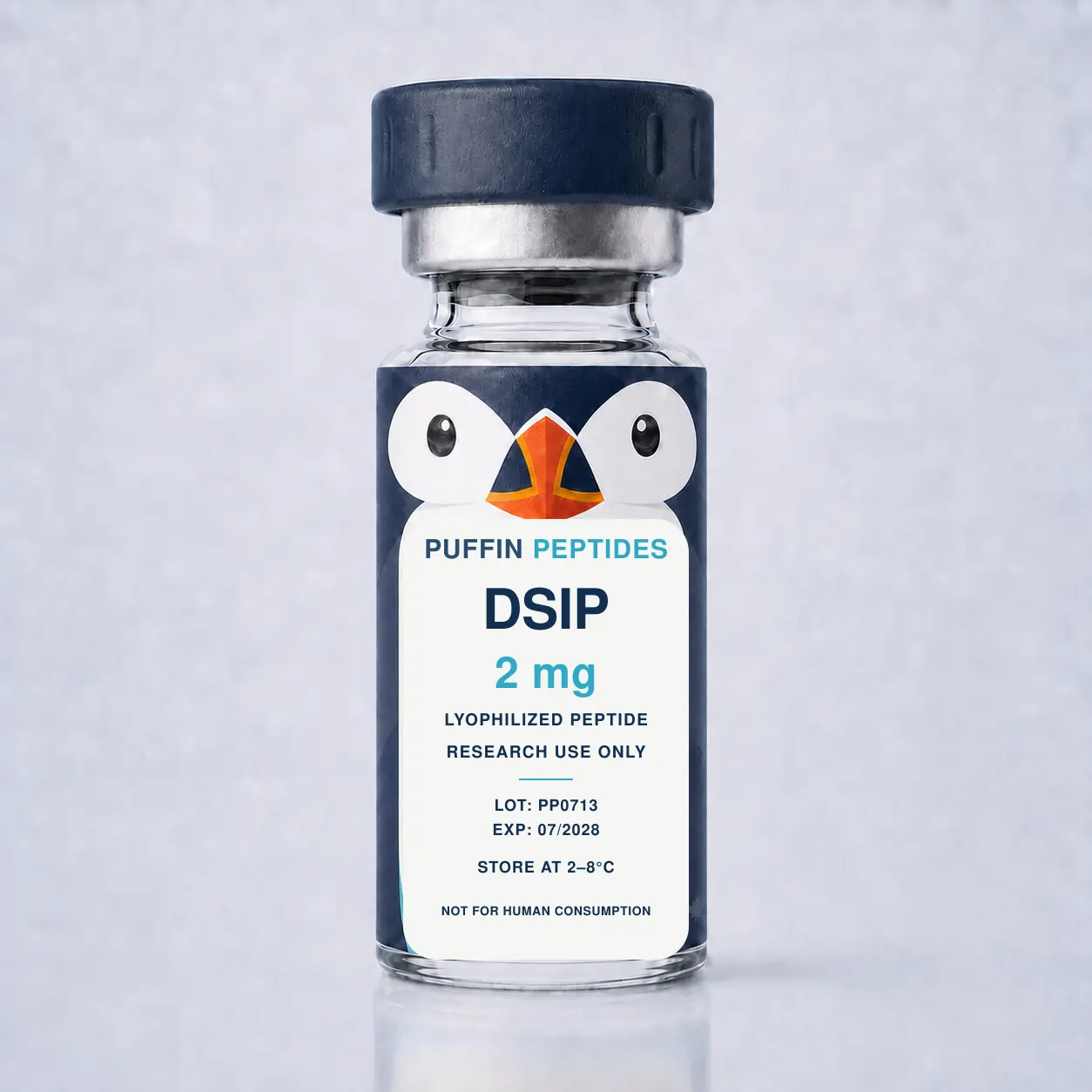
Vote for DSIP
This compound is not currently stocked. Add it to your five-choice catalogue ballot.