
At a glance
- Bacteriostatic Water is a preserved sterile diluent, not a peptide or active research compound. Its identity depends on the labelled formulation, container, preservative concentration, sterility, and lot documentation.
- This page provides identity and documentation context only. It does not give reconstitution, injection, dosing, or human-use instructions. The verified label and lot documentation take priority over generic descriptions.
- Verify the actual preservative, concentration, container, sterility statement, expiry, and lot documentation.
- Treat compatibility and stability as product-specific questions rather than assuming one diluent works with every material.
What Bacteriostatic Water is—and what the name does not establish
Bacteriostatic Water is a preserved sterile diluent, not a peptide or active research compound. Its identity depends on the labelled formulation, container, preservative concentration, sterility, and lot documentation.
A common labelled formulation is Water for Injection containing 0.9% benzyl alcohol as a bacteriostatic preservative. A diluent does not make another material sterile, compatible, isotonic, stable, or suitable for a particular use; those questions belong to the exact labelled products and protocol.
Questions to settle before interpreting a result
A useful Bacteriostatic Water study begins with material identity, a defined model, a relevant comparator, and an endpoint chosen before the result is known. Broad catalogue language cannot replace those controls.
- Verify the actual preservative, concentration, container, sterility statement, expiry, and lot documentation.
- Treat compatibility and stability as product-specific questions rather than assuming one diluent works with every material.
- Do not use this guide as preparation, dosing, injection, or clinical-use instruction.
How to read the Bacteriostatic Water evidence
These evidence snapshots summarize the most important distinctions in the published record. They do not combine unlike models or turn an experimental signal into a human-use claim.
Official label context
- Design
- Bacteriostatic and sterile water are not interchangeable labels
- Finding
- The DailyMed label describes a 0.9% benzyl-alcohol formulation and product-specific warnings. Puffin’s exact lot documents must still be checked.
- Read with care
- Keep the finding attached to the linked study’s exact material, design, population, exposure, and endpoint.
Compatibility boundary
- Design
- A diluent is part of the experimental system
- Finding
- Preservative, pH, tonicity, container, and the material being dissolved can all affect compatibility and stability.
- Read with care
- This is an interpretation boundary, not a claim that a specific outcome has been established in people.
Scope
- Design
- This is a supply guide—not a compound efficacy guide
- Finding
- No biological benefit is claimed, and no preparation or human-use procedure is provided.
- Read with care
- This is an interpretation boundary, not a claim that a specific outcome has been established in people.
What the evidence does not establish
This page provides identity and documentation context only. It does not give reconstitution, injection, dosing, or human-use instructions. The verified label and lot documentation take priority over generic descriptions.
Mechanism, cell, animal, observational, and controlled human evidence answer different questions. A positive result at one level cannot be silently promoted to another, and evidence for a sponsor’s defined product does not establish equivalence for an independently sourced research material.
Keep the publication and the vial separate
A published paper identifies its own sequence or chemical identity, formulation, manufacturing context, analytical controls, exposure, and test system. Matching a familiar name on a label is not enough to show that a catalogue vial is the same study material.
For practical research planning, verify the lot-specific identity and documentation, then write the model, comparator, endpoint, and stopping criteria before testing. This guide does not provide preparation, dosing, injection, or human-use instructions.
Sources
Links lead to the paper, official registry, regulator page, or product label used for this guide. Registry records describe protocols and status; they are not treated as positive results.
- Bacteriostatic Water for Injection, USP labelDailyMed · U.S. National Library of Medicine · Linked record
The DailyMed label describes a 0.9% benzyl-alcohol formulation and product-specific warnings. Puffin’s exact lot documents must still be checked. The result remains tied to the exact study material, design, population, and endpoint.
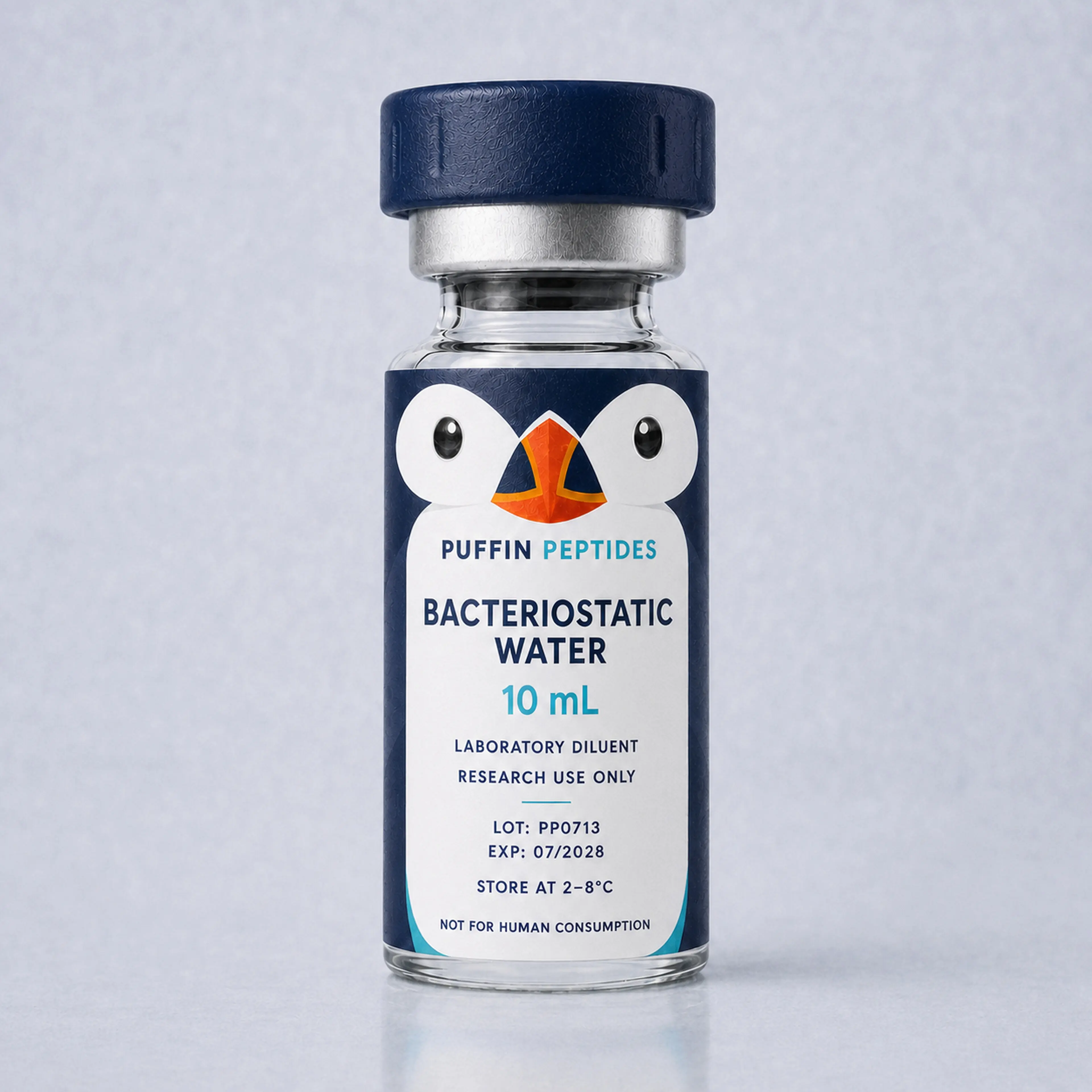
Explore BACTERIOSTATIC WATER
Review available strengths, pricing, stock status, and product documentation.