
At a glance
- BPC-157 is a synthetic 15-amino-acid research peptide described in a substantial preclinical literature.
- Published tendon, ligament, and cell-migration findings are mainly from rodents or in-vitro models.
- There is not yet a peer-reviewed, controlled human efficacy result that validates the broad claims commonly made online.
- Safety, pharmacokinetics, immunogenicity, impurities, route-specific risk, and long-term effects remain uncertain.
What BPC-157 is
BPC-157 is a synthetic pentadecapeptide—a chain of 15 amino acids—with the sequence GEPPPGKPADDAGLV. The research literature frequently calls it a “stable gastric pentadecapeptide” and investigates it in injury, gastrointestinal, vascular, and neurological models.
That description should not be mistaken for an approved therapeutic identity or a complete mechanism. A short peptide can interact with biological systems in ways that vary by concentration, route, model, formulation, and measurement method. The published literature proposes several pathways, but no single, fully validated human mechanism explains the wide range of claims attached to BPC-157.
The most responsible starting point is therefore evidence classification: cell work can establish a plausible mechanism; animal work can test that mechanism in a whole organism; controlled human trials are needed to evaluate efficacy and safety in people. Evidence does not automatically move upward from one level to the next.
Where the recovery claims come from
Several frequently cited studies used surgically injured rats. Researchers reported improved biomechanical or histological measures after Achilles-tendon transection, tendon-to-bone injury, or ligament injury. Other experiments used cultured rat tendon fibroblasts and reported changes in cell outgrowth, migration, survival under stress, and signalling involving focal adhesion kinase and paxillin.
These findings explain why BPC-157 attracts interest in tissue-repair research. They do not show that the same intervention improves a sports injury in a human. A rodent surgical model differs from a spontaneous human injury in scale, loading, rehabilitation, immune response, outcome definition, and exposure. Cell migration in a dish is even farther from a clinical endpoint.
What the evidence ladder contains
BPC-157 has multiple preclinical publications but very little public human evidence. Keeping each study at its correct evidence level prevents a plausible signal from becoming an unsupported health claim.
Rat Achilles-tendon transection
- Design
- A 2003 experiment evaluated functional, biomechanical, and microscopic outcomes after complete Achilles-tendon transection in rats.
- Finding
- The authors reported improved measures of tendon healing in treated animals compared with controls.
- Read with care
- This was a rodent surgical-injury model. It does not establish a safe or effective intervention for human tendon injury.
Rat tendon-to-bone and ligament models
- Design
- Separate experiments studied healing after tendon detachment from bone and after medial collateral ligament injury in rats.
- Finding
- The publications reported improvements in selected biomechanical and histological outcomes.
- Read with care
- Model-specific endpoints, small animal studies, and uncertain replication limit direct clinical inference.
Tendon fibroblast experiments
- Design
- Cultured rat tendon fibroblasts and tendon explants were used to examine outgrowth, migration, survival, and focal-adhesion signalling.
- Finding
- BPC-157 was associated with increased migration or outgrowth and changes involving FAK and paxillin signalling.
- Read with care
- An in-vitro concentration-response does not establish absorption, distribution, target exposure, safety, or functional healing in a living human.
Registered human studies
- Design
- A phase 1 safety and pharmacokinetic study was registered in 2015, and a randomized phase 2 hamstring-strain trial was registered in 2026.
- Finding
- The registries show that formal human questions have been proposed, including return-to-sport and MRI outcomes in the phase 2 protocol.
- Read with care
- A registry is a study record, not a positive result. No peer-reviewed controlled human efficacy result from these records is available to support broad therapeutic claims.
The human evidence gap
The central limitation is not that every preclinical result is necessarily wrong. It is that the decisive human questions remain unanswered. A useful trial must define the population, injury, comparator, route, formulation, rehabilitation protocol, timing, and clinically meaningful endpoint before seeing the data.
The registered 2026 hamstring-strain study is designed around a specific injury and standardized rehabilitation. If completed and reported, it could provide more relevant evidence than anecdotal recovery stories. Until results are available and critically reviewed, the registration itself should not be used as evidence of efficacy.
Claims based on testimonials are particularly weak because recovery is influenced by injury severity, concurrent treatment, rehabilitation, regression to the mean, and selective reporting. Without a control group and prespecified outcomes, improvement after exposure cannot be confidently attributed to the peptide.
Safety and regulatory cautions
Human safety is not well characterized. Uncertainties include pharmacokinetics, immunogenicity, dose-response, degradation products, impurities, route-specific complications, interactions, and long-term effects. A lack of reported harm in animal experiments or informal use is not evidence that a material is safe.
The U.S. Food and Drug Administration identifies BPC-157 among bulk substances that may present significant safety risks in compounding, citing possible immunogenicity, peptide-related impurities, difficulties characterizing the active ingredient, and limited safety information. Health Canada warns that unauthorized injectable peptide products sold online have not been assessed for safety, efficacy, quality, or appropriate labelling.
For sport researchers and tested athletes, another boundary is explicit: BPC-157 appears in section S0 of the World Anti-Doping Agency Prohibited List for non-approved substances. Anti-doping status is separate from efficacy, but it is a practical and ethical consideration.
What stronger research would look like
Before a biological experiment, the material itself needs characterization. Identity, purity, concentration, counterion, water content, aggregation, stability, endotoxin, and sterility are different attributes. A purity percentage alone does not answer all of them.
For translational research, the most useful next steps are independently replicated preclinical work, validated exposure measurements, transparent toxicology, and controlled human trials with registered protocols and complete reporting. Negative and null results matter because a literature built only from positive findings will exaggerate certainty.
- Use a model and endpoint that match the biological question.
- Include vehicle, positive, and mechanistic controls where appropriate.
- Measure exposure rather than assuming the nominal amount reaches the target tissue.
- Pre-register primary outcomes and report attrition, adverse events, and null findings.
- Do not extrapolate an animal amount or route into instructions for people.
Sources
Links lead to the paper, official registry, regulator page, or product label used for this guide. Registry records describe protocols and status; they are not treated as positive results.
- Gastric pentadecapeptide BPC 157 positively affects both non-union and function recovery in transected rat Achilles tendonJournal of Orthopaedic Research · 2003
Preclinical rat Achilles-tendon model.
- Pentadecapeptide BPC 157 and the healing of the transected tendon in the ratJournal of Orthopaedic Research · 2006
Preclinical tendon-to-bone healing study.
- Pentadecapeptide BPC 157 improves ligament healing in the ratJournal of Orthopaedic Research · 2010
Preclinical medial collateral ligament model.
- The promoting effect of pentadecapeptide BPC 157 on tendon healing involves tendon outgrowth, cell survival, and cell migrationJournal of Applied Physiology · 2011
Rat tendon explant and fibroblast research.
- Pentadecapeptide BPC 157 enhances the growth hormone receptor expression in tendon fibroblastsMolecules · 2014
Tendon-fibroblast study of growth-hormone receptor expression and downstream JAK2 signalling.
- A Study to Evaluate the Safety and Pharmacokinetics of BPC-157ClinicalTrials.gov · NCT02637284 · Current record
Registered phase 1 record; registry status is not a peer-reviewed result.
- BPC-157 for Acute Grade II Hamstring StrainClinicalTrials.gov · NCT07437547 · Current record
Registered randomized phase 2 protocol; no results are reported in this guide.
- Certain Bulk Drug Substances for Use in Compounding May Present Significant Safety RisksU.S. Food and Drug Administration · Current page
Official safety-risk statement that includes BPC-157.
- Think twice before injecting peptides bought onlineHealth Canada · 2026
Official Canadian warning about unauthorized injectable peptide products.
- 2026 Prohibited ListWorld Anti-Doping Agency · 2026
BPC-157 is listed under S0 non-approved substances.
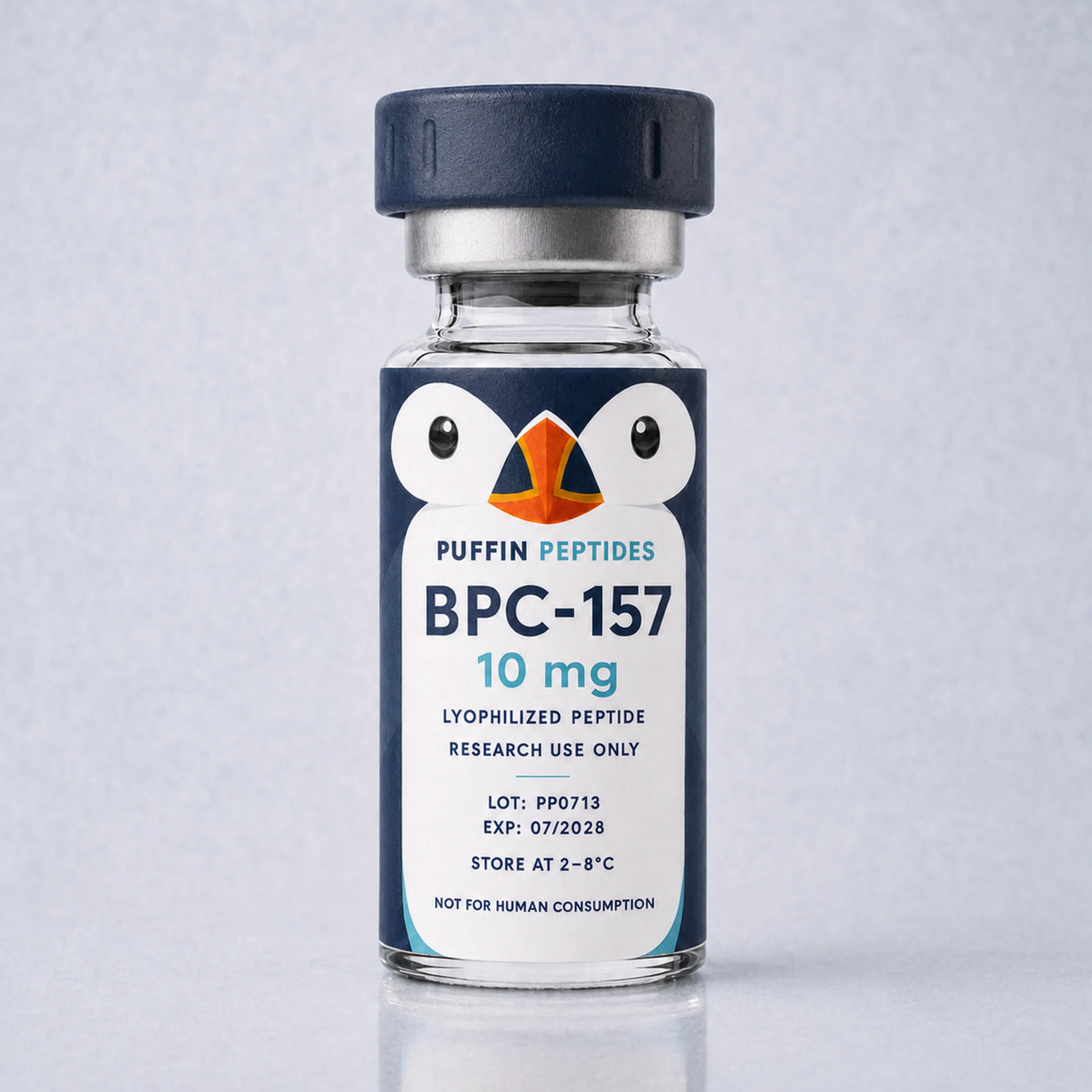
Explore BPC-157
Review available strengths, pricing, stock status, and product documentation.