
At a glance
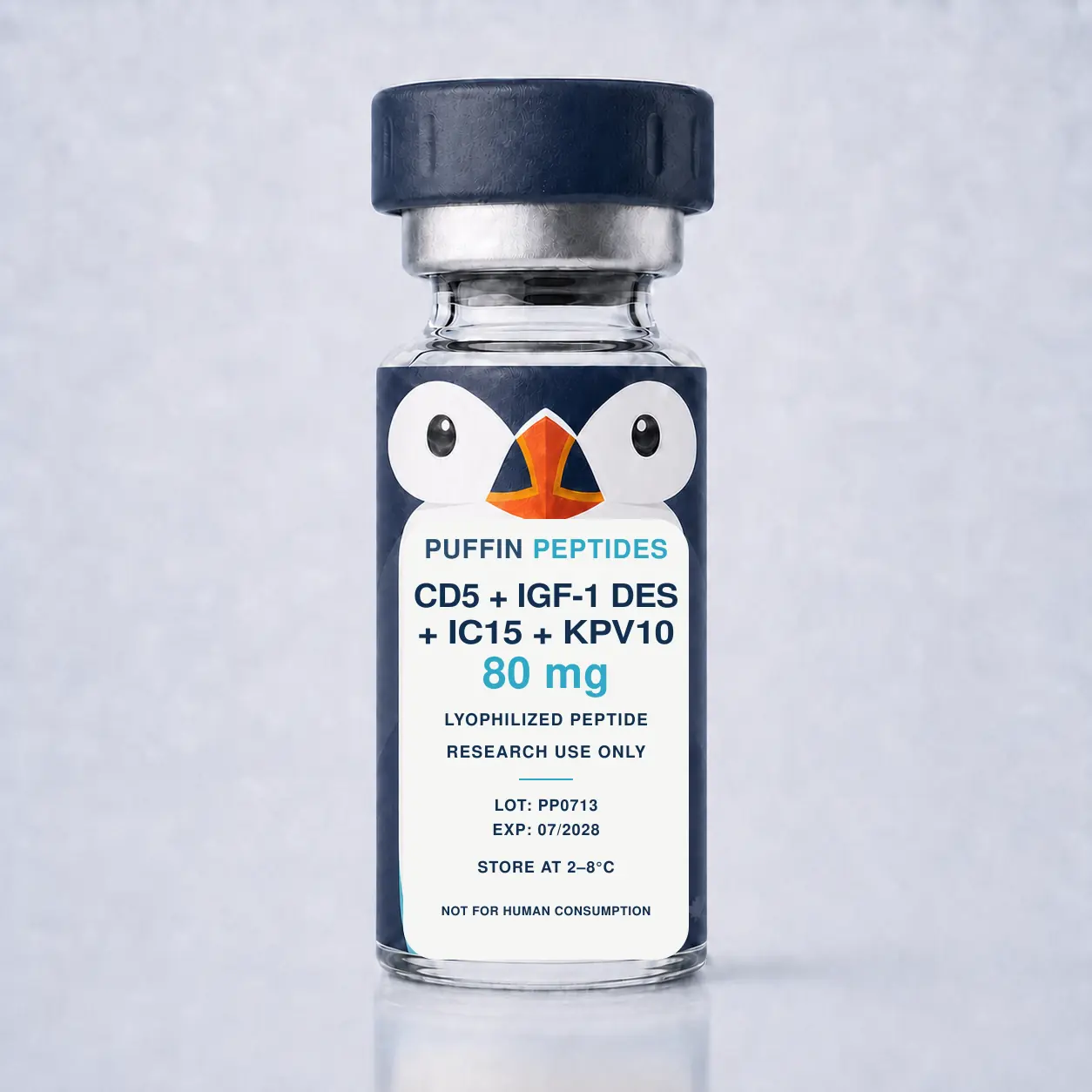
- This is a proprietary multi-component label, but two component names—CD5 and IC15—are not defined well enough to support a reliable scientific description. IGF-1 DES and KPV are recognizable research names; the complete blend is not interpretable until every sequence and ratio is disclosed.
- The complete blend has no established approval or clinical evidence. Before research use or product-page claims, the supplier should define CD5, IC15, what “KPV10” means, each amino-acid sequence, salt form, component amount, and blend ratio.
- Obtain full sequences, molecular identities, component amounts, and the intended meaning of CD5, IC15, and KPV10.
- Verify each component analytically before testing the mixture; one total-mass result cannot confirm a four-component formulation.
What CD5 + IGF-1 DES + IC15 + KPV10 is—and what the name does not establish
This is a proprietary multi-component label, but two component names—CD5 and IC15—are not defined well enough to support a reliable scientific description. IGF-1 DES and KPV are recognizable research names; the complete blend is not interpretable until every sequence and ratio is disclosed.
A mixture can only be mapped when each component’s chemical identity, amount, and role are known. In plain language, abbreviations are not mechanisms. Assigning immune, growth, recovery, or anti-inflammatory effects to this blend without the missing definitions would invent evidence.
Questions to settle before interpreting a result
A useful CD5 + IGF-1 DES + IC15 + KPV10 study begins with material identity, a defined model, a relevant comparator, and an endpoint chosen before the result is known. Broad catalogue language cannot replace those controls.
- Obtain full sequences, molecular identities, component amounts, and the intended meaning of CD5, IC15, and KPV10.
- Verify each component analytically before testing the mixture; one total-mass result cannot confirm a four-component formulation.
- After identity is established, design single-component and combination controls so any response can be assigned.
How to read the CD5 + IGF-1 DES + IC15 + KPV10 evidence
These evidence snapshots summarize the most important distinctions in the published record. They do not combine unlike models or turn an experimental signal into a human-use claim.
First requirement
- Design
- Define the product before describing it
- Finding
- CD5 can refer to a cell-surface protein, an antibody target, a peptide shorthand, or something proprietary. IC15 and KPV10 are similarly ambiguous without a specification.
- Read with care
- This is an interpretation boundary, not a claim that a specific outcome has been established in people.
What is known
- Design
- IGF-1 DES and KPV have separate preclinical literatures
- Finding
- Those individual literatures do not establish a mechanism, safety, or result for a four-component mixture—especially when half of the formulation is undefined.
- Read with care
- This is an interpretation boundary, not a claim that a specific outcome has been established in people.
Evidence policy
- Design
- No identity, no benefit claim
- Finding
- The strongest and most credible product page is transparent about missing information. It should not fill the gap with generic recovery or immune language.
- Read with care
- This is an interpretation boundary, not a claim that a specific outcome has been established in people.
What the evidence does not establish
The complete blend has no established approval or clinical evidence. Before research use or product-page claims, the supplier should define CD5, IC15, what “KPV10” means, each amino-acid sequence, salt form, component amount, and blend ratio.
Mechanism, cell, animal, observational, and controlled human evidence answer different questions. A positive result at one level cannot be silently promoted to another, and evidence for a sponsor’s defined product does not establish equivalence for an independently sourced research material.
Keep the publication and the vial separate
A published paper identifies its own sequence or chemical identity, formulation, manufacturing context, analytical controls, exposure, and test system. Matching a familiar name on a label is not enough to show that a catalogue vial is the same study material.
For practical research planning, verify the lot-specific identity and documentation, then write the model, comparator, endpoint, and stopping criteria before testing. This guide does not provide preparation, dosing, injection, or human-use instructions.
Sources
Links lead to the paper, official registry, regulator page, or product label used for this guide. Registry records describe protocols and status; they are not treated as positive results.
- Effects of IGF-I, IGF-II, and des(1-3)IGF-I on growth-hormone secretionPubMed-indexed primary study · 1991
Component-level IGF-1 DES research only. It does not test this blend or resolve the identities of CD5, IC15, or KPV10.
- PepT1-mediated tripeptide KPV uptake reduces intestinal inflammationGastroenterology · 2008
Component-level KPV cell and animal research. It cannot establish a mechanism or outcome for a four-component mixture whose specification remains incomplete.
- Think twice before injecting peptides bought online: unauthorized products can seriously harm youHealth Canada · 2026
Official Canadian advisory explaining that a research-use label does not establish authorization, safety, efficacy, or product quality for human use.
Vote for CD5 + IGF-1 DES + IC15 + KPV10
This compound is not currently stocked. Add it to your five-choice catalogue ballot.