
At a glance
- CJC-1295 without DAC is commonly used to mean modified GRF(1–29), a short-acting GHRH analogue. It keeps the active 29-amino-acid GHRH region while adding substitutions intended to resist rapid enzymatic breakdown.
- Modified GRF(1–29) is not an approved medicine. Direct human evidence is limited, and it should not inherit the prolonged pharmacokinetic claims or clinical data reported for CJC-1295 with DAC.
- Use time-course sampling to characterize short-acting GHRH-receptor signalling and pituitary GH release.
- Compare directly with sermorelin when the question is how sequence substitutions change stability or response.
What CJC-1295 (NO DAC) is—and what the name does not establish
CJC-1295 without DAC is commonly used to mean modified GRF(1–29), a short-acting GHRH analogue. It keeps the active 29-amino-acid GHRH region while adding substitutions intended to resist rapid enzymatic breakdown.
It activates GHRH receptors on pituitary cells and can prompt growth-hormone release. Because it lacks the drug-affinity-complex extension, it does not use albumin binding to create the prolonged exposure associated with true CJC-1295 with DAC.
Questions to settle before interpreting a result
A useful CJC-1295 (NO DAC) study begins with material identity, a defined model, a relevant comparator, and an endpoint chosen before the result is known. Broad catalogue language cannot replace those controls.
- Use time-course sampling to characterize short-acting GHRH-receptor signalling and pituitary GH release.
- Compare directly with sermorelin when the question is how sequence substitutions change stability or response.
- Keep the no-DAC material separate from CJC-1295 with DAC in labels, protocols, and evidence summaries.
How to read the CJC-1295 (NO DAC) evidence
These evidence snapshots summarize the most important distinctions in the published record. They do not combine unlike models or turn an experimental signal into a human-use claim.
Identity first
- Design
- “No DAC” usually means modified GRF—not CJC-1295 minus one accessory
- Finding
- The shorthand is common in research catalogues but chemically imprecise. Sequence confirmation is the cleanest way to know which 29-amino-acid GHRH analogue is actually being studied.
- Read with care
- This is an interpretation boundary, not a claim that a specific outcome has been established in people.
Best comparison
- Design
- Sermorelin, modified GRF, and CJC-1295 DAC differ
- Finding
- All target the GHRH receptor, but they use different sequence modifications and exposure strategies. Evidence and time-course expectations should stay attached to the exact construct.
- Read with care
- This is an interpretation boundary, not a claim that a specific outcome has been established in people.
Evidence gap
- Design
- Direct no-DAC human data are limited
- Finding
- Human pharmacokinetic findings for albumin-binding CJC-1295 should not be used to fill the evidence gap for a short modified-GRF preparation.
- Read with care
- This is an interpretation boundary, not a claim that a specific outcome has been established in people.
What the evidence does not establish
Modified GRF(1–29) is not an approved medicine. Direct human evidence is limited, and it should not inherit the prolonged pharmacokinetic claims or clinical data reported for CJC-1295 with DAC.
Mechanism, cell, animal, observational, and controlled human evidence answer different questions. A positive result at one level cannot be silently promoted to another, and evidence for a sponsor’s defined product does not establish equivalence for an independently sourced research material.
Keep the publication and the vial separate
A published paper identifies its own sequence or chemical identity, formulation, manufacturing context, analytical controls, exposure, and test system. Matching a familiar name on a label is not enough to show that a catalogue vial is the same study material.
For practical research planning, verify the lot-specific identity and documentation, then write the model, comparator, endpoint, and stopping criteria before testing. This guide does not provide preparation, dosing, injection, or human-use instructions.
Sources
Links lead to the paper, official registry, regulator page, or product label used for this guide. Registry records describe protocols and status; they are not treated as positive results.
- Human growth hormone-releasing factor (hGRF)1-29-albumin bioconjugates activate the GRF receptorJournal of Controlled Release · 2005
Primary analogue-development paper. It helps distinguish modified GHRH constructs, but it is not evidence that every product called “no DAC” has the same identity or exposure profile.
- Think twice before injecting peptides bought online: unauthorized products can seriously harm youHealth Canada · 2026
Official Canadian advisory explaining that a research-use label does not establish authorization, safety, efficacy, or product quality for human use.
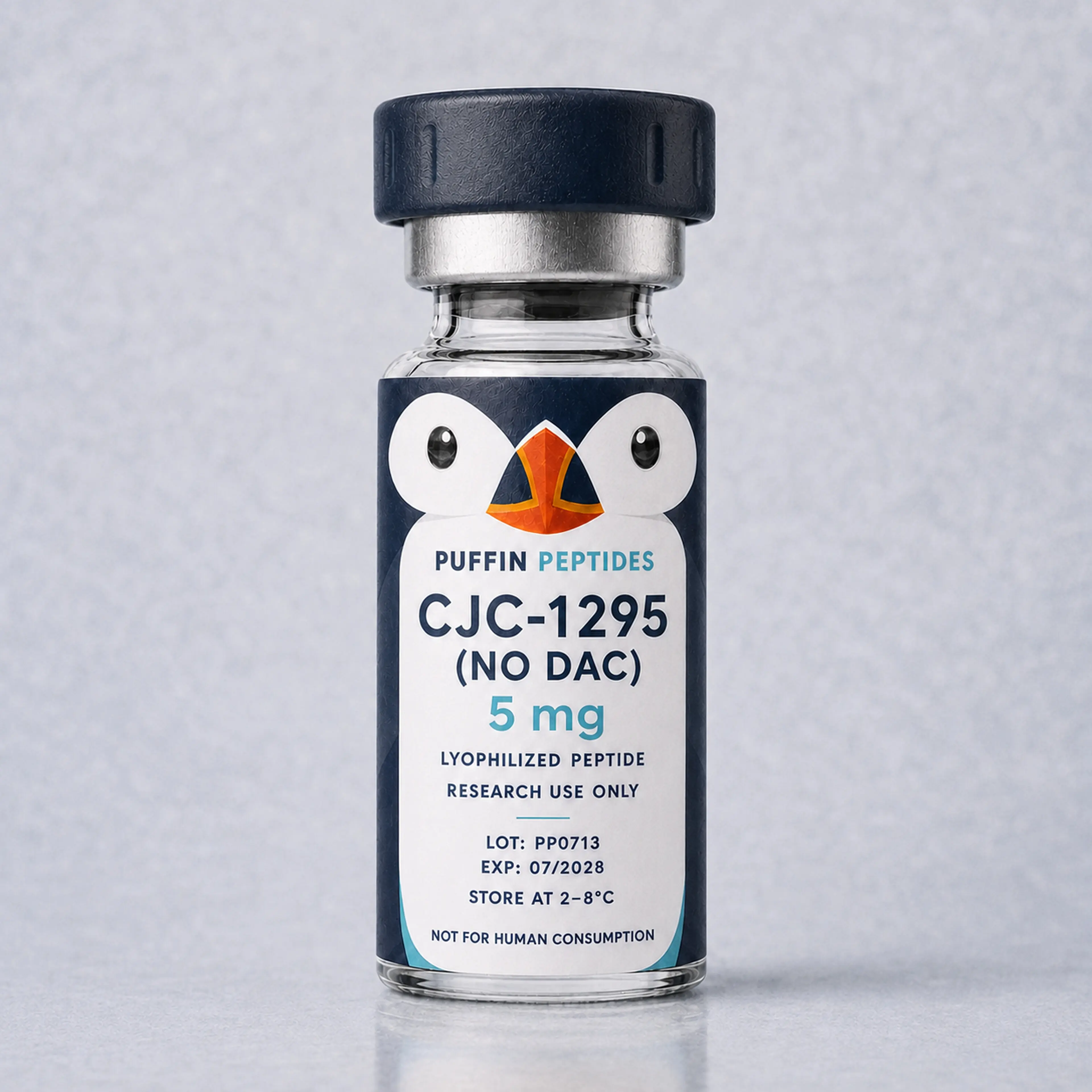
Explore CJC-1295 (NO DAC)
Review available strengths, pricing, stock status, and product documentation.