
At a glance
- CJC-1295 with DAC is a long-acting GHRH analogue engineered with a reactive group that binds circulating albumin. That albumin-binding design—not just the GHRH sequence—is what separates it from the shorter no-DAC material.
- CJC-1295 with DAC reached early human studies but is not an approved medicine. Published results relate to a defined investigational compound and cannot be transferred to no-DAC material or an independently sourced vial.
- Measure both immediate GH response and longer IGF-1 changes when studying the consequences of albumin-linked exposure.
- Use a short-acting GHRH analogue as the comparator when the question is duration rather than receptor identity.
What CJC-1295 (WITH DAC) is—and what the name does not establish
CJC-1295 with DAC is a long-acting GHRH analogue engineered with a reactive group that binds circulating albumin. That albumin-binding design—not just the GHRH sequence—is what separates it from the shorter no-DAC material.
After the DAC group forms a stable bond with albumin, the peptide remains available far longer than short GHRH fragments. It still signals through the GHRH receptor, but the extended exposure can sustain changes in GH and IGF-1 rather than producing only a brief pulse.
Questions to settle before interpreting a result
A useful CJC-1295 (WITH DAC) study begins with material identity, a defined model, a relevant comparator, and an endpoint chosen before the result is known. Broad catalogue language cannot replace those controls.
- Measure both immediate GH response and longer IGF-1 changes when studying the consequences of albumin-linked exposure.
- Use a short-acting GHRH analogue as the comparator when the question is duration rather than receptor identity.
- Verify the DAC-containing sequence and reactive chemistry before assigning published CJC-1295 pharmacokinetics to a sample.
How to read the CJC-1295 (WITH DAC) evidence
These evidence snapshots summarize the most important distinctions in the published record. They do not combine unlike models or turn an experimental signal into a human-use claim.
Early human study
- Design
- GH and IGF-1 increases persisted after a single dose
- Finding
- A placebo-controlled early study reported prolonged GH and IGF-1 changes in healthy adults after CJC-1295. It supports the albumin-binding design, but it is not evidence for routine anti-aging or performance use.
- Read with care
- Keep the finding attached to the linked study’s exact material, design, population, exposure, and endpoint.
Critical distinction
- Design
- DAC changes the exposure profile
- Finding
- With-DAC and no-DAC materials share a pathway but not the same molecular design or duration. Treating their names as interchangeable makes both the mechanism and the evidence misleading.
- Read with care
- This is an interpretation boundary, not a claim that a specific outcome has been established in people.
Design mechanism
- Design
- Albumin binding is the duration strategy
- Finding
- The reactive DAC group and albumin conjugation are central to the published persistence. A sample that lacks that chemistry cannot be expected to reproduce the same time course.
- Read with care
- This is an interpretation boundary, not a claim that a specific outcome has been established in people.
What the evidence does not establish
CJC-1295 with DAC reached early human studies but is not an approved medicine. Published results relate to a defined investigational compound and cannot be transferred to no-DAC material or an independently sourced vial.
Mechanism, cell, animal, observational, and controlled human evidence answer different questions. A positive result at one level cannot be silently promoted to another, and evidence for a sponsor’s defined product does not establish equivalence for an independently sourced research material.
Keep the publication and the vial separate
A published paper identifies its own sequence or chemical identity, formulation, manufacturing context, analytical controls, exposure, and test system. Matching a familiar name on a label is not enough to show that a catalogue vial is the same study material.
For practical research planning, verify the lot-specific identity and documentation, then write the model, comparator, endpoint, and stopping criteria before testing. This guide does not provide preparation, dosing, injection, or human-use instructions.
Sources
Links lead to the paper, official registry, regulator page, or product label used for this guide. Registry records describe protocols and status; they are not treated as positive results.
- Prolonged stimulation of GH and IGF-I secretion by CJC-1295 in healthy adultsPeer-reviewed publication · 2006
A placebo-controlled early study reported prolonged GH and IGF-1 changes in healthy adults after CJC-1295. It supports the albumin-binding design, but it is not evidence for routine anti-aging or performance use. The result remains tied to the exact study material, design, population, and endpoint.
- Think twice before injecting peptides bought online: unauthorized products can seriously harm youHealth Canada · 2026
Official Canadian advisory explaining that a research-use label does not establish authorization, safety, efficacy, or product quality for human use.
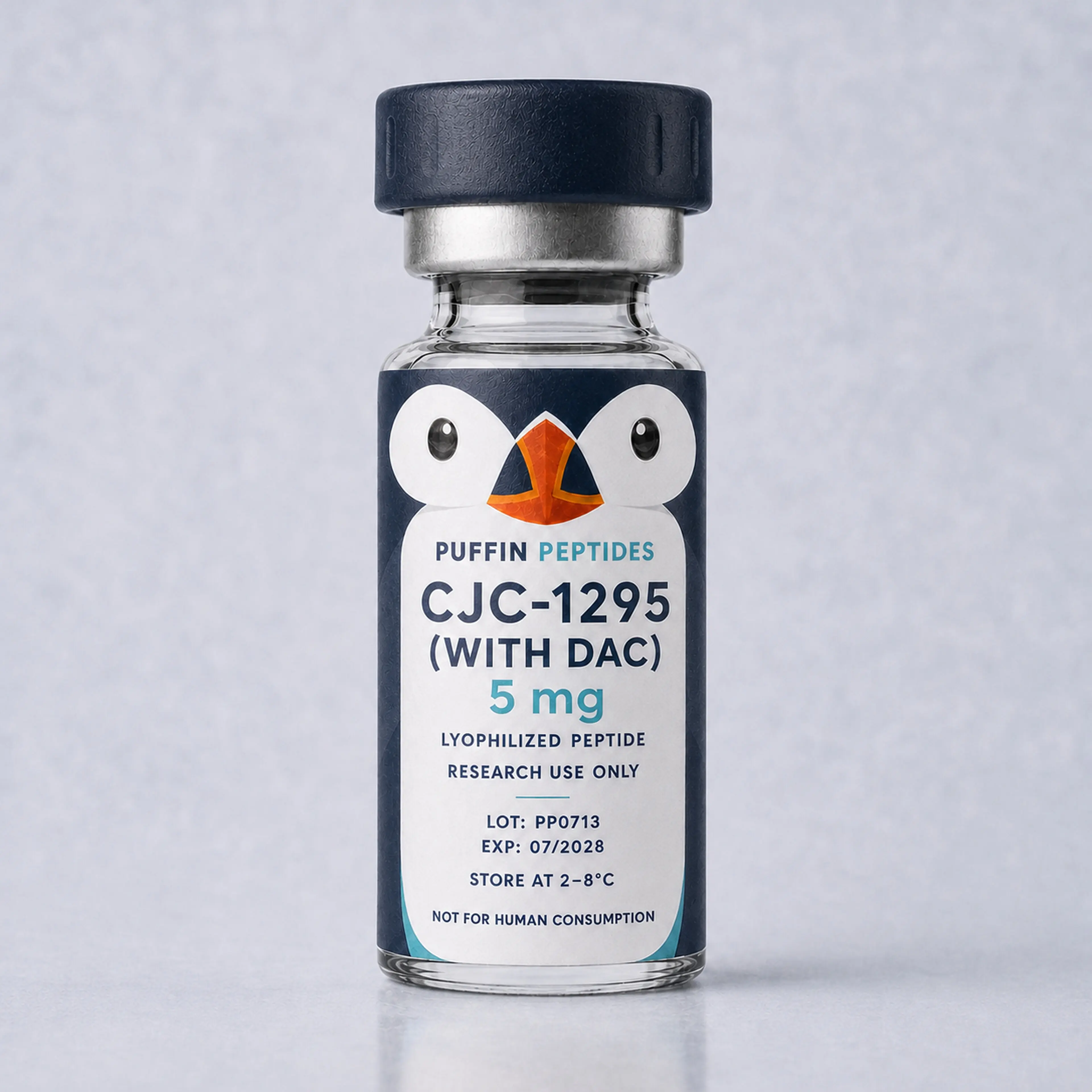
Explore CJC-1295 (WITH DAC)
Review available strengths, pricing, stock status, and product documentation.