
At a glance
- FOXO4 in peptide catalogues usually means FOXO4-DRI, a D-retro-inverso peptide designed to disrupt the FOXO4–p53 interaction in senescent cells. The shorthand is incomplete, so the exact sequence and stereochemistry must be verified.
- FOXO4-DRI is not an approved medicine and has no established human clinical benefit. Published evidence is preclinical, and a vial labelled only “FOXO4” is scientifically incomplete without sequence and chirality confirmation.
- Confirm a D-retro-inverso FOXO4-derived sequence; native FOXO4 protein and FOXO4-DRI are not the same material.
- Measure senescence markers, p53 localization, apoptosis, and non-senescent-cell effects separately.
What FOXO4 is—and what the name does not establish
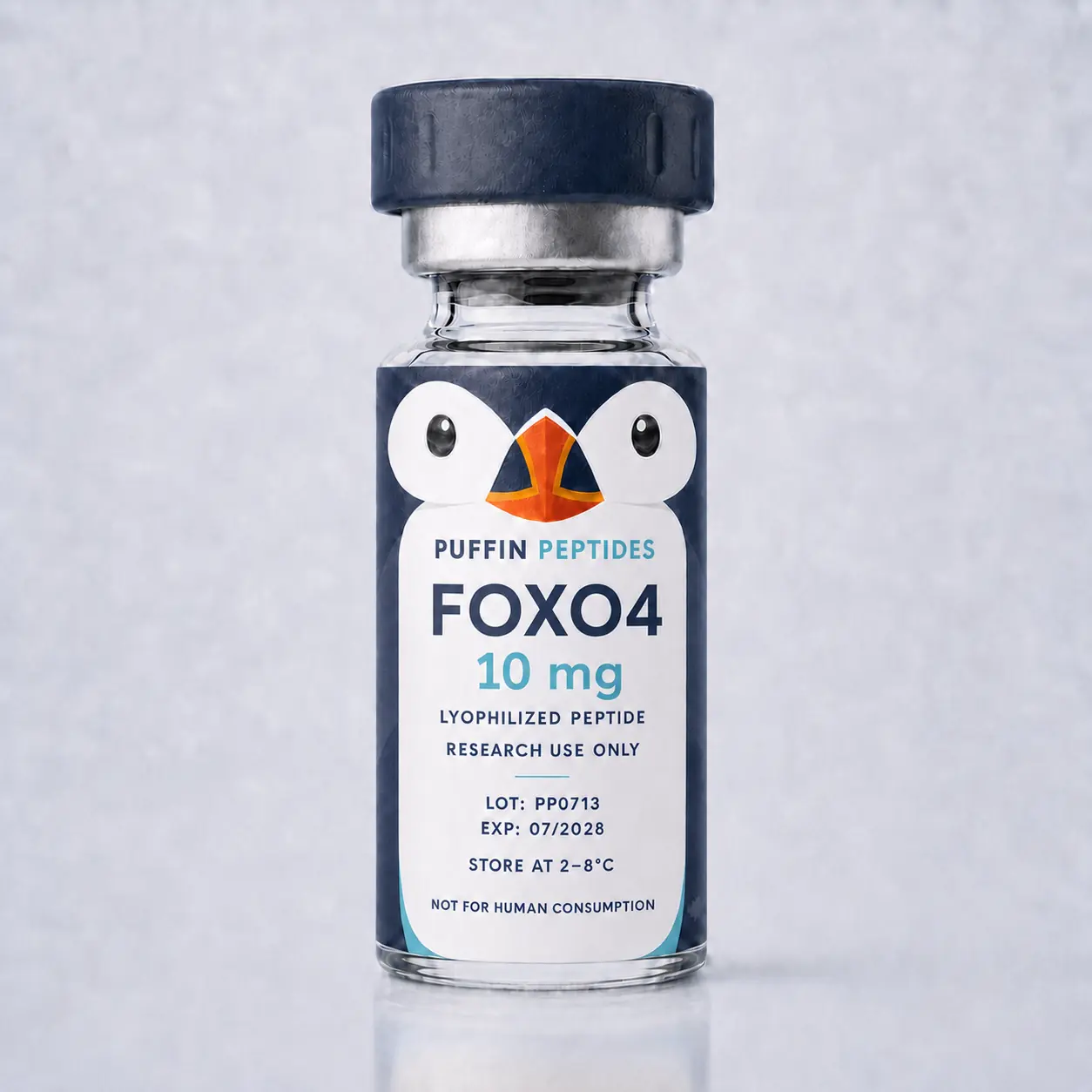
FOXO4 in peptide catalogues usually means FOXO4-DRI, a D-retro-inverso peptide designed to disrupt the FOXO4–p53 interaction in senescent cells. The shorthand is incomplete, so the exact sequence and stereochemistry must be verified.
Senescent cells can use FOXO4 to retain p53 in the nucleus and resist apoptosis. FOXO4-DRI was designed to disturb that interaction, allowing p53 relocation and selective death in some senescent-cell models. In plain language, the peptide tries to remove a survival signal from selected aged cells.
Questions to settle before interpreting a result
A useful FOXO4 study begins with material identity, a defined model, a relevant comparator, and an endpoint chosen before the result is known. Broad catalogue language cannot replace those controls.
- Confirm a D-retro-inverso FOXO4-derived sequence; native FOXO4 protein and FOXO4-DRI are not the same material.
- Measure senescence markers, p53 localization, apoptosis, and non-senescent-cell effects separately.
- Use more than one senescence model because cell type and induction method can change sensitivity and selectivity.
How to read the FOXO4 evidence
These evidence snapshots summarize the most important distinctions in the published record. They do not combine unlike models or turn an experimental signal into a human-use claim.
Foundational preclinical study
- Design
- Senescent-cell targeting improved selected mouse outcomes
- Finding
- A 2017 study reported that FOXO4-DRI promoted apoptosis in senescent cells and improved several measures in aged and chemotherapy-exposed mice. It was not a human longevity trial.
- Read with care
- Keep the finding attached to the linked study’s exact material, design, population, exposure, and endpoint.
Identity warning
- Design
- “FOXO4” is a protein name, not a complete product description
- Finding
- The research peptide’s retro-inverso design and D-amino-acid stereochemistry are central to stability and function. An unspecified FOXO4 label cannot support the same evidence claim.
- Read with care
- This is an interpretation boundary, not a claim that a specific outcome has been established in people.
Evidence boundary
- Design
- Senolytic activity is not proven human rejuvenation
- Finding
- Clearing cells in selected laboratory models can reveal biology while leaving delivery, tissue effects, immune consequences, dosing, and long-term safety unanswered.
- Read with care
- This is an interpretation boundary, not a claim that a specific outcome has been established in people.
What the evidence does not establish
FOXO4-DRI is not an approved medicine and has no established human clinical benefit. Published evidence is preclinical, and a vial labelled only “FOXO4” is scientifically incomplete without sequence and chirality confirmation.
Mechanism, cell, animal, observational, and controlled human evidence answer different questions. A positive result at one level cannot be silently promoted to another, and evidence for a sponsor’s defined product does not establish equivalence for an independently sourced research material.
Keep the publication and the vial separate
A published paper identifies its own sequence or chemical identity, formulation, manufacturing context, analytical controls, exposure, and test system. Matching a familiar name on a label is not enough to show that a catalogue vial is the same study material.
For practical research planning, verify the lot-specific identity and documentation, then write the model, comparator, endpoint, and stopping criteria before testing. This guide does not provide preparation, dosing, injection, or human-use instructions.
Sources
Links lead to the paper, official registry, regulator page, or product label used for this guide. Registry records describe protocols and status; they are not treated as positive results.
- the primary Cell paperPeer-reviewed publication · Linked record
A 2017 study reported that FOXO4-DRI promoted apoptosis in senescent cells and improved several measures in aged and chemotherapy-exposed mice. It was not a human longevity trial. The result remains tied to the exact study material, design, population, and endpoint.
- Think twice before injecting peptides bought online: unauthorized products can seriously harm youHealth Canada · 2026
Official Canadian advisory explaining that a research-use label does not establish authorization, safety, efficacy, or product quality for human use.
Vote for FOXO4
This compound is not currently stocked. Add it to your five-choice catalogue ballot.