
At a glance
- GLOW is a three-component research blend containing BPC-157, the copper-binding tripeptide GHK-Cu, and TB-500. The convenient name groups several tissue-response pathways; it is not evidence of a cosmetic, skin, or recovery outcome.
- GLOW is not an approved medicine or cosmetic product. The components have different evidence levels, and results for one ingredient—or for full-length thymosin beta-4—do not establish the safety or effectiveness of this three-component blend.
- Test the full blend beside each single component and vehicle so a response can be assigned rather than guessed.
- Choose a specific matrix, migration, collagen, or cell-response endpoint instead of using “glow” as the measured outcome.
What GLOW (BPC-157 + GHK-Cu + TB-500) is—and what the name does not establish
GLOW is a three-component research blend containing BPC-157, the copper-binding tripeptide GHK-Cu, and TB-500. The convenient name groups several tissue-response pathways; it is not evidence of a cosmetic, skin, or recovery outcome.
The components point to different research questions: BPC-157 is discussed in preclinical tissue-response models, GHK-Cu in copper-dependent matrix and cell signalling, and TB-500 in thymosin-related actin and migration biology. A combined result cannot reveal which component caused it without single-component controls.
Questions to settle before interpreting a result
A useful GLOW (BPC-157 + GHK-Cu + TB-500) study begins with material identity, a defined model, a relevant comparator, and an endpoint chosen before the result is known. Broad catalogue language cannot replace those controls.
- Test the full blend beside each single component and vehicle so a response can be assigned rather than guessed.
- Choose a specific matrix, migration, collagen, or cell-response endpoint instead of using “glow” as the measured outcome.
- Control copper availability and verify the GHK-Cu complex because free copper, GHK, and GHK-Cu are not equivalent materials.
How to read the GLOW (BPC-157 + GHK-Cu + TB-500) evidence
These evidence snapshots summarize the most important distinctions in the published record. They do not combine unlike models or turn an experimental signal into a human-use claim.
Combination logic
- Design
- Three ingredients create more possible explanations
- Finding
- A larger response from the blend could be additive, interactive, or driven by one component. A factorial design is much more informative than comparing the blend only with vehicle.
- Read with care
- This is an interpretation boundary, not a claim that a specific outcome has been established in people.
Evidence levels
- Design
- The components do not share one evidence base
- Finding
- BPC-157 and TB-500 are dominated by preclinical work. GHK-Cu has cellular, animal, and limited topical/cosmetic research. Combining them does not raise the blend to the strongest evidence level among the three.
- Read with care
- This is an interpretation boundary, not a claim that a specific outcome has been established in people.
What not to assume
- Design
- The product name is not a clinical claim
- Finding
- “GLOW” is merchandising shorthand. It should never replace a named endpoint or imply established skin, hair, injury, or anti-aging benefits in people.
- Read with care
- This is an interpretation boundary, not a claim that a specific outcome has been established in people.
What the evidence does not establish
GLOW is not an approved medicine or cosmetic product. The components have different evidence levels, and results for one ingredient—or for full-length thymosin beta-4—do not establish the safety or effectiveness of this three-component blend.
Mechanism, cell, animal, observational, and controlled human evidence answer different questions. A positive result at one level cannot be silently promoted to another, and evidence for a sponsor’s defined product does not establish equivalence for an independently sourced research material.
Keep the publication and the vial separate
A published paper identifies its own sequence or chemical identity, formulation, manufacturing context, analytical controls, exposure, and test system. Matching a familiar name on a label is not enough to show that a catalogue vial is the same study material.
For practical research planning, verify the lot-specific identity and documentation, then write the model, comparator, endpoint, and stopping criteria before testing. This guide does not provide preparation, dosing, injection, or human-use instructions.
Sources
Links lead to the paper, official registry, regulator page, or product label used for this guide. Registry records describe protocols and status; they are not treated as positive results.
- The promoting effect of pentadecapeptide BPC 157 on tendon healing involves tendon outgrowth, cell survival, and cell migrationJournal of Applied Physiology · 2011
Preclinical BPC-157 work; it does not test the GLOW combination.
- Stimulation of collagen synthesis in fibroblast cultures by the tripeptide-copper complex glycyl-L-histidyl-L-lysine-Cu2+FEBS Letters · 1988
Cell-culture GHK-Cu study; it does not establish a blend outcome.
- The actin binding site on thymosin beta4 promotes angiogenesisFASEB Journal · 2003
Primary full-length thymosin beta-4 research. TB-500 is a related fragment and should not inherit the parent peptide’s evidence automatically.
- Think twice before injecting peptides bought online: unauthorized products can seriously harm youHealth Canada · 2026
Official Canadian advisory explaining that a research-use label does not establish authorization, safety, efficacy, or product quality for human use.
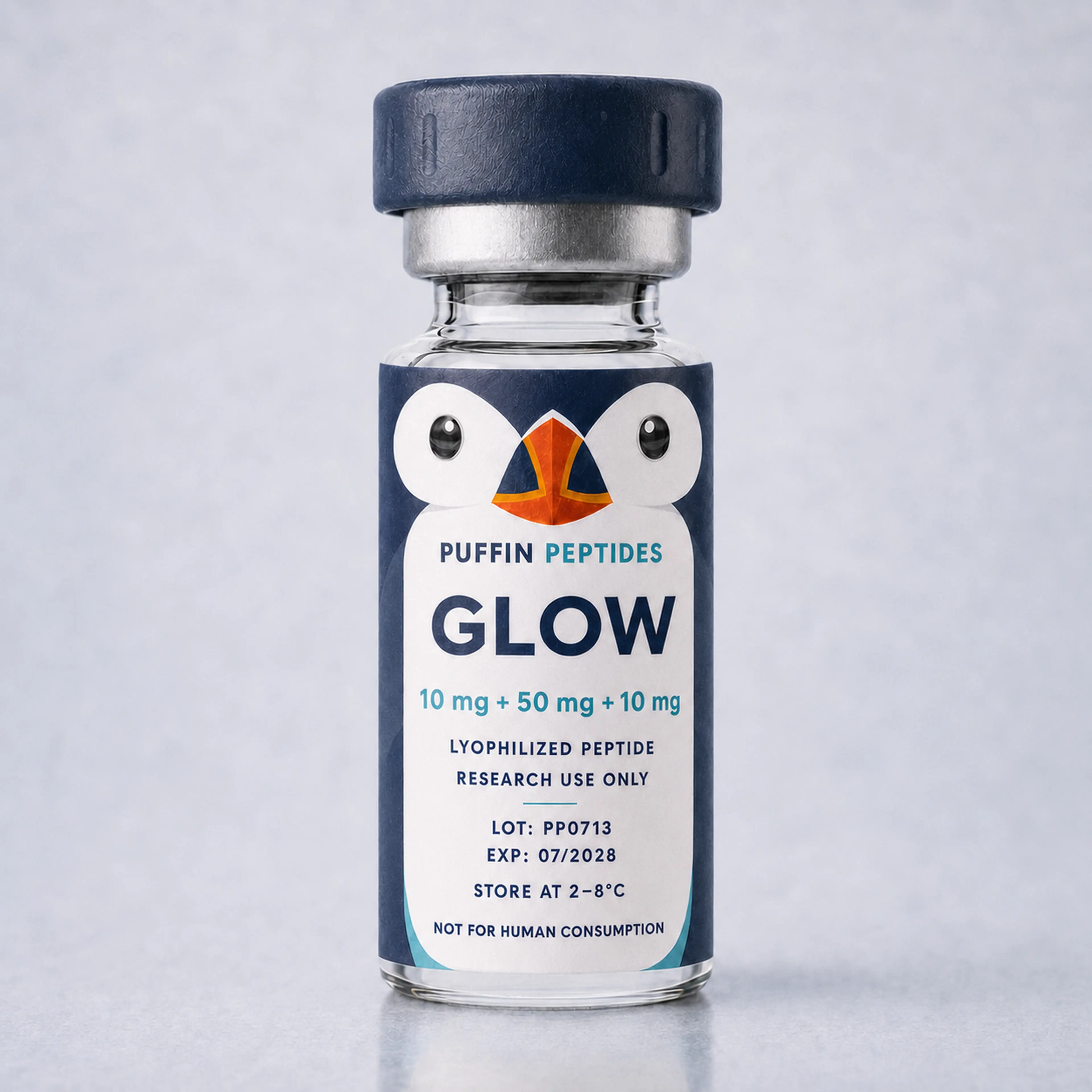
Explore GLOW
Review available strengths, pricing, stock status, and product documentation.