
At a glance
- Hexarelin acetate is the acetate-salt form of hexarelin. The active peptide sequence and ghrelin-receptor mechanism are the same; “acetate” describes the counter-ion associated with the material, not a new hormone pathway.
- Hexarelin acetate is not an approved medicine. Evidence for hexarelin can inform the active-sequence hypothesis only after identity, peptide content, acetate content, and formulation are properly accounted for.
- Convert labelled mass to actual peptide content when comparing acetate salt with another salt or free-base specification.
- Measure pH, water, residual counter-ion, purity, and biological potency for accurate lot-to-lot work.
What HEXARELIN ACETATE is—and what the name does not establish
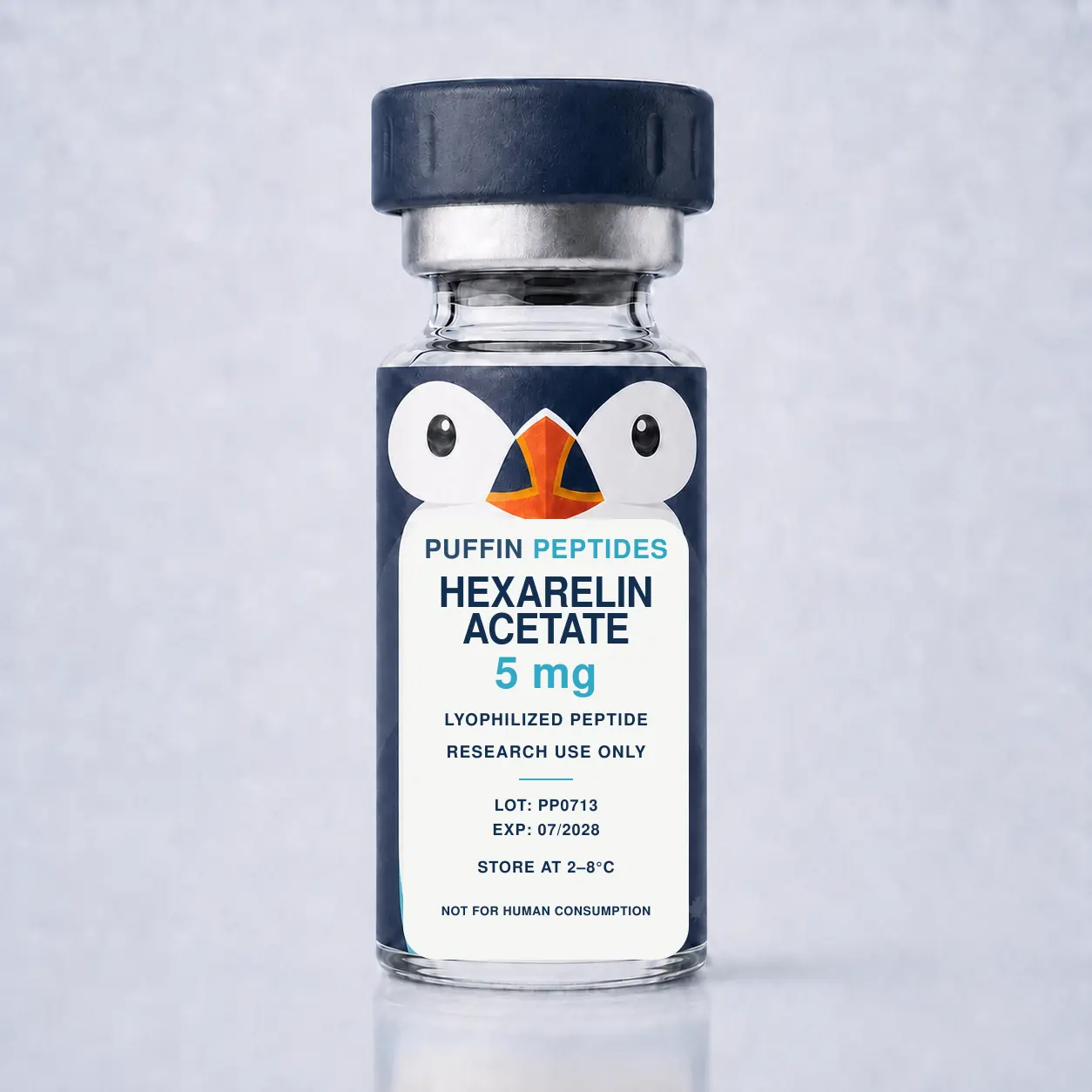
Hexarelin acetate is the acetate-salt form of hexarelin. The active peptide sequence and ghrelin-receptor mechanism are the same; “acetate” describes the counter-ion associated with the material, not a new hormone pathway.
Once dissolved, the hexarelin peptide is the GHSR1a agonist. The counter-ion can affect measured mass, pH, solubility, handling, and analytical results, but it does not create a second receptor mechanism.
Questions to settle before interpreting a result
A useful HEXARELIN ACETATE study begins with material identity, a defined model, a relevant comparator, and an endpoint chosen before the result is known. Broad catalogue language cannot replace those controls.
- Convert labelled mass to actual peptide content when comparing acetate salt with another salt or free-base specification.
- Measure pH, water, residual counter-ion, purity, and biological potency for accurate lot-to-lot work.
- Use the same receptor and endocrine controls as hexarelin; the salt name does not justify a separate mechanism claim.
How to read the HEXARELIN ACETATE evidence
These evidence snapshots summarize the most important distinctions in the published record. They do not combine unlike models or turn an experimental signal into a human-use claim.
Chemistry explained
- Design
- The acetate is a counter-ion
- Finding
- Salt form can change handling and the relationship between gross mass and active peptide mass. It does not turn hexarelin acetate into a different receptor agonist.
- Read with care
- This is an interpretation boundary, not a claim that a specific outcome has been established in people.
Best comparison
- Design
- Normalize to peptide moles—not vial milligrams
- Finding
- A fair comparison accounts for counter-ion, water, and purity so both preparations deliver the same amount of hexarelin sequence.
- Read with care
- This is an interpretation boundary, not a claim that a specific outcome has been established in people.
Evidence boundary
- Design
- Hexarelin’s early evidence remains early
- Finding
- Changing the salt form does not upgrade acute human hormone studies or preclinical findings into approved long-term benefits.
- Read with care
- This is an interpretation boundary, not a claim that a specific outcome has been established in people.
What the evidence does not establish
Hexarelin acetate is not an approved medicine. Evidence for hexarelin can inform the active-sequence hypothesis only after identity, peptide content, acetate content, and formulation are properly accounted for.
Mechanism, cell, animal, observational, and controlled human evidence answer different questions. A positive result at one level cannot be silently promoted to another, and evidence for a sponsor’s defined product does not establish equivalence for an independently sourced research material.
Keep the publication and the vial separate
A published paper identifies its own sequence or chemical identity, formulation, manufacturing context, analytical controls, exposure, and test system. Matching a familiar name on a label is not enough to show that a catalogue vial is the same study material.
For practical research planning, verify the lot-specific identity and documentation, then write the model, comparator, endpoint, and stopping criteria before testing. This guide does not provide preparation, dosing, injection, or human-use instructions.
Sources
Links lead to the paper, official registry, regulator page, or product label used for this guide. Registry records describe protocols and status; they are not treated as positive results.
- Growth hormone-releasing activity of hexarelin in humansPubMed-indexed human pharmacology study · 1994
Primary evidence for the active hexarelin sequence. It does not establish the composition, peptide-equivalent mass, or handling of a particular acetate-salt vial.
- Think twice before injecting peptides bought online: unauthorized products can seriously harm youHealth Canada · 2026
Official Canadian advisory explaining that a research-use label does not establish authorization, safety, efficacy, or product quality for human use.
Vote for HEXARELIN ACETATE
This compound is not currently stocked. Add it to your five-choice catalogue ballot.