
At a glance
- Ipamorelin is a five-residue synthetic agonist of the ghrelin/growth-hormone-secretagogue receptor. It was developed to stimulate growth-hormone release with less ACTH and cortisol spillover than earlier GHRPs.
- Ipamorelin is not an approved medicine. It reached phase 2 development for postoperative ileus, but that programme was discontinued after efficacy was not established. Its selective GH-release profile is not proof of anti-aging or performance benefit.
- Use time-resolved GH sampling and include ACTH, cortisol, and prolactin when testing the claimed selectivity profile.
- Compare with GHRP-2 or hexarelin at matched molar exposure to study endocrine spillover.
What IPAMORELIN is—and what the name does not establish
Ipamorelin is a five-residue synthetic agonist of the ghrelin/growth-hormone-secretagogue receptor. It was developed to stimulate growth-hormone release with less ACTH and cortisol spillover than earlier GHRPs.
Ipamorelin activates GHSR1a on pituitary and related cells, prompting growth-hormone release through the ghrelin-receptor route. It does not activate the GHRH receptor, so pairing it with a GHRH analogue studies two upstream inputs to the same pituitary output.
Questions to settle before interpreting a result
A useful IPAMORELIN study begins with material identity, a defined model, a relevant comparator, and an endpoint chosen before the result is known. Broad catalogue language cannot replace those controls.
- Use time-resolved GH sampling and include ACTH, cortisol, and prolactin when testing the claimed selectivity profile.
- Compare with GHRP-2 or hexarelin at matched molar exposure to study endocrine spillover.
- Use a GHRH analogue as a separate-pathway comparator, not as though it were another ghrelin agonist.
How to read the IPAMORELIN evidence
These evidence snapshots summarize the most important distinctions in the published record. They do not combine unlike models or turn an experimental signal into a human-use claim.
Early human research
- Design
- Selective GH release was demonstrated
- Finding
- Early studies described dose-related GH release with comparatively limited ACTH/cortisol effects. These were pharmacology studies, not demonstrations of long-term body-composition or recovery outcomes.
- Read with care
- Keep the finding attached to the linked study’s exact material, design, population, exposure, and endpoint.
Phase 2 outcome
- Design
- The ileus programme did not establish efficacy
- Finding
- A randomized postoperative-ileus study did not lead to an approved treatment and development was discontinued. Negative development outcomes belong in a complete evidence summary.
- Read with care
- Keep the finding attached to the linked study’s exact material, design, population, exposure, and endpoint.
Best comparison
- Design
- Selectivity is relative—not absolute
- Finding
- Ipamorelin may show less endocrine spillover than some older GHRPs under certain conditions. Model, concentration, timing, and assay sensitivity still matter.
- Read with care
- This is an interpretation boundary, not a claim that a specific outcome has been established in people.
What the evidence does not establish
Ipamorelin is not an approved medicine. It reached phase 2 development for postoperative ileus, but that programme was discontinued after efficacy was not established. Its selective GH-release profile is not proof of anti-aging or performance benefit.
Mechanism, cell, animal, observational, and controlled human evidence answer different questions. A positive result at one level cannot be silently promoted to another, and evidence for a sponsor’s defined product does not establish equivalence for an independently sourced research material.
Keep the publication and the vial separate
A published paper identifies its own sequence or chemical identity, formulation, manufacturing context, analytical controls, exposure, and test system. Matching a familiar name on a label is not enough to show that a catalogue vial is the same study material.
For practical research planning, verify the lot-specific identity and documentation, then write the model, comparator, endpoint, and stopping criteria before testing. This guide does not provide preparation, dosing, injection, or human-use instructions.
Sources
Links lead to the paper, official registry, regulator page, or product label used for this guide. Registry records describe protocols and status; they are not treated as positive results.
- Ipamorelin, the first selective growth hormone secretagoguePeer-reviewed publication · 1998
Early studies described dose-related GH release with comparatively limited ACTH/cortisol effects. These were pharmacology studies, not demonstrations of long-term body-composition or recovery outcomes. The result remains tied to the exact study material, design, population, and endpoint.
- Randomized postoperative-ileus trial of ipamorelinPeer-reviewed publication · 2015
A randomized postoperative-ileus study did not lead to an approved treatment and development was discontinued. Negative development outcomes belong in a complete evidence summary. The result remains tied to the exact study material, design, population, and endpoint.
- Think twice before injecting peptides bought online: unauthorized products can seriously harm youHealth Canada · 2026
Official Canadian advisory explaining that a research-use label does not establish authorization, safety, efficacy, or product quality for human use.
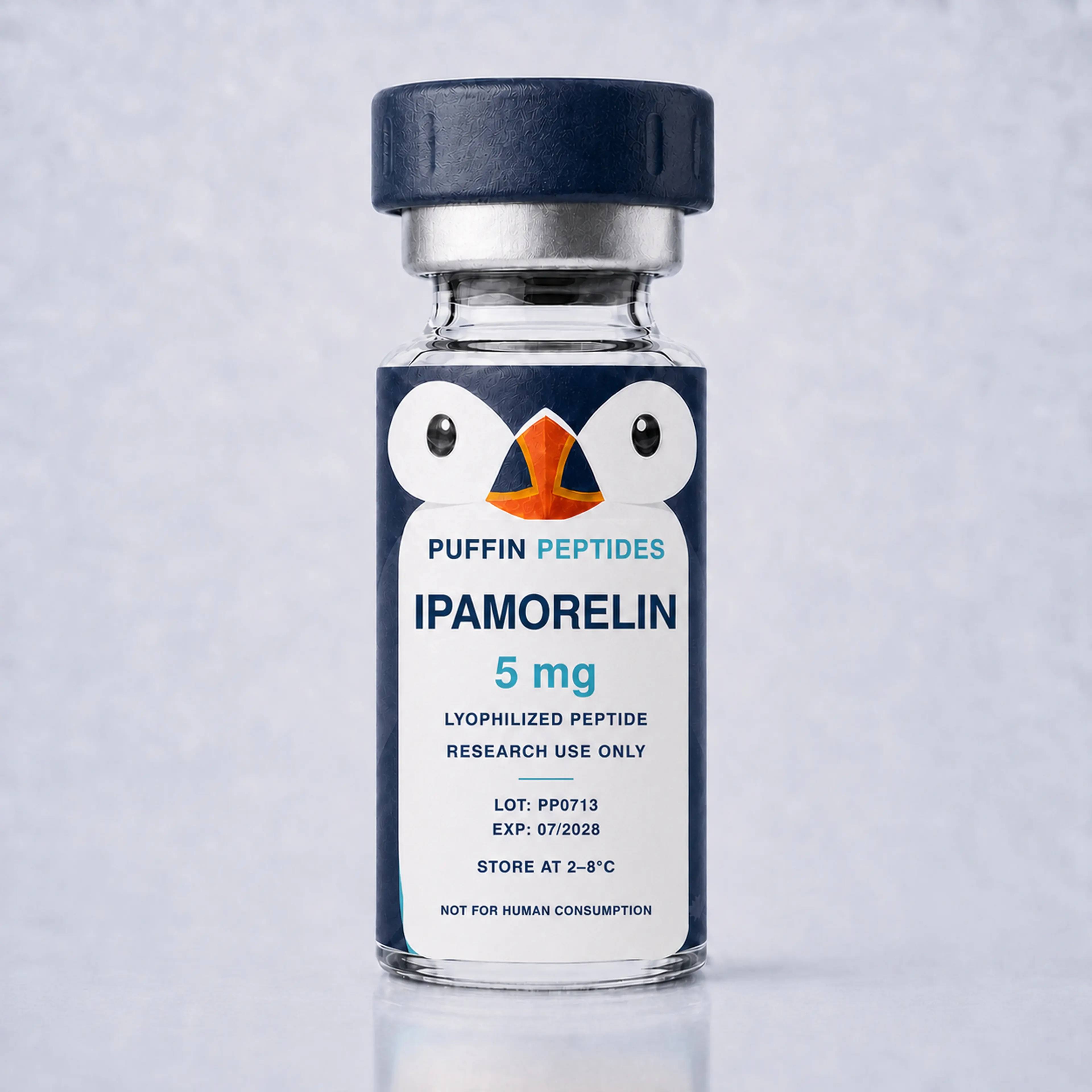
Explore IPAMORELIN
Review available strengths, pricing, stock status, and product documentation.