
At a glance
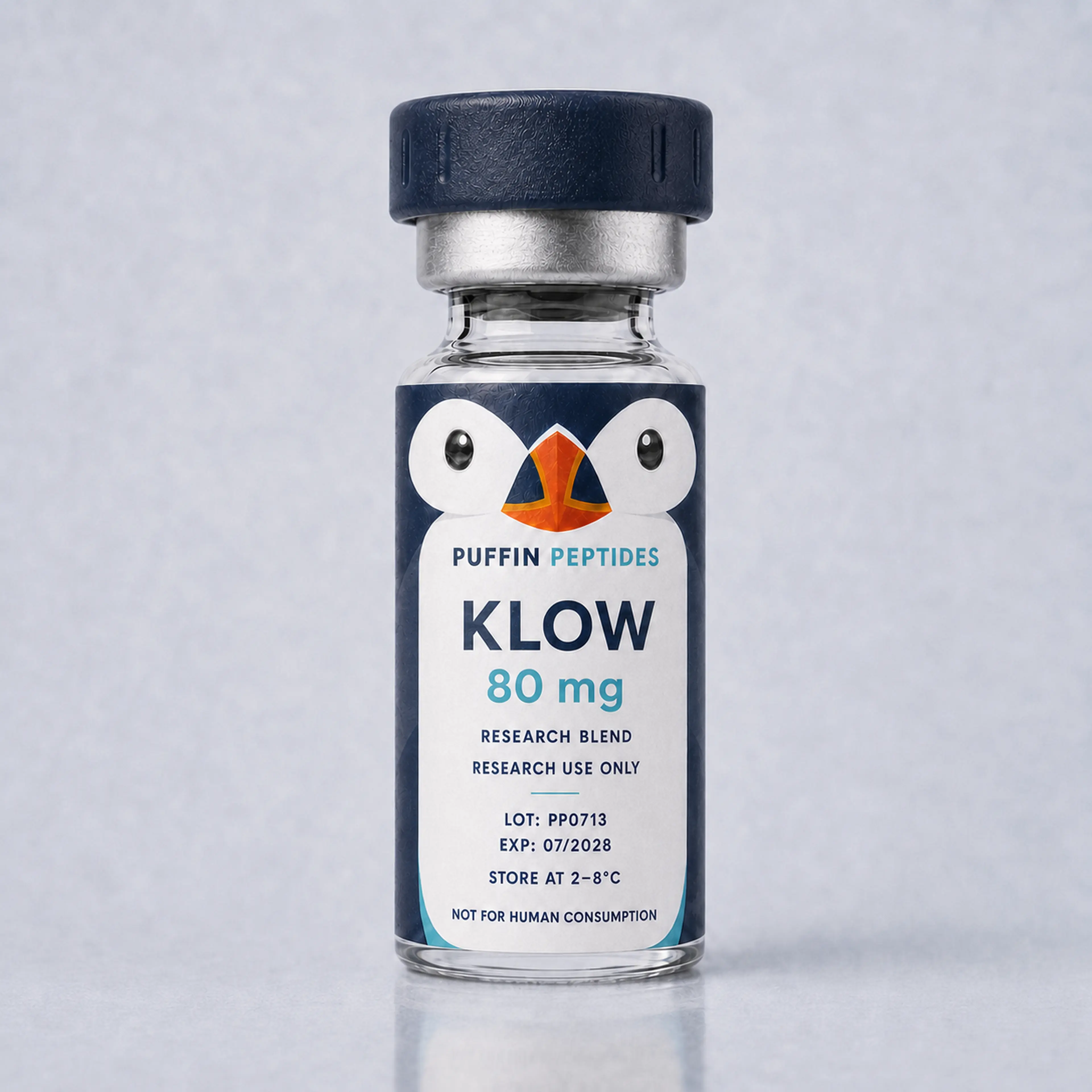
- KLOW is a four-component formulation containing GHK-Cu, BPC-157, TB-500, and KPV. Each component has a different proposed mechanism and evidence base; the blend does not have a shared clinical evidence record.
- KLOW is not an approved medicine, and component-level cell or animal findings do not establish the blend’s safety or effectiveness. The exact component amounts and lot identity must be verified before study design.
- Confirm the amount and identity of every component against the lot-specific documentation.
- Include vehicle, single-component, and relevant combination controls if the study aims to identify which component produced a signal.
What KLOW (GHK-Cu + BPC-157 + TB-500 + KPV) is—and what the name does not establish
KLOW is a four-component formulation containing GHK-Cu, BPC-157, TB-500, and KPV. Each component has a different proposed mechanism and evidence base; the blend does not have a shared clinical evidence record.
A multi-component formulation can affect copper-peptide, cell-migration, actin-related, and inflammatory-response models at the same time. That breadth makes controls more important, because an observed result cannot be attributed to one component without testing the components separately.
Questions to settle before interpreting a result
A useful KLOW (GHK-Cu + BPC-157 + TB-500 + KPV) study begins with material identity, a defined model, a relevant comparator, and an endpoint chosen before the result is known. Broad catalogue language cannot replace those controls.
- Confirm the amount and identity of every component against the lot-specific documentation.
- Include vehicle, single-component, and relevant combination controls if the study aims to identify which component produced a signal.
- Do not combine unrelated component findings into one promised recovery, skin, or inflammatory outcome.
How to read the KLOW (GHK-Cu + BPC-157 + TB-500 + KPV) evidence
These evidence snapshots summarize the most important distinctions in the published record. They do not combine unlike models or turn an experimental signal into a human-use claim.
Evidence architecture
- Design
- The available literature is component-level
- Finding
- BPC-157, GHK-Cu, thymosin-related materials, and KPV have been studied in different models. Those papers are not studies of KLOW.
- Read with care
- This is an interpretation boundary, not a claim that a specific outcome has been established in people.
Study design
- Design
- Attribution requires component controls
- Finding
- Testing the blend alone cannot show which ingredient, interaction, or analytical difference produced a result.
- Read with care
- This is an interpretation boundary, not a claim that a specific outcome has been established in people.
Translation boundary
- Design
- Four preclinical rationales do not create clinical proof
- Finding
- No combined safety, exposure, compatibility, or human efficacy conclusion follows from separate component papers.
- Read with care
- This is an interpretation boundary, not a claim that a specific outcome has been established in people.
What the evidence does not establish
KLOW is not an approved medicine, and component-level cell or animal findings do not establish the blend’s safety or effectiveness. The exact component amounts and lot identity must be verified before study design.
Mechanism, cell, animal, observational, and controlled human evidence answer different questions. A positive result at one level cannot be silently promoted to another, and evidence for a sponsor’s defined product does not establish equivalence for an independently sourced research material.
Keep the publication and the vial separate
A published paper identifies its own sequence or chemical identity, formulation, manufacturing context, analytical controls, exposure, and test system. Matching a familiar name on a label is not enough to show that a catalogue vial is the same study material.
For practical research planning, verify the lot-specific identity and documentation, then write the model, comparator, endpoint, and stopping criteria before testing. This guide does not provide preparation, dosing, injection, or human-use instructions.
Sources
Links lead to the paper, official registry, regulator page, or product label used for this guide. Registry records describe protocols and status; they are not treated as positive results.
- The promoting effect of pentadecapeptide BPC 157 on tendon healing involves tendon outgrowth, cell survival, and cell migrationJournal of Applied Physiology · 2011
Component-level preclinical evidence only; the study did not test KLOW.
- PepT1-mediated tripeptide KPV uptake reduces intestinal inflammationGastroenterology · 2008
Component-level KPV research; the result cannot be assigned to the four-component blend.
- Stimulation of collagen synthesis in fibroblast cultures by the tripeptide-copper complex glycyl-L-histidyl-L-lysine-Cu2+FEBS Letters · 1988
Component-level GHK-Cu cell research; it does not establish a combined effect.
- Think twice before injecting peptides bought online: unauthorized products can seriously harm youHealth Canada · 2026
Official Canadian advisory explaining that a research-use label does not establish authorization, safety, efficacy, or product quality for human use.
Explore KLOW
Review available strengths, pricing, stock status, and product documentation.