
At a glance
- KPV is the three-amino-acid sequence Lys-Pro-Val from the C terminus of alpha-MSH. It is studied in inflammatory-response, epithelial, intestinal, and skin models without reproducing every melanocortin effect of the full hormone.
- KPV is not an approved medicine and robust controlled human efficacy evidence is lacking. Findings in cultured cells and colitis or skin models do not establish treatment of inflammatory disease in people.
- Measure cytokine and NF-kappaB-related endpoints alongside cell viability and barrier function.
- Use transporter and receptor controls when testing whether PepT1 uptake or melanocortin pathways contribute.
What KPV is—and what the name does not establish
KPV is the three-amino-acid sequence Lys-Pro-Val from the C terminus of alpha-MSH. It is studied in inflammatory-response, epithelial, intestinal, and skin models without reproducing every melanocortin effect of the full hormone.
KPV has been reported to reduce selected NF-kappaB-related and cytokine responses, and intestinal uptake through the PepT1 transporter has been studied. In plain language, it is a short anti-inflammatory research motif with proposed actions that may not require the classic melanocortin receptor.
Questions to settle before interpreting a result
A useful KPV study begins with material identity, a defined model, a relevant comparator, and an endpoint chosen before the result is known. Broad catalogue language cannot replace those controls.
- Measure cytokine and NF-kappaB-related endpoints alongside cell viability and barrier function.
- Use transporter and receptor controls when testing whether PepT1 uptake or melanocortin pathways contribute.
- Compare KPV with alpha-MSH only when the study is designed to separate the short C-terminal motif from the full peptide.
How to read the KPV evidence
These evidence snapshots summarize the most important distinctions in the published record. They do not combine unlike models or turn an experimental signal into a human-use claim.
Intestinal research
- Design
- PepT1-mediated uptake reduced inflammation in models
- Finding
- A 2008 Gastroenterology study reported transporter-dependent uptake and anti-inflammatory effects in cell and mouse intestinal models. It was preclinical, not a human inflammatory-bowel-disease trial.
- Read with care
- This is an interpretation boundary, not a claim that a specific outcome has been established in people.
Mechanism status
- Design
- The short motif may act outside classic melanocortin signalling
- Finding
- KPV is derived from alpha-MSH, but direct receptor dependence varies across studies. Transporter, concentration, and tissue context belong in the protocol.
- Read with care
- This is an interpretation boundary, not a claim that a specific outcome has been established in people.
Evidence boundary
- Design
- Anti-inflammatory markers are not clinical remission
- Finding
- A lower cytokine signal or improved mouse histology can guide research without proving safe, effective treatment in people.
- Read with care
- This is an interpretation boundary, not a claim that a specific outcome has been established in people.
What the evidence does not establish
KPV is not an approved medicine and robust controlled human efficacy evidence is lacking. Findings in cultured cells and colitis or skin models do not establish treatment of inflammatory disease in people.
Mechanism, cell, animal, observational, and controlled human evidence answer different questions. A positive result at one level cannot be silently promoted to another, and evidence for a sponsor’s defined product does not establish equivalence for an independently sourced research material.
Keep the publication and the vial separate
A published paper identifies its own sequence or chemical identity, formulation, manufacturing context, analytical controls, exposure, and test system. Matching a familiar name on a label is not enough to show that a catalogue vial is the same study material.
For practical research planning, verify the lot-specific identity and documentation, then write the model, comparator, endpoint, and stopping criteria before testing. This guide does not provide preparation, dosing, injection, or human-use instructions.
Sources
Links lead to the paper, official registry, regulator page, or product label used for this guide. Registry records describe protocols and status; they are not treated as positive results.
- PepT1-mediated tripeptide KPV uptake reduces intestinal inflammationGastroenterology · 2008
Cell and animal intestinal-inflammation models; not a controlled human efficacy trial.
- Think twice before injecting peptides bought online: unauthorized products can seriously harm youHealth Canada · 2026
Official Canadian advisory explaining that a research-use label does not establish authorization, safety, efficacy, or product quality for human use.
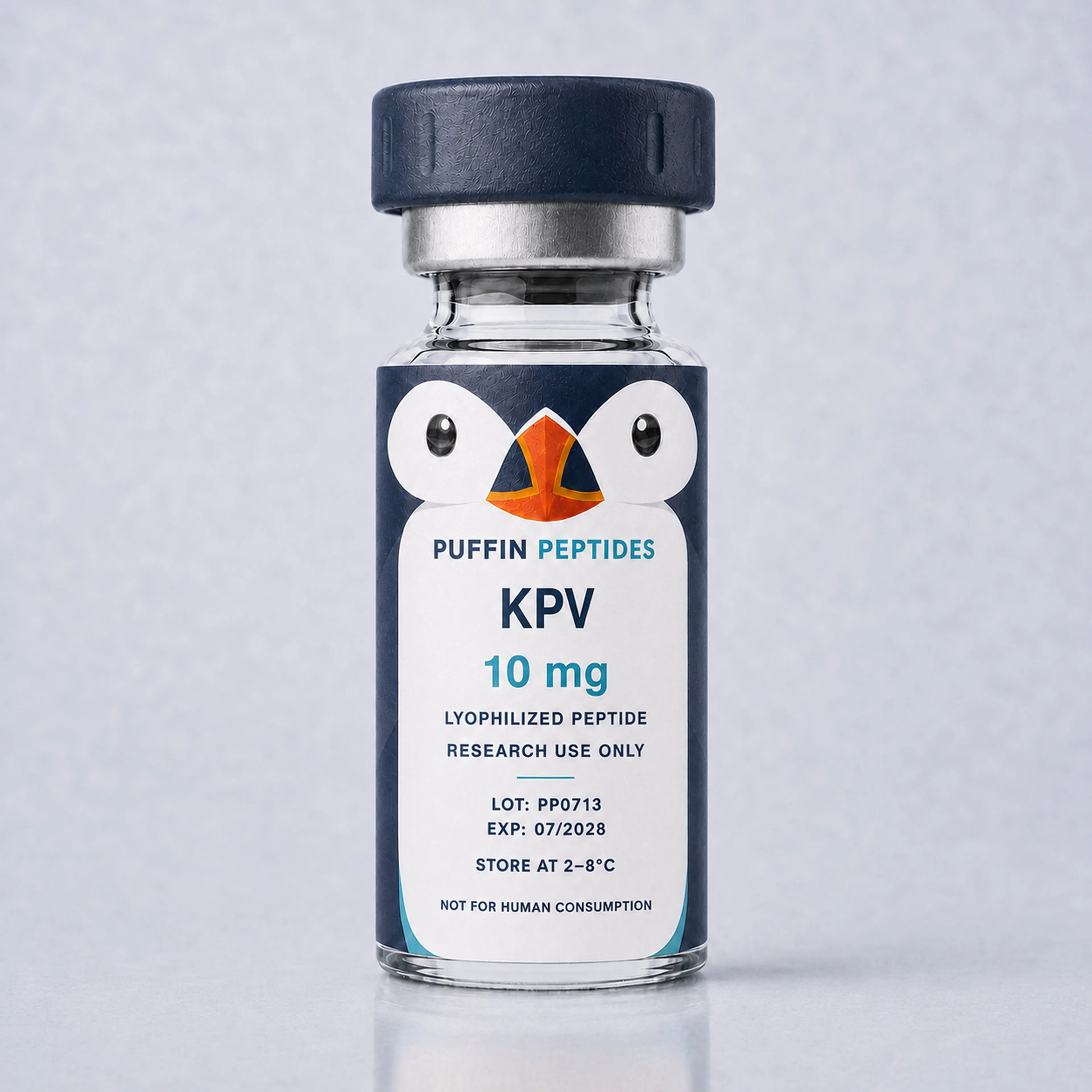
Explore KPV
Review available strengths, pricing, stock status, and product documentation.