
At a glance
- Melanotan is an ambiguous catalogue name often used for melanotan I or melanotan II—related but different melanocortin analogues. The exact sequence must be confirmed before a mechanism, comparison, or evidence summary is assigned.
- Unlicensed products called melanotan are not approved medicines. Afamelanotide is an approved, specifically formulated analogue for a narrow indication, but its evidence and quality controls cannot be transferred to a generic “Melanotan” vial.
- Confirm whether the lot is melanotan I, melanotan II, or another sequence before selecting receptor assays.
- Measure melanocortin-receptor subtype activity rather than treating pigmentation as the only possible signal.
What MELANOTAN is—and what the name does not establish
Melanotan is an ambiguous catalogue name often used for melanotan I or melanotan II—related but different melanocortin analogues. The exact sequence must be confirmed before a mechanism, comparison, or evidence summary is assigned.
Melanocortin receptors regulate pigmentation and several neuroendocrine processes. Melanotan I is more closely associated with MC1-receptor pigmentation research, while melanotan II has broader melanocortin-receptor activity. In plain language, the number after the name changes the research target.
Questions to settle before interpreting a result
A useful MELANOTAN study begins with material identity, a defined model, a relevant comparator, and an endpoint chosen before the result is known. Broad catalogue language cannot replace those controls.
- Confirm whether the lot is melanotan I, melanotan II, or another sequence before selecting receptor assays.
- Measure melanocortin-receptor subtype activity rather than treating pigmentation as the only possible signal.
- Keep afamelanotide evidence separate unless the tested sequence and regulated product are actually the same.
How to read the MELANOTAN evidence
These evidence snapshots summarize the most important distinctions in the published record. They do not combine unlike models or turn an experimental signal into a human-use claim.
First question
- Design
- Which melanotan is it?
- Finding
- Melanotan I and II differ in sequence, receptor profile, and development history. A product page that does not specify the identity cannot support a precise scientific claim.
- Read with care
- This is an interpretation boundary, not a claim that a specific outcome has been established in people.
Approved comparator
- Design
- Afamelanotide is not evidence for generic melanotan material
- Finding
- A regulated implant product has formulation, manufacturing, dosing, and indication-specific evidence. Similar naming or shared ancestry does not create clinical equivalence.
- Read with care
- This is an interpretation boundary, not a claim that a specific outcome has been established in people.
Evidence boundary
- Design
- Pigmentation signals do not establish safe human use
- Finding
- Receptor activation or pigment changes can support laboratory research while leaving dosing, impurities, cardiovascular effects, and long-term safety unanswered.
- Read with care
- This is an interpretation boundary, not a claim that a specific outcome has been established in people.
What the evidence does not establish
Unlicensed products called melanotan are not approved medicines. Afamelanotide is an approved, specifically formulated analogue for a narrow indication, but its evidence and quality controls cannot be transferred to a generic “Melanotan” vial.
Mechanism, cell, animal, observational, and controlled human evidence answer different questions. A positive result at one level cannot be silently promoted to another, and evidence for a sponsor’s defined product does not establish equivalence for an independently sourced research material.
Keep the publication and the vial separate
A published paper identifies its own sequence or chemical identity, formulation, manufacturing context, analytical controls, exposure, and test system. Matching a familiar name on a label is not enough to show that a catalogue vial is the same study material.
For practical research planning, verify the lot-specific identity and documentation, then write the model, comparator, endpoint, and stopping criteria before testing. This guide does not provide preparation, dosing, injection, or human-use instructions.
Sources
Links lead to the paper, official registry, regulator page, or product label used for this guide. Registry records describe protocols and status; they are not treated as positive results.
- Characterization of melanocortin receptor ligands on grooming and stretching behaviour in ratsEuropean Journal of Pharmacology · 1999
Preclinical receptor-ligand work involving Melanotan II. A generic Melanotan label must be sequence-confirmed before this evidence is applied.
- Melanotan II injection resulting in systemic toxicity and rhabdomyolysisClinical Toxicology · 2012
Published case report documenting risk; it is not an efficacy study.
- Think twice before injecting peptides bought online: unauthorized products can seriously harm youHealth Canada · 2026
Official Canadian advisory explaining that a research-use label does not establish authorization, safety, efficacy, or product quality for human use.
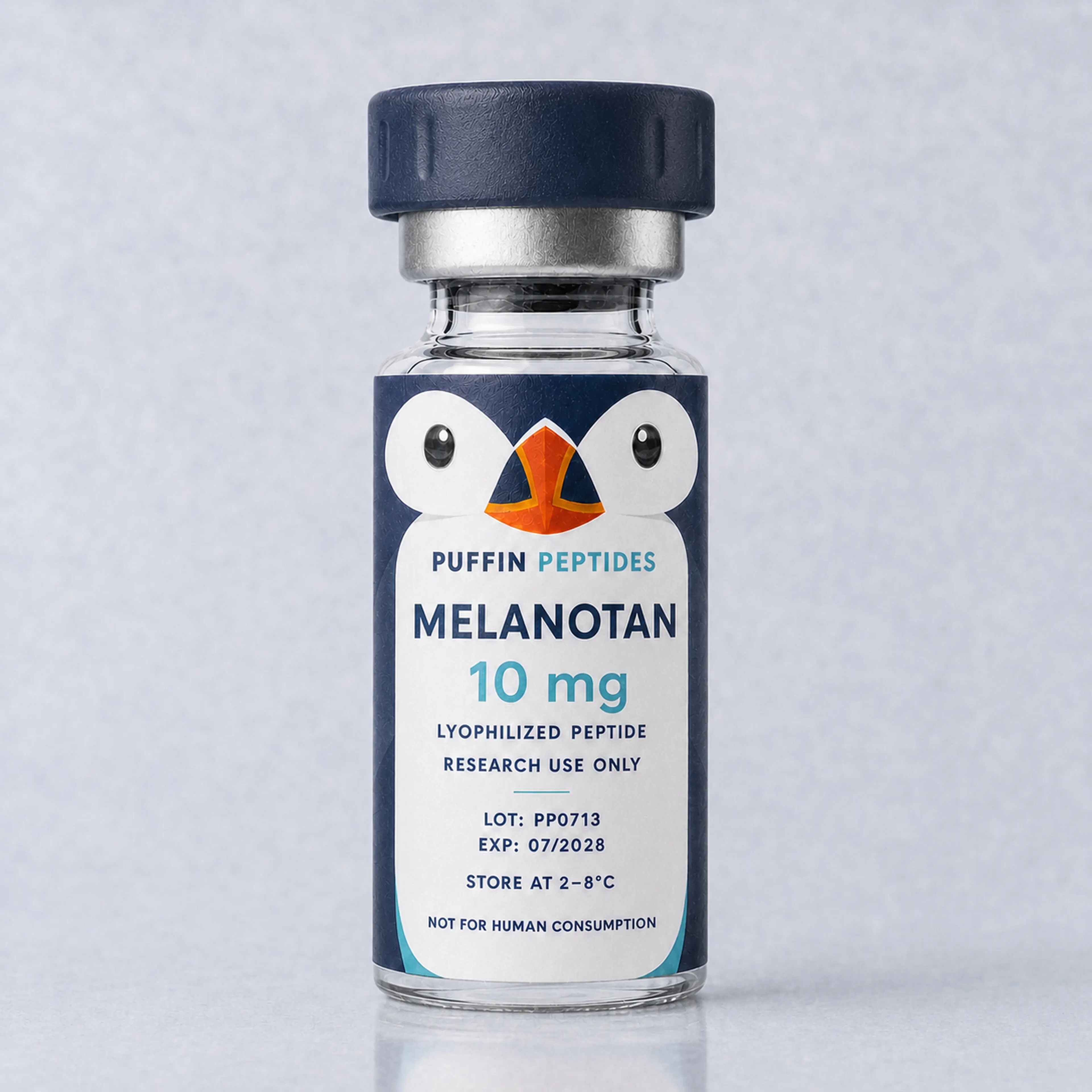
Explore MELANOTAN
Review available strengths, pricing, stock status, and product documentation.