
At a glance
- MGF, or mechano growth factor, usually refers to the E-domain peptide associated with the IGF-1Ec splice variant. It is studied in local mechanical-response, cell-survival, and tissue-growth models, but the exact sequence used matters.
- MGF-related work is mainly cellular and animal research. There is no approved MGF medicine, and published results can involve different splice products, E-domain fragments, species sequences, or stabilized analogues that should not be treated as identical.
- Confirm the exact amino-acid sequence before comparing a synthetic MGF peptide with IGF-1Ec expression studies.
- Separate mature IGF-1 receptor signalling from any response attributed to the E-domain peptide.
What MGF is—and what the name does not establish
MGF, or mechano growth factor, usually refers to the E-domain peptide associated with the IGF-1Ec splice variant. It is studied in local mechanical-response, cell-survival, and tissue-growth models, but the exact sequence used matters.
Mechanical loading can change IGF-1 splice-variant expression. Synthetic MGF-related peptides are used to explore whether the E-domain has activity that is partly independent of mature IGF-1. In plain language, this is a local signalling question—not simply a shorter version of injectable IGF-1.
Questions to settle before interpreting a result
A useful MGF study begins with material identity, a defined model, a relevant comparator, and an endpoint chosen before the result is known. Broad catalogue language cannot replace those controls.
- Confirm the exact amino-acid sequence before comparing a synthetic MGF peptide with IGF-1Ec expression studies.
- Separate mature IGF-1 receptor signalling from any response attributed to the E-domain peptide.
- Use tissue-specific endpoints—such as cell survival, migration, or local growth response—instead of a broad muscle-growth claim.
How to read the MGF evidence
These evidence snapshots summarize the most important distinctions in the published record. They do not combine unlike models or turn an experimental signal into a human-use claim.
Preclinical signal
- Design
- The E-domain has shown activity outside classic IGF-1 readouts
- Finding
- Cell and animal studies have reported neuroprotective, cardiac-cell, and neurogenesis signals from MGF-related E-domain peptides. The models and peptide constructs differ, so they do not establish one universal MGF effect.
- Read with care
- Keep the finding attached to the linked study’s exact material, design, population, exposure, and endpoint.
Identity check
- Design
- MGF is not one perfectly standardized material
- Finding
- Native splice-variant biology, isolated E-domain peptides, species-specific sequences, and modified synthetic analogues appear under the same shorthand. Sequence and assay confirmation come before interpretation.
- Read with care
- This is an interpretation boundary, not a claim that a specific outcome has been established in people.
Translation gap
- Design
- There is no established human MGF outcome
- Finding
- Preclinical survival or growth signals do not establish muscle gain, injury recovery, neuroprotection, or safe exposure in people.
- Read with care
- This is an interpretation boundary, not a claim that a specific outcome has been established in people.
What the evidence does not establish
MGF-related work is mainly cellular and animal research. There is no approved MGF medicine, and published results can involve different splice products, E-domain fragments, species sequences, or stabilized analogues that should not be treated as identical.
Mechanism, cell, animal, observational, and controlled human evidence answer different questions. A positive result at one level cannot be silently promoted to another, and evidence for a sponsor’s defined product does not establish equivalence for an independently sourced research material.
Keep the publication and the vial separate
A published paper identifies its own sequence or chemical identity, formulation, manufacturing context, analytical controls, exposure, and test system. Matching a familiar name on a label is not enough to show that a catalogue vial is the same study material.
For practical research planning, verify the lot-specific identity and documentation, then write the model, comparator, endpoint, and stopping criteria before testing. This guide does not provide preparation, dosing, injection, or human-use instructions.
Sources
Links lead to the paper, official registry, regulator page, or product label used for this guide. Registry records describe protocols and status; they are not treated as positive results.
- a primary mouse neurogenesis studyPeer-reviewed publication · Linked record
Cell and animal studies have reported neuroprotective, cardiac-cell, and neurogenesis signals from MGF-related E-domain peptides. The models and peptide constructs differ, so they do not establish one universal MGF effect. The result remains tied to the exact study material, design, population, and endpoint.
- Think twice before injecting peptides bought online: unauthorized products can seriously harm youHealth Canada · 2026
Official Canadian advisory explaining that a research-use label does not establish authorization, safety, efficacy, or product quality for human use.
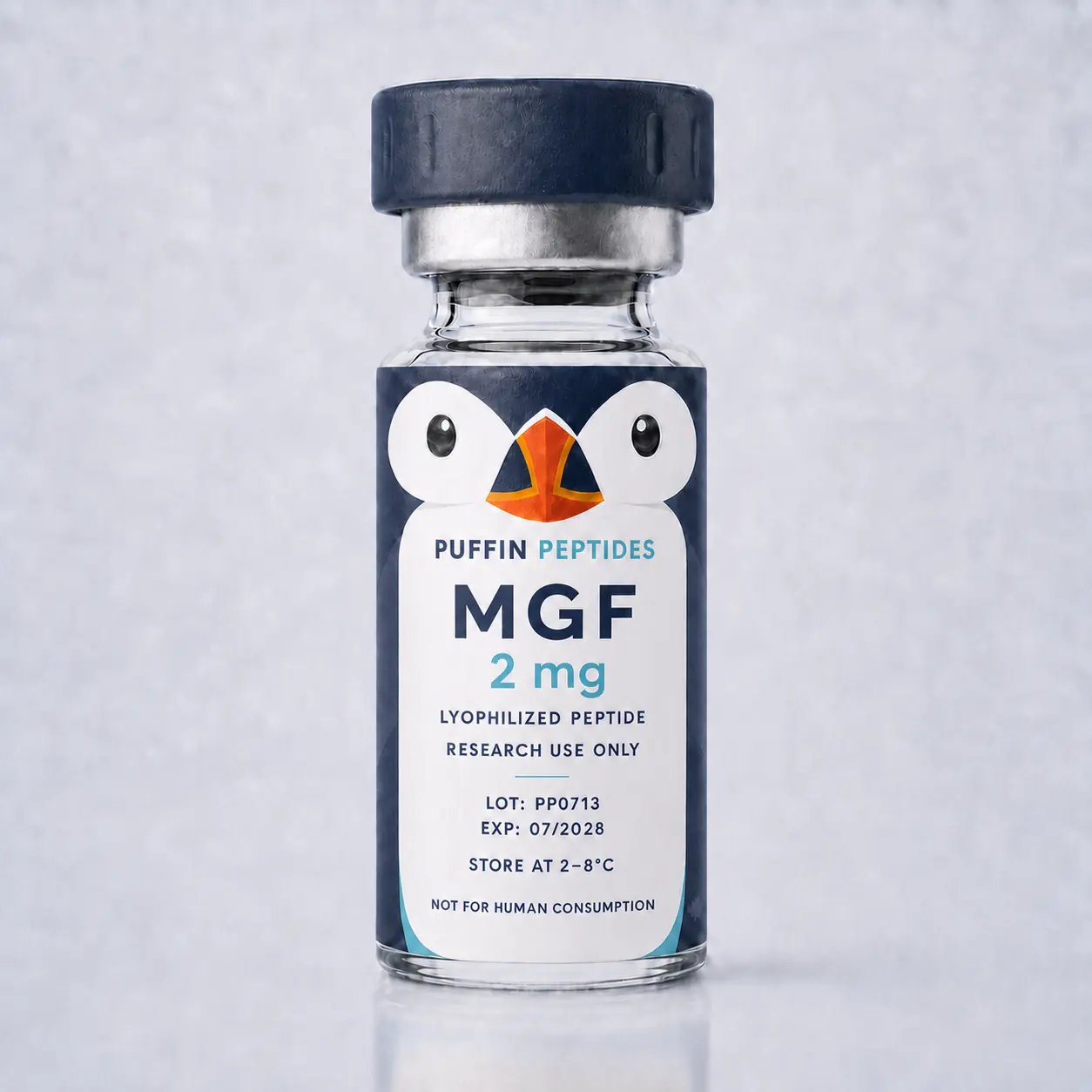
Vote for MGF
This compound is not currently stocked. Add it to your five-choice catalogue ballot.