
At a glance
- MOTS-c is a 16-amino-acid peptide encoded within mitochondrial 12S rRNA. It is studied as a mitochondria-derived signal connecting cellular stress, nutrient metabolism, and skeletal-muscle adaptation.
- Native MOTS-c is not an approved medicine. Most causal evidence comes from cells and mice; small observational human studies and clinical work on related analogues do not establish therapeutic benefit for native research MOTS-c.
- Confirm the native human 16-amino-acid sequence and distinguish it from longer-acting clinical analogues.
- Measure AMPK-related, metabolomic, stress-response, and nuclear-localization endpoints rather than one general energy outcome.
What MOTS-C is—and what the name does not establish
MOTS-c is a 16-amino-acid peptide encoded within mitochondrial 12S rRNA. It is studied as a mitochondria-derived signal connecting cellular stress, nutrient metabolism, and skeletal-muscle adaptation.
Early work suggests MOTS-c can alter folate and purine metabolism, activate AMPK-related responses, and move to the nucleus during stress. In plain language, it may act as a message from mitochondrial biology to the rest of the cell rather than as fuel or a replacement for mitochondria.
Questions to settle before interpreting a result
A useful MOTS-C study begins with material identity, a defined model, a relevant comparator, and an endpoint chosen before the result is known. Broad catalogue language cannot replace those controls.
- Confirm the native human 16-amino-acid sequence and distinguish it from longer-acting clinical analogues.
- Measure AMPK-related, metabolomic, stress-response, and nuclear-localization endpoints rather than one general energy outcome.
- Use mitochondrial-stress and metabolic controls to test whether the response depends on the proposed cell-state context.
How to read the MOTS-C evidence
These evidence snapshots summarize the most important distinctions in the published record. They do not combine unlike models or turn an experimental signal into a human-use claim.
Foundational mouse study
- Design
- Metabolic-homeostasis effects were reported in mice
- Finding
- The 2015 discovery paper reported improved glucose handling and resistance to diet-induced metabolic dysfunction in mouse models. It established a research pathway, not a proven human treatment.
- Read with care
- Keep the finding attached to the linked study’s exact material, design, population, exposure, and endpoint.
Ageing model
- Design
- Physical-capacity effects were later reported in mice
- Finding
- Subsequent work linked MOTS-c with exercise response and age-dependent physical capacity in mice. Species, exposure, and outcome differences limit direct human inference.
- Read with care
- Keep the finding attached to the linked study’s exact material, design, population, exposure, and endpoint.
Translation caution
- Design
- Analogue trials are not native MOTS-c trials
- Finding
- A stabilized derivative can have different exposure and activity. Clinical data for an analogue should not be marketed as direct proof for the native mitochondrial peptide.
- Read with care
- This is an interpretation boundary, not a claim that a specific outcome has been established in people.
What the evidence does not establish
Native MOTS-c is not an approved medicine. Most causal evidence comes from cells and mice; small observational human studies and clinical work on related analogues do not establish therapeutic benefit for native research MOTS-c.
Mechanism, cell, animal, observational, and controlled human evidence answer different questions. A positive result at one level cannot be silently promoted to another, and evidence for a sponsor’s defined product does not establish equivalence for an independently sourced research material.
Keep the publication and the vial separate
A published paper identifies its own sequence or chemical identity, formulation, manufacturing context, analytical controls, exposure, and test system. Matching a familiar name on a label is not enough to show that a catalogue vial is the same study material.
For practical research planning, verify the lot-specific identity and documentation, then write the model, comparator, endpoint, and stopping criteria before testing. This guide does not provide preparation, dosing, injection, or human-use instructions.
Sources
Links lead to the paper, official registry, regulator page, or product label used for this guide. Registry records describe protocols and status; they are not treated as positive results.
- The mitochondrial-derived peptide MOTS-c promotes metabolic homeostasisPeer-reviewed publication · 2015
The 2015 discovery paper reported improved glucose handling and resistance to diet-induced metabolic dysfunction in mouse models. It established a research pathway, not a proven human treatment. The result remains tied to the exact study material, design, population, and endpoint.
- MOTS-c and age-dependent physical decline and muscle homeostasisPeer-reviewed publication · 2021
Subsequent work linked MOTS-c with exercise response and age-dependent physical capacity in mice. Species, exposure, and outcome differences limit direct human inference. The result remains tied to the exact study material, design, population, and endpoint.
- Think twice before injecting peptides bought online: unauthorized products can seriously harm youHealth Canada · 2026
Official Canadian advisory explaining that a research-use label does not establish authorization, safety, efficacy, or product quality for human use.
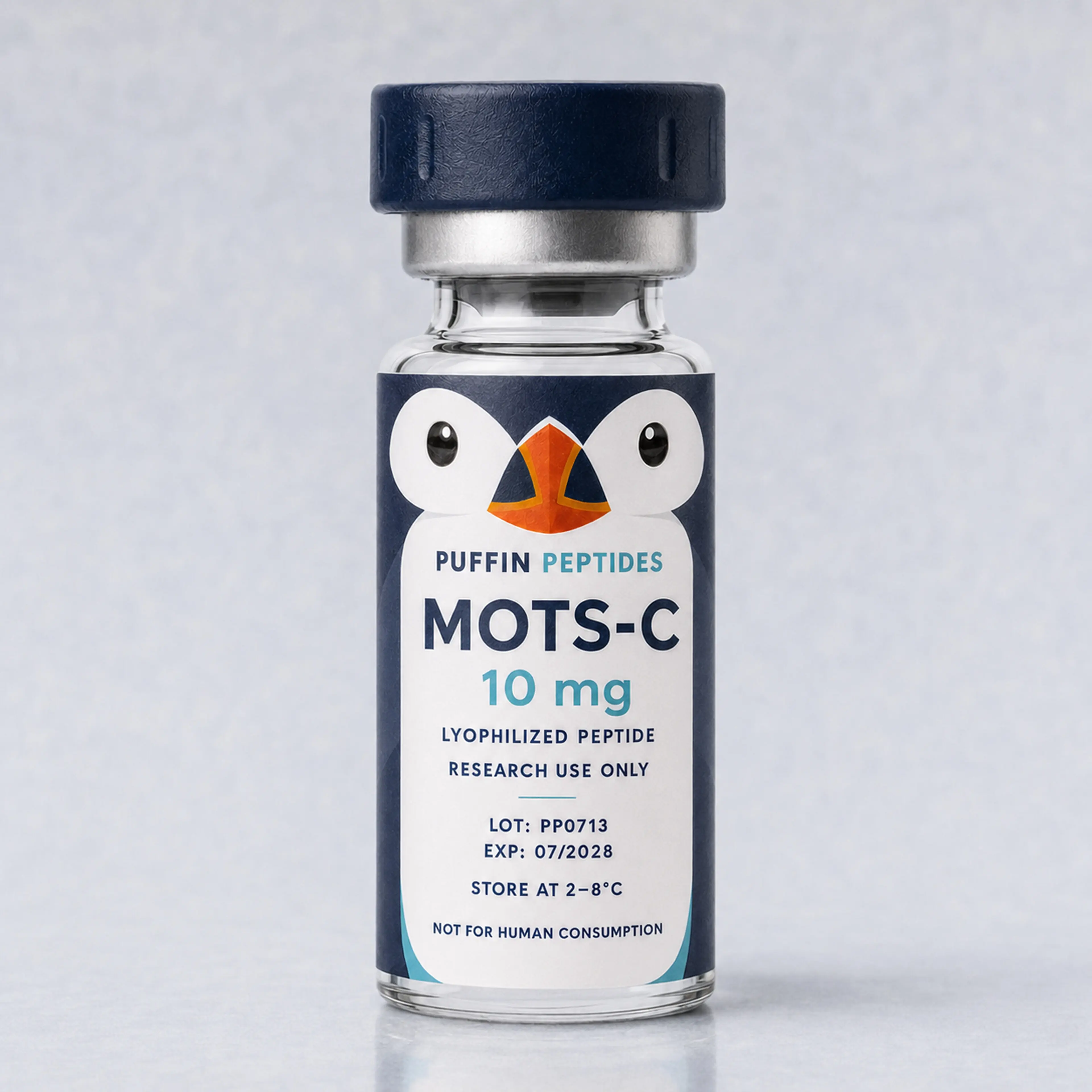
Explore MOTS-C
Review available strengths, pricing, stock status, and product documentation.