
At a glance
- NAD+ is an essential cellular cofactor—not a peptide. It carries electrons in metabolic reactions and is also consumed by enzymes such as sirtuins, PARPs, and CD38.
- NAD+ biology is fundamental and well established, but direct NAD+ supplementation or infusion claims do not follow automatically from cell biochemistry. This research vial is not an approved anti-aging, energy, or wellness treatment.
- Measure NAD+, NADH, and their ratio with a validated assay rather than treating total signal as cellular redox state.
- Separate extracellular NAD+ effects from changes produced after precursor uptake or intracellular synthesis.
What NAD+ is—and what the name does not establish
NAD+ is an essential cellular cofactor—not a peptide. It carries electrons in metabolic reactions and is also consumed by enzymes such as sirtuins, PARPs, and CD38.
Cells cycle NAD+ between oxidized and reduced forms to move electrons through energy pathways. Other enzymes break NAD+ apart to regulate stress responses, DNA repair, and signalling. In plain language, it is both a metabolic shuttle and a spendable cellular substrate.
Questions to settle before interpreting a result
A useful NAD+ study begins with material identity, a defined model, a relevant comparator, and an endpoint chosen before the result is known. Broad catalogue language cannot replace those controls.
- Measure NAD+, NADH, and their ratio with a validated assay rather than treating total signal as cellular redox state.
- Separate extracellular NAD+ effects from changes produced after precursor uptake or intracellular synthesis.
- Use sirtuin-, PARP-, or CD38-specific readouts when the study concerns NAD+-consuming enzymes rather than general energy metabolism.
How to read the NAD+ evidence
These evidence snapshots summarize the most important distinctions in the published record. They do not combine unlike models or turn an experimental signal into a human-use claim.
Biology · established
- Design
- NAD+ is central to redox metabolism
- Finding
- Its role in glycolysis, the citric-acid cycle, oxidative metabolism, and enzyme signalling is firmly established. That foundation explains why NAD+ is widely studied, not whether one delivery format produces a health benefit.
- Read with care
- This is an interpretation boundary, not a claim that a specific outcome has been established in people.
Translation gap
- Design
- Cellular necessity is not a supplementation outcome
- Finding
- A molecule can be essential inside cells without an externally supplied form reaching the same compartment or producing a useful clinical effect. Uptake, breakdown, distribution, and endpoint all matter.
- Read with care
- This is an interpretation boundary, not a claim that a specific outcome has been established in people.
Catalogue correction
- Design
- This product is a dinucleotide cofactor
- Finding
- Calling the catalogue “peptides” should not obscure NAD+ chemistry. Identity, stability, and assays differ from those used for peptide products.
- Read with care
- This is an interpretation boundary, not a claim that a specific outcome has been established in people.
What the evidence does not establish
NAD+ biology is fundamental and well established, but direct NAD+ supplementation or infusion claims do not follow automatically from cell biochemistry. This research vial is not an approved anti-aging, energy, or wellness treatment.
Mechanism, cell, animal, observational, and controlled human evidence answer different questions. A positive result at one level cannot be silently promoted to another, and evidence for a sponsor’s defined product does not establish equivalence for an independently sourced research material.
Keep the publication and the vial separate
A published paper identifies its own sequence or chemical identity, formulation, manufacturing context, analytical controls, exposure, and test system. Matching a familiar name on a label is not enough to show that a catalogue vial is the same study material.
For practical research planning, verify the lot-specific identity and documentation, then write the model, comparator, endpoint, and stopping criteria before testing. This guide does not provide preparation, dosing, injection, or human-use instructions.
Sources
Links lead to the paper, official registry, regulator page, or product label used for this guide. Registry records describe protocols and status; they are not treated as positive results.
- Intravenous infusion of nicotinamide adenine dinucleotide and nicotinamide riboside in humansPeer-reviewed human research · 2026
Human infusion study with defined products and endpoints; it does not establish broad anti-aging or wellness outcomes for a catalogue vial.
- Think twice before injecting peptides bought online: unauthorized products can seriously harm youHealth Canada · 2026
Official Canadian advisory explaining that a research-use label does not establish authorization, safety, efficacy, or product quality for human use.
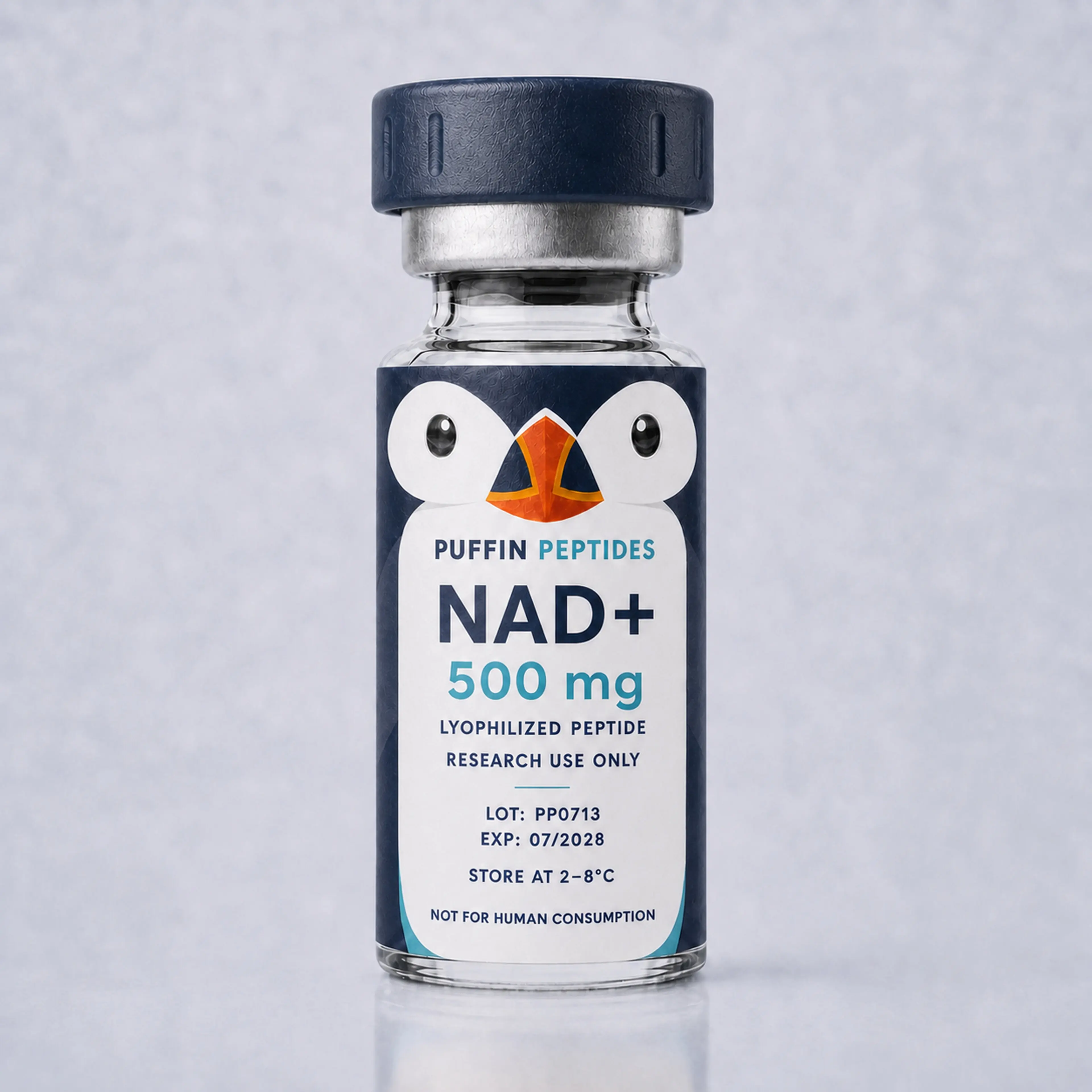
Explore NAD+
Review available strengths, pricing, stock status, and product documentation.