
At a glance
- Selank is a synthetic heptapeptide derived from the immune peptide tuftsin. It is studied in neuroimmune, stress-response, neurotransmitter, and behavioural models, with most published work coming from a limited number of regional research groups.
- Selank is not an FDA- or Health Canada-approved medicine. Small or region-specific human reports and animal findings do not establish broad anti-anxiety, cognitive, or stress benefits for an independently sourced research vial.
- Choose a specific neuroimmune, gene-expression, neurotransmitter, or behavioural endpoint rather than a broad “calming” outcome.
- Use blinded behavioural scoring and independent biochemical readouts when testing stress-response models.
What SELANK is—and what the name does not establish
Selank is a synthetic heptapeptide derived from the immune peptide tuftsin. It is studied in neuroimmune, stress-response, neurotransmitter, and behavioural models, with most published work coming from a limited number of regional research groups.
There is no single universally accepted receptor mechanism. Studies report changes in gene expression, cytokine balance, monoamine systems, and neurotrophic signalling. In plain language, Selank is an exploratory regulatory peptide—not a well-settled one-target drug.
Questions to settle before interpreting a result
A useful SELANK study begins with material identity, a defined model, a relevant comparator, and an endpoint chosen before the result is known. Broad catalogue language cannot replace those controls.
- Choose a specific neuroimmune, gene-expression, neurotransmitter, or behavioural endpoint rather than a broad “calming” outcome.
- Use blinded behavioural scoring and independent biochemical readouts when testing stress-response models.
- Separate evidence for tuftsin from evidence for Selank; the analogue was derived from tuftsin but is not the same peptide.
How to read the SELANK evidence
These evidence snapshots summarize the most important distinctions in the published record. They do not combine unlike models or turn an experimental signal into a human-use claim.
Evidence level · early
- Design
- Interesting signals, limited independent replication
- Finding
- Preclinical studies report neurochemical and gene-expression effects, while human literature is smaller and regionally concentrated. Larger independent controlled trials are needed before broad conclusions are justified.
- Read with care
- This is an interpretation boundary, not a claim that a specific outcome has been established in people.
Mechanism status
- Design
- Multiple pathways have been proposed
- Finding
- Cytokine, monoamine, GABA-related, and neurotrophic explanations appear in the literature. A page should present them as research hypotheses, not one proven mechanism.
- Read with care
- This is an interpretation boundary, not a claim that a specific outcome has been established in people.
What not to assume
- Design
- A behavioural result is not a clinical anxiety claim
- Finding
- Animal-maze performance or stress markers can support mechanistic work. They do not establish treatment effectiveness or appropriate use in people.
- Read with care
- This is an interpretation boundary, not a claim that a specific outcome has been established in people.
What the evidence does not establish
Selank is not an FDA- or Health Canada-approved medicine. Small or region-specific human reports and animal findings do not establish broad anti-anxiety, cognitive, or stress benefits for an independently sourced research vial.
Mechanism, cell, animal, observational, and controlled human evidence answer different questions. A positive result at one level cannot be silently promoted to another, and evidence for a sponsor’s defined product does not establish equivalence for an independently sourced research material.
Keep the publication and the vial separate
A published paper identifies its own sequence or chemical identity, formulation, manufacturing context, analytical controls, exposure, and test system. Matching a familiar name on a label is not enough to show that a catalogue vial is the same study material.
For practical research planning, verify the lot-specific identity and documentation, then write the model, comparator, endpoint, and stopping criteria before testing. This guide does not provide preparation, dosing, injection, or human-use instructions.
Sources
Links lead to the paper, official registry, regulator page, or product label used for this guide. Registry records describe protocols and status; they are not treated as positive results.
- The molecular aspects of heptapeptide Selank biological activityCurrent Protein & Peptide Science · 2018
Mechanistic review of a limited and regionally concentrated literature. It is included for context, not treated as independent clinical confirmation.
- Think twice before injecting peptides bought online: unauthorized products can seriously harm youHealth Canada · 2026
Official Canadian advisory explaining that a research-use label does not establish authorization, safety, efficacy, or product quality for human use.
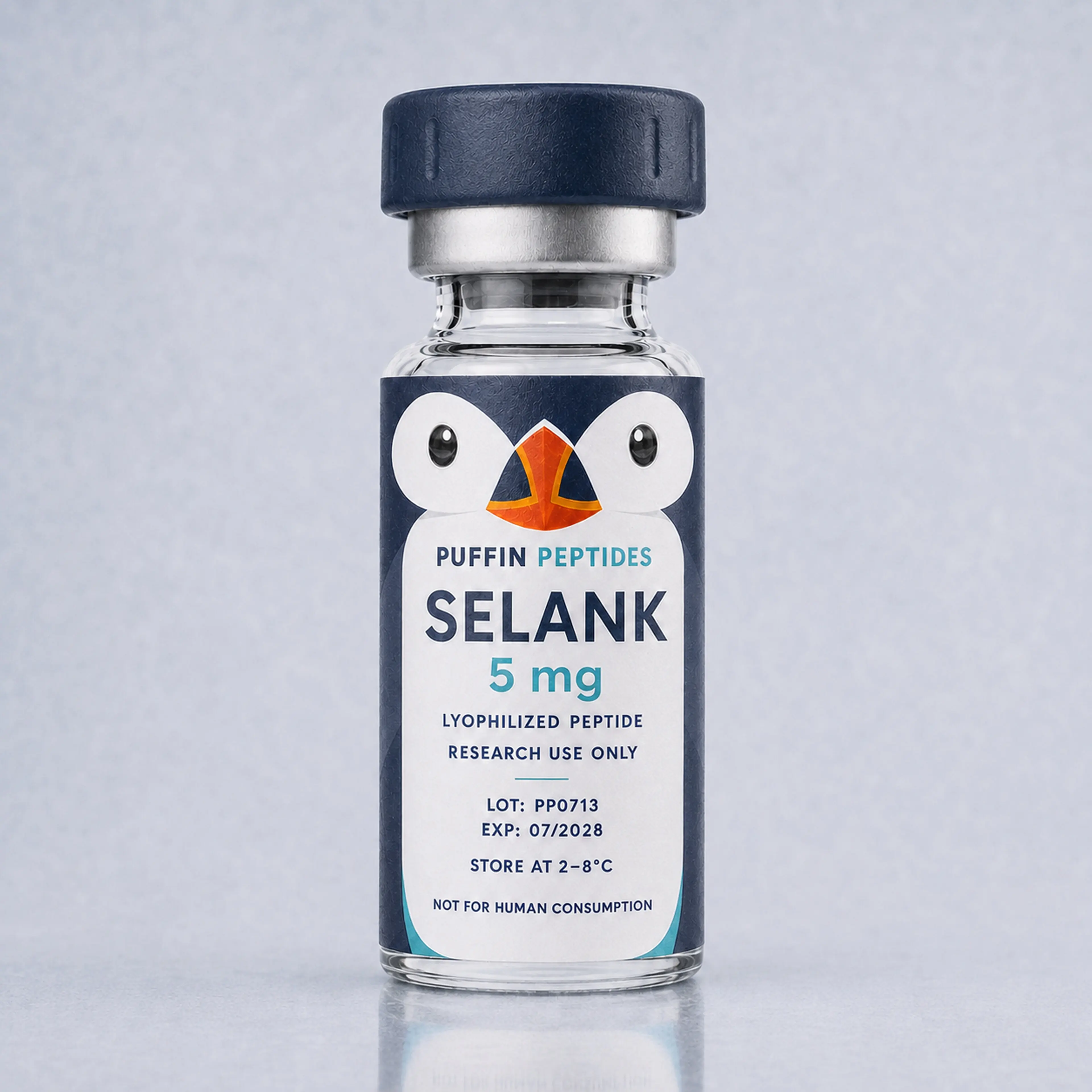
Explore SELANK
Review available strengths, pricing, stock status, and product documentation.