
At a glance
- TB-500 is commonly identified as an N-terminally acetylated fragment related to amino acids 17–23 of thymosin beta-4. It is studied around actin organization, cell migration, and tissue-response biology, but it is not full-length thymosin beta-4.
- TB-500 is not an approved human medicine. Much of the literature cited in marketing concerns full-length thymosin beta-4, different fragments, cells, or animals rather than TB-500 itself.
- Confirm the exact sequence and acetylation state before comparing a sample with published TB-500 characterization.
- Use cell-migration, actin-organization, or tissue-specific endpoints instead of a general recovery label.
What TB-500 is—and what the name does not establish
TB-500 is commonly identified as an N-terminally acetylated fragment related to amino acids 17–23 of thymosin beta-4. It is studied around actin organization, cell migration, and tissue-response biology, but it is not full-length thymosin beta-4.
Thymosin beta-4 binds actin and participates in cell movement and tissue-response processes. The short TB-500-related fragment is linked to a region of that biology, but a seven-amino-acid fragment cannot automatically be assumed to reproduce every function of the 43-amino-acid parent peptide.
Questions to settle before interpreting a result
A useful TB-500 study begins with material identity, a defined model, a relevant comparator, and an endpoint chosen before the result is known. Broad catalogue language cannot replace those controls.
- Confirm the exact sequence and acetylation state before comparing a sample with published TB-500 characterization.
- Use cell-migration, actin-organization, or tissue-specific endpoints instead of a general recovery label.
- Include full-length thymosin beta-4 only when the experiment is designed to test fragment-versus-parent differences.
How to read the TB-500 evidence
These evidence snapshots summarize the most important distinctions in the published record. They do not combine unlike models or turn an experimental signal into a human-use claim.
Product identity
- Design
- TB-500 was characterized as an acetylated thymosin fragment
- Finding
- Analytical work identified TB-500 as an N-terminally acetylated 17–23 fragment of thymosin beta-4. That identity distinction is essential when reading studies or interpreting a catalogue claim.
- Read with care
- Keep the finding attached to the linked study’s exact material, design, population, exposure, and endpoint.
Evidence boundary
- Design
- Parent-peptide findings do not automatically transfer
- Finding
- Full-length thymosin beta-4 has a wider research literature, including cell migration and repair models. A shorter fragment may retain, lose, or change activity and needs direct testing.
- Read with care
- This is an interpretation boundary, not a claim that a specific outcome has been established in people.
What not to claim
- Design
- Preclinical signals are not proof of human recovery
- Finding
- Tissue-response or migration findings in laboratory models do not establish faster injury healing, less pain, or safe use in people.
- Read with care
- This is an interpretation boundary, not a claim that a specific outcome has been established in people.
What the evidence does not establish
TB-500 is not an approved human medicine. Much of the literature cited in marketing concerns full-length thymosin beta-4, different fragments, cells, or animals rather than TB-500 itself.
Mechanism, cell, animal, observational, and controlled human evidence answer different questions. A positive result at one level cannot be silently promoted to another, and evidence for a sponsor’s defined product does not establish equivalence for an independently sourced research material.
Keep the publication and the vial separate
A published paper identifies its own sequence or chemical identity, formulation, manufacturing context, analytical controls, exposure, and test system. Matching a familiar name on a label is not enough to show that a catalogue vial is the same study material.
For practical research planning, verify the lot-specific identity and documentation, then write the model, comparator, endpoint, and stopping criteria before testing. This guide does not provide preparation, dosing, injection, or human-use instructions.
Sources
Links lead to the paper, official registry, regulator page, or product label used for this guide. Registry records describe protocols and status; they are not treated as positive results.
- Analytical characterization of TB-500 as a thymosin beta-4-related fragmentPeer-reviewed publication · 2013
Analytical work identified TB-500 as an N-terminally acetylated 17–23 fragment of thymosin beta-4. That identity distinction is essential when reading studies or interpreting a catalogue claim. The result remains tied to the exact study material, design, population, and endpoint.
- Think twice before injecting peptides bought online: unauthorized products can seriously harm youHealth Canada · 2026
Official Canadian advisory explaining that a research-use label does not establish authorization, safety, efficacy, or product quality for human use.
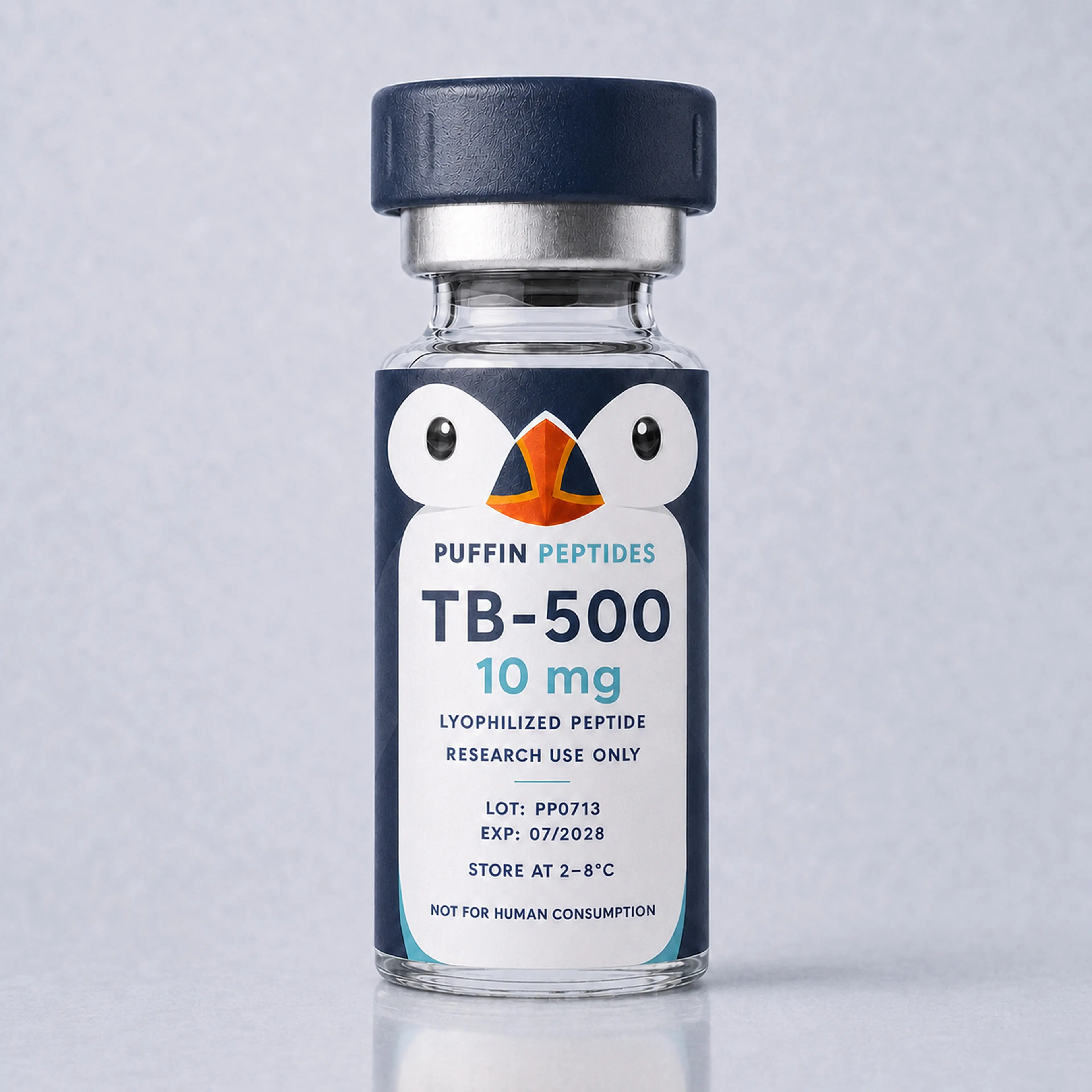
Explore TB-500
Review available strengths, pricing, stock status, and product documentation.