
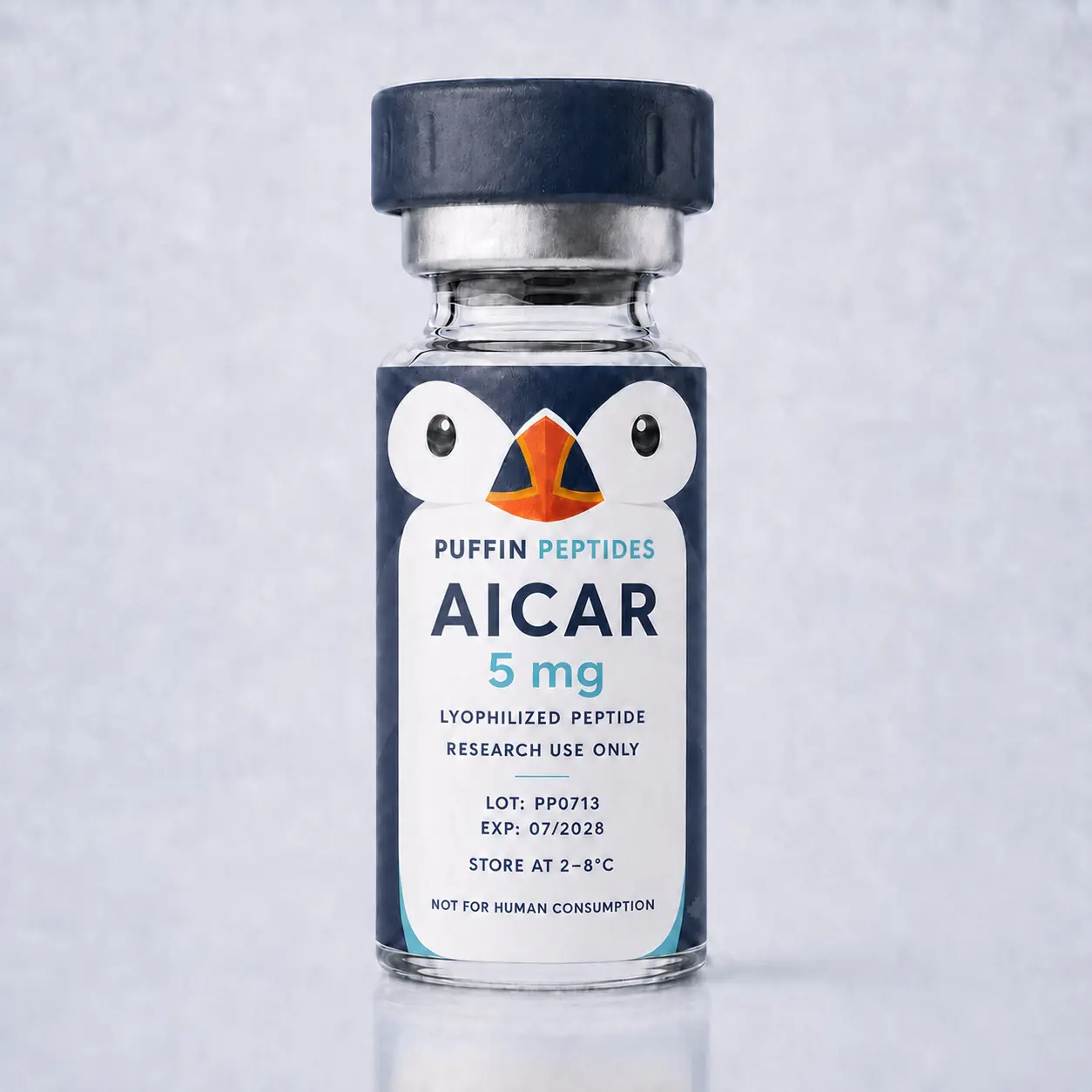
 Catalogue preview · final packaging and presentation may vary if stocked
Five choices across your ballotUse votes only for compounds you would consider ordering
One vote per compoundEach candidate can be selected once on this browser
Flexible interest signalRemove or reassign a vote whenever you like
AICAR
AICAR, also called acadesine, is an adenosine analogue—not a peptide. Inside cells it is converted to ZMP, which resembles AMP and can influence AMP-sensitive enzymes including AMPK.
Loading your saved choices…
AICAR is currently being evaluated through customer voting and is not available to order. Final product specifications and batch documentation will be published only if it joins the catalogue.
This page records catalogue interest only. If AICAR is selected for supply, Puffin will publish the confirmed format, batch documentation, and laboratory preparation information on the product listing.
Storage and handling requirements depend on the final supplied format. Confirmed instructions will be provided with the batch details if this candidate is added to the catalogue.
Understanding Aicar
Explore the science, research focus, and key information behind this compound.
What is Aicar?+
AICAR is a familiar experimental reference for following AMPK-related energy-sensing pathways.
What Researchers Study+
Researchers examine AMPK activation, Cellular energy sensing, and Metabolic-response models.
How Aicar Works+
ZMP can make parts of the cell respond as though energy is limited, but AICAR is not a perfectly selective AMPK switch. In plain language, it perturbs cellular energy sensing and nucleotide metabolism, so a response cannot automatically be assigned to AMPK alone.
Research at a Glance+
An endurance-like transcriptional programme was reported. A 2008 mouse study found that AICAR increased endurance and activated an oxidative gene programme. The work popularized the term “exercise mimetic,” but it did not test an approved human exercise substitute. Read the primary Cell study. AICAR is broader than AMPK alone. The intracellular nucleotide analogue can affect other AMP-sensitive processes and nucleotide pools. Genetic or pharmacological controls are needed before attributing a result solely to AMPK. This is a nucleoside analogue. Its chemistry, analytical methods, and handling differ from peptide materials even when it appears in the same retail collection.
If this candidate is added to the catalogue, it would be offered for controlled laboratory research only. It is not for human consumption and is not represented as a medicine, treatment, supplement, or substitute for an approved product.