
At a glance
- AICAR, also called acadesine, is an adenosine analogue—not a peptide. Inside cells it is converted to ZMP, which resembles AMP and can influence AMP-sensitive enzymes including AMPK.
- AICAR has been studied in humans for cardiovascular and metabolic questions but is not approved as an exercise mimetic, weight-loss product, or performance drug. Mouse endurance findings are not evidence of a comparable human benefit.
- Measure ZMP formation and AMPK target phosphorylation rather than assuming cellular uptake produces pathway activation.
- Use AMPK-deficient or pathway-inhibited controls when the experiment needs to separate AMPK-dependent from off-target effects.
What AICAR is—and what the name does not establish
AICAR, also called acadesine, is an adenosine analogue—not a peptide. Inside cells it is converted to ZMP, which resembles AMP and can influence AMP-sensitive enzymes including AMPK.
ZMP can make parts of the cell respond as though energy is limited, but AICAR is not a perfectly selective AMPK switch. In plain language, it perturbs cellular energy sensing and nucleotide metabolism, so a response cannot automatically be assigned to AMPK alone.
Questions to settle before interpreting a result
A useful AICAR study begins with material identity, a defined model, a relevant comparator, and an endpoint chosen before the result is known. Broad catalogue language cannot replace those controls.
- Measure ZMP formation and AMPK target phosphorylation rather than assuming cellular uptake produces pathway activation.
- Use AMPK-deficient or pathway-inhibited controls when the experiment needs to separate AMPK-dependent from off-target effects.
- Keep exercise-gene-expression findings in mice separate from human endurance, body-composition, or treatment claims.
How to read the AICAR evidence
These evidence snapshots summarize the most important distinctions in the published record. They do not combine unlike models or turn an experimental signal into a human-use claim.
Mouse study
- Design
- An endurance-like transcriptional programme was reported
- Finding
- A 2008 mouse study found that AICAR increased endurance and activated an oxidative gene programme. The work popularized the term “exercise mimetic,” but it did not test an approved human exercise substitute.
- Read with care
- Keep the finding attached to the linked study’s exact material, design, population, exposure, and endpoint.
Mechanism caution
- Design
- AICAR is broader than AMPK alone
- Finding
- The intracellular nucleotide analogue can affect other AMP-sensitive processes and nucleotide pools. Genetic or pharmacological controls are needed before attributing a result solely to AMPK.
- Read with care
- This is an interpretation boundary, not a claim that a specific outcome has been established in people.
Catalogue correction
- Design
- This is a nucleoside analogue
- Finding
- Its chemistry, analytical methods, and handling differ from peptide materials even when it appears in the same retail collection.
- Read with care
- This is an interpretation boundary, not a claim that a specific outcome has been established in people.
What the evidence does not establish
AICAR has been studied in humans for cardiovascular and metabolic questions but is not approved as an exercise mimetic, weight-loss product, or performance drug. Mouse endurance findings are not evidence of a comparable human benefit.
Mechanism, cell, animal, observational, and controlled human evidence answer different questions. A positive result at one level cannot be silently promoted to another, and evidence for a sponsor’s defined product does not establish equivalence for an independently sourced research material.
Keep the publication and the vial separate
A published paper identifies its own sequence or chemical identity, formulation, manufacturing context, analytical controls, exposure, and test system. Matching a familiar name on a label is not enough to show that a catalogue vial is the same study material.
For practical research planning, verify the lot-specific identity and documentation, then write the model, comparator, endpoint, and stopping criteria before testing. This guide does not provide preparation, dosing, injection, or human-use instructions.
Sources
Links lead to the paper, official registry, regulator page, or product label used for this guide. Registry records describe protocols and status; they are not treated as positive results.
- the primary Cell studyPeer-reviewed publication · Linked record
A 2008 mouse study found that AICAR increased endurance and activated an oxidative gene programme. The work popularized the term “exercise mimetic,” but it did not test an approved human exercise substitute. The result remains tied to the exact study material, design, population, and endpoint.
- Think twice before injecting peptides bought online: unauthorized products can seriously harm youHealth Canada · 2026
Official Canadian advisory explaining that a research-use label does not establish authorization, safety, efficacy, or product quality for human use.
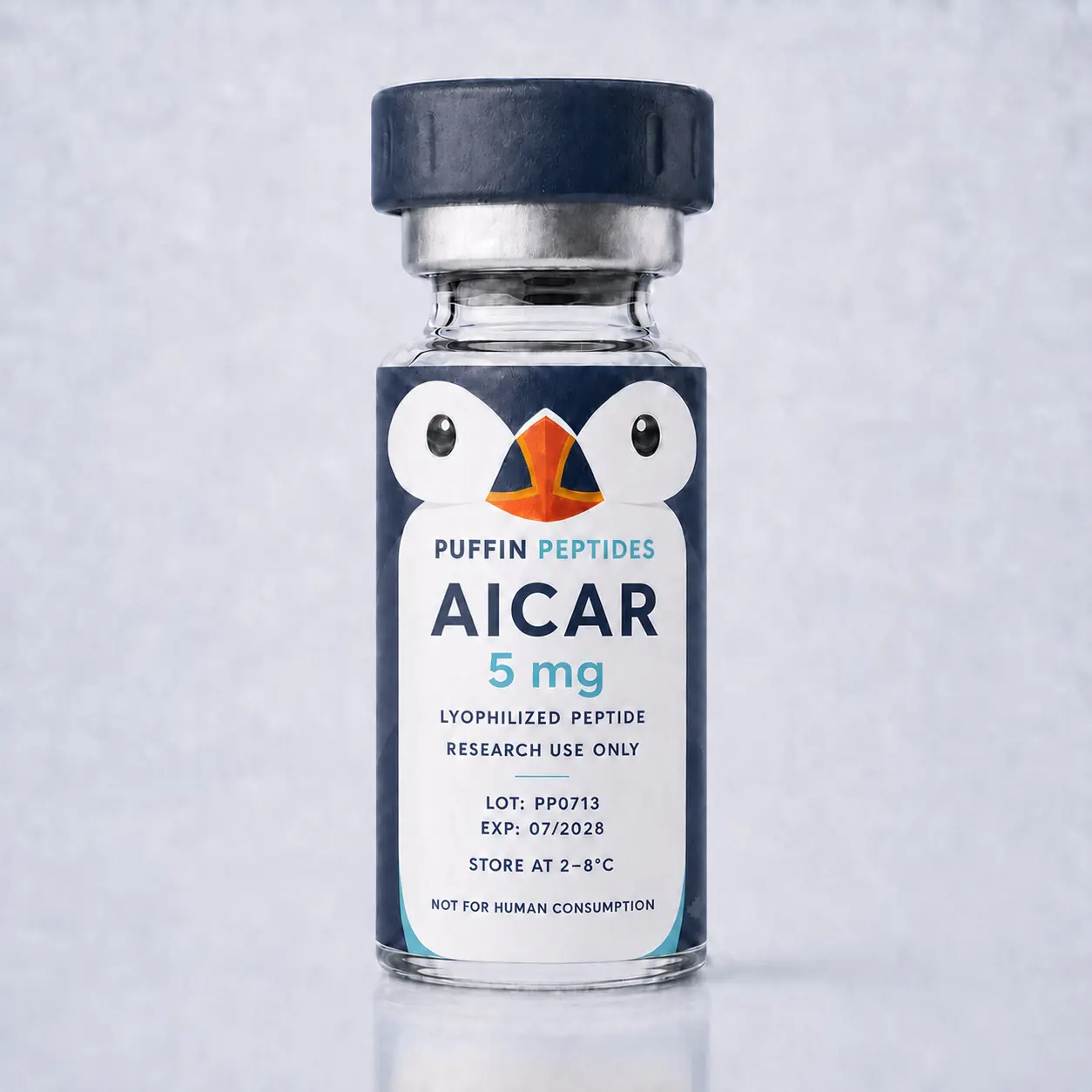
Vote for AICAR
This compound is not currently stocked. Add it to your five-choice catalogue ballot.