
At a glance
- 5-Amino-1MQ is a small-molecule inhibitor used to study nicotinamide N-methyltransferase, or NNMT. It is not a peptide, and its primary research target is an enzyme involved in nicotinamide and methyl-donor metabolism.
- 5-Amino-1MQ is not an approved medicine and has no established human clinical evidence for weight loss, body composition, or metabolic disease. Frequently quoted effects come from cellular and mouse research.
- Confirm NNMT inhibition with enzyme or metabolite readouts before interpreting downstream adipocyte or metabolic changes.
- Measure nicotinamide, 1-methylnicotinamide, SAM/SAH, and energy endpoints where possible to map the pathway.
What 5-AMINO-1MQ is—and what the name does not establish
5-Amino-1MQ is a small-molecule inhibitor used to study nicotinamide N-methyltransferase, or NNMT. It is not a peptide, and its primary research target is an enzyme involved in nicotinamide and methyl-donor metabolism.
NNMT converts nicotinamide to 1-methylnicotinamide while consuming a methyl donor. Inhibiting it can change nicotinamide, methylation, and energy-related pathways in cells and animals. In plain language, the compound changes a metabolic branch point rather than acting as an appetite hormone.
Questions to settle before interpreting a result
A useful 5-AMINO-1MQ study begins with material identity, a defined model, a relevant comparator, and an endpoint chosen before the result is known. Broad catalogue language cannot replace those controls.
- Confirm NNMT inhibition with enzyme or metabolite readouts before interpreting downstream adipocyte or metabolic changes.
- Measure nicotinamide, 1-methylnicotinamide, SAM/SAH, and energy endpoints where possible to map the pathway.
- Use NNMT-deficient or orthogonal inhibitor controls to separate target-dependent effects from compound-specific toxicity.
How to read the 5-AMINO-1MQ evidence
These evidence snapshots summarize the most important distinctions in the published record. They do not combine unlike models or turn an experimental signal into a human-use claim.
Preclinical evidence
- Design
- Mouse and adipocyte studies reported metabolic effects
- Finding
- Early studies of NNMT inhibitors reported changes in adiposity and metabolic measures in diet-related mouse models. Those results establish a target hypothesis, not a human weight-loss product.
- Read with care
- This is an interpretation boundary, not a claim that a specific outcome has been established in people.
Mechanism caution
- Design
- NNMT sits inside a connected metabolic network
- Finding
- Changes in nicotinamide handling, methyl donors, NAD-related metabolism, and gene regulation can overlap. A single body-weight endpoint cannot show which route caused the effect.
- Read with care
- This is an interpretation boundary, not a claim that a specific outcome has been established in people.
Catalogue correction
- Design
- This is a small heterocyclic molecule
- Finding
- It requires small-molecule analytical methods and should not be described as a peptide simply because it appears in the same catalogue.
- Read with care
- This is an interpretation boundary, not a claim that a specific outcome has been established in people.
What the evidence does not establish
5-Amino-1MQ is not an approved medicine and has no established human clinical evidence for weight loss, body composition, or metabolic disease. Frequently quoted effects come from cellular and mouse research.
Mechanism, cell, animal, observational, and controlled human evidence answer different questions. A positive result at one level cannot be silently promoted to another, and evidence for a sponsor’s defined product does not establish equivalence for an independently sourced research material.
Keep the publication and the vial separate
A published paper identifies its own sequence or chemical identity, formulation, manufacturing context, analytical controls, exposure, and test system. Matching a familiar name on a label is not enough to show that a catalogue vial is the same study material.
For practical research planning, verify the lot-specific identity and documentation, then write the model, comparator, endpoint, and stopping criteria before testing. This guide does not provide preparation, dosing, injection, or human-use instructions.
Sources
Links lead to the paper, official registry, regulator page, or product label used for this guide. Registry records describe protocols and status; they are not treated as positive results.
- Selective and membrane-permeable small molecule inhibitors of nicotinamide N-methyltransferase reverse high-fat diet-induced obesity in miceBiochemical Pharmacology · 2018
Primary mouse and cellular work. No human weight-loss conclusion can be drawn from this design.
- Think twice before injecting peptides bought online: unauthorized products can seriously harm youHealth Canada · 2026
Official Canadian advisory explaining that a research-use label does not establish authorization, safety, efficacy, or product quality for human use.
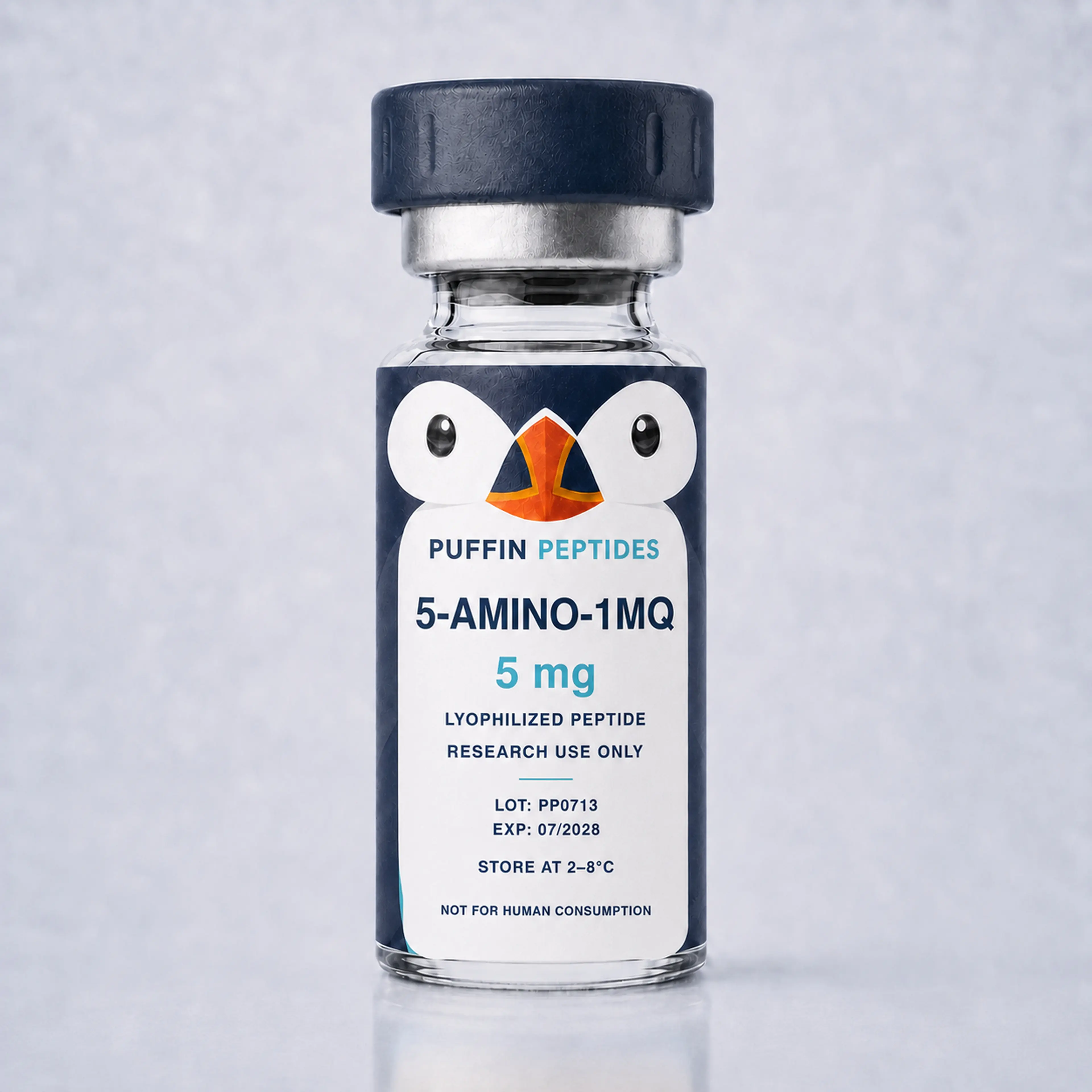
Explore 5-AMINO-1MQ
Review available strengths, pricing, stock status, and product documentation.