
At a glance
- Adipotide is an experimental peptidomimetic designed to target prohibitin-associated blood vessels in white adipose tissue and deliver a pro-apoptotic sequence. Its research strategy targets the tissue’s blood supply rather than an appetite receptor.
- Adipotide is not an approved medicine and has no established human clinical use. Reported metabolic and weight effects come from mouse and non-human-primate studies, alongside important kidney-safety concerns in the preclinical literature.
- Verify target-marker expression and include non-target vascular-cell controls before interpreting selectivity.
- Measure vascular, adipose, renal, and systemic endpoints separately because a tissue-targeting design can have off-target consequences.
What ADIPOTIDE is—and what the name does not establish
Adipotide is an experimental peptidomimetic designed to target prohibitin-associated blood vessels in white adipose tissue and deliver a pro-apoptotic sequence. Its research strategy targets the tissue’s blood supply rather than an appetite receptor.
One region binds a vascular marker reported on white-fat blood vessels; another disrupts mitochondria and triggers cell death. In plain language, the design tries to steer a destructive payload toward selected vasculature—a fundamentally different approach from incretin or amylin agonists.
Questions to settle before interpreting a result
A useful ADIPOTIDE study begins with material identity, a defined model, a relevant comparator, and an endpoint chosen before the result is known. Broad catalogue language cannot replace those controls.
- Verify target-marker expression and include non-target vascular-cell controls before interpreting selectivity.
- Measure vascular, adipose, renal, and systemic endpoints separately because a tissue-targeting design can have off-target consequences.
- Compare its vascular-ablation strategy with metabolic receptor agonists only when the study explicitly addresses mechanism, not just body-weight change.
How to read the ADIPOTIDE evidence
These evidence snapshots summarize the most important distinctions in the published record. They do not combine unlike models or turn an experimental signal into a human-use claim.
Non-human primate study
- Design
- Weight and insulin-resistance changes were reported in obese monkeys
- Finding
- A 2011 study reported reductions in body weight and improved insulin sensitivity in obese rhesus monkeys after a prohibitin-targeting peptidomimetic. It was preclinical work and included reversible renal effects.
- Read with care
- Keep the finding attached to the linked study’s exact material, design, population, exposure, and endpoint.
Mechanism distinction
- Design
- This is not an appetite-pathway peptide
- Finding
- Adipotide was designed around vascular targeting and apoptosis. Comparing it with GLP-1 agonists requires care because the proposed biological route and safety questions are entirely different.
- Read with care
- This is an interpretation boundary, not a claim that a specific outcome has been established in people.
Evidence boundary
- Design
- Primate data are still not human evidence
- Finding
- A signal in rhesus monkeys can justify more research, but it does not establish safe exposure, appropriate dose, or clinical effectiveness in people.
- Read with care
- This is an interpretation boundary, not a claim that a specific outcome has been established in people.
What the evidence does not establish
Adipotide is not an approved medicine and has no established human clinical use. Reported metabolic and weight effects come from mouse and non-human-primate studies, alongside important kidney-safety concerns in the preclinical literature.
Mechanism, cell, animal, observational, and controlled human evidence answer different questions. A positive result at one level cannot be silently promoted to another, and evidence for a sponsor’s defined product does not establish equivalence for an independently sourced research material.
Keep the publication and the vial separate
A published paper identifies its own sequence or chemical identity, formulation, manufacturing context, analytical controls, exposure, and test system. Matching a familiar name on a label is not enough to show that a catalogue vial is the same study material.
For practical research planning, verify the lot-specific identity and documentation, then write the model, comparator, endpoint, and stopping criteria before testing. This guide does not provide preparation, dosing, injection, or human-use instructions.
Sources
Links lead to the paper, official registry, regulator page, or product label used for this guide. Registry records describe protocols and status; they are not treated as positive results.
- the primary primate studyPeer-reviewed publication · Linked record
A 2011 study reported reductions in body weight and improved insulin sensitivity in obese rhesus monkeys after a prohibitin-targeting peptidomimetic. It was preclinical work and included reversible renal effects. The result remains tied to the exact study material, design, population, and endpoint.
- Think twice before injecting peptides bought online: unauthorized products can seriously harm youHealth Canada · 2026
Official Canadian advisory explaining that a research-use label does not establish authorization, safety, efficacy, or product quality for human use.
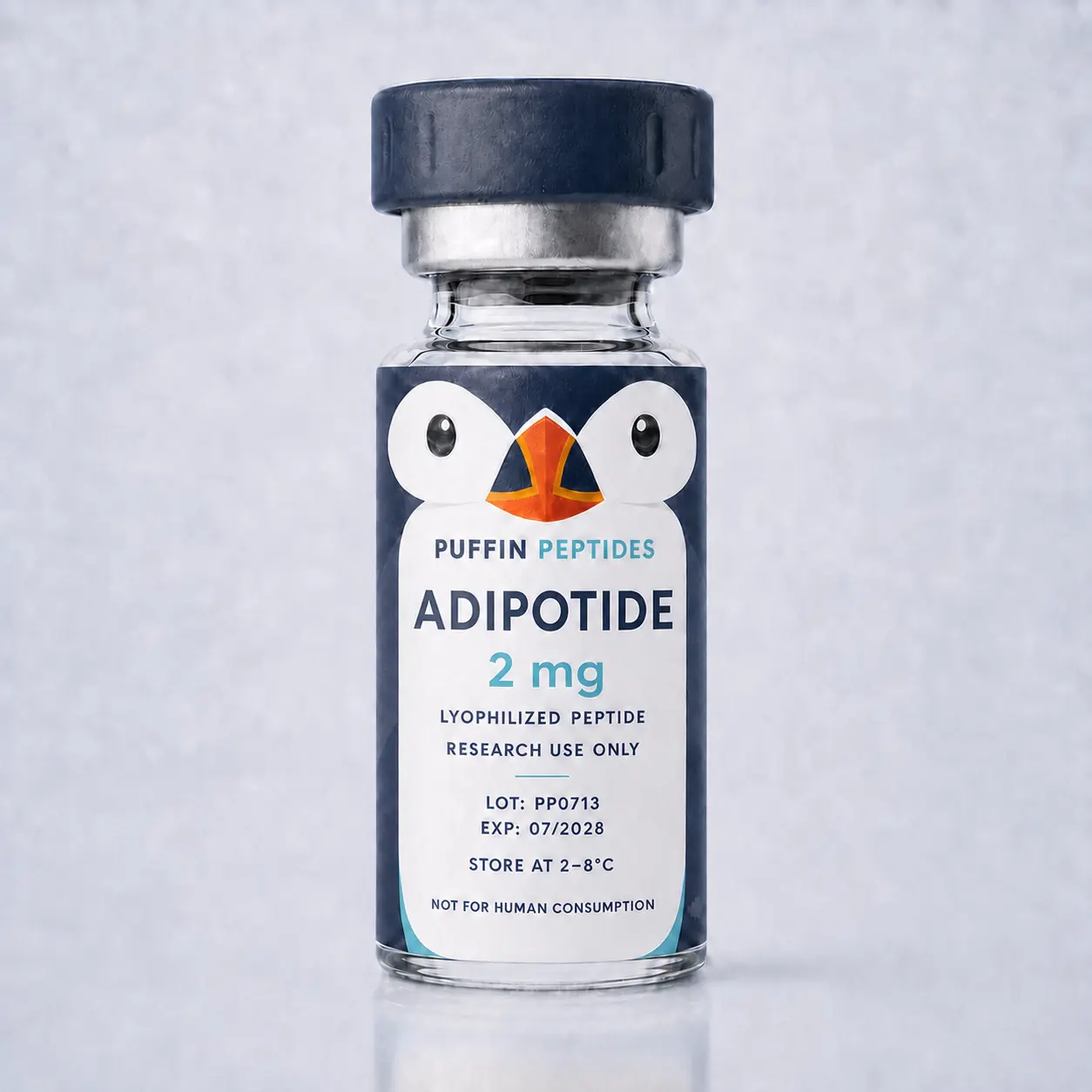
Vote for ADIPOTIDE
This compound is not currently stocked. Add it to your five-choice catalogue ballot.