
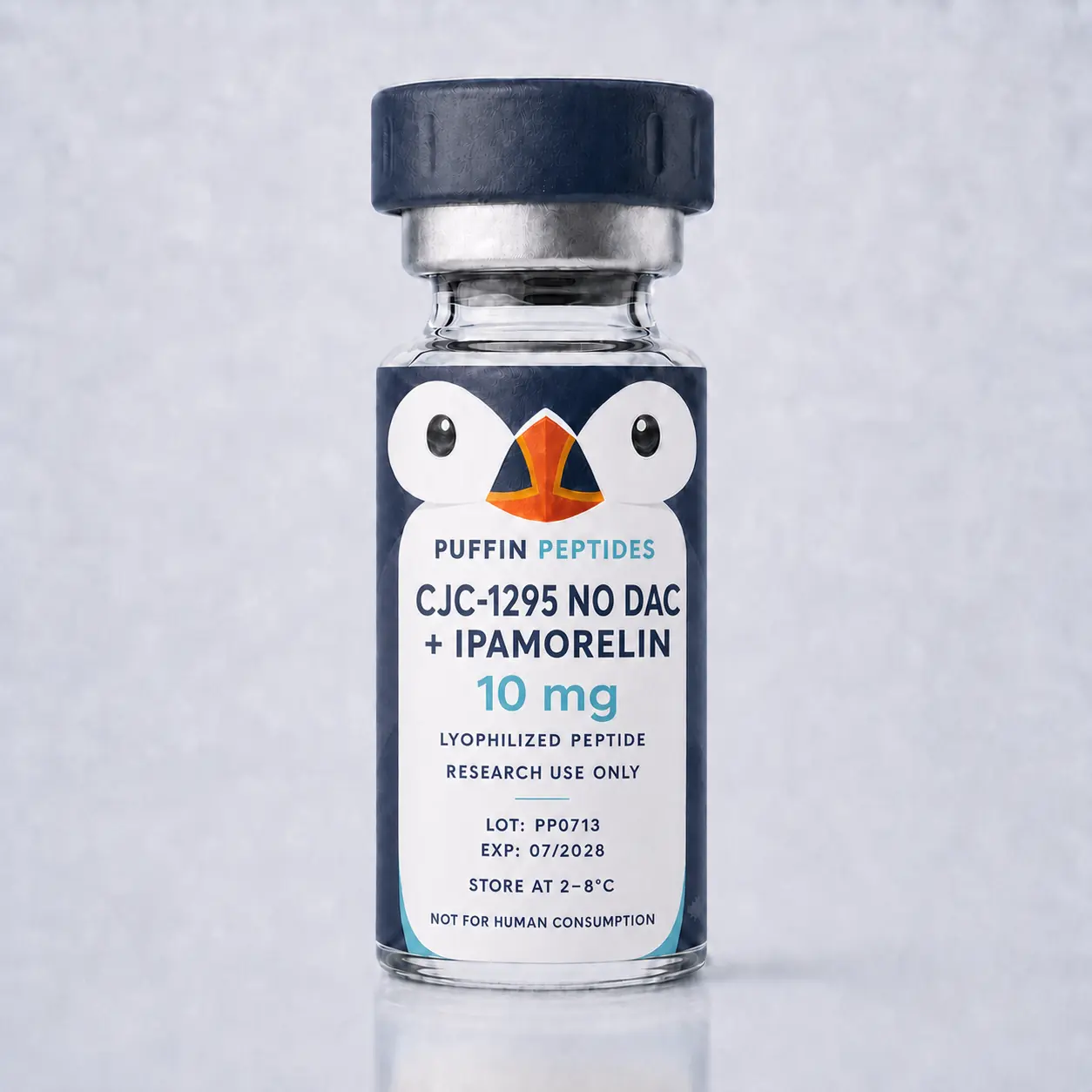
 Catalogue preview · final packaging and presentation may vary if stocked
Five choices across your ballotUse votes only for compounds you would consider ordering
One vote per compoundEach candidate can be selected once on this browser
Flexible interest signalRemove or reassign a vote whenever you like
CJC-1295 NO DAC + IPAMORELIN
This blend pairs two upstream routes into growth-hormone release. CJC-1295 without DAC is a short-acting GHRH analogue; ipamorelin is a ghrelin-receptor agonist. The combination is studied because both can reach pituitary GH release through different receptors.
Loading your saved choices…
CJC-1295 NO DAC + IPAMORELIN is currently being evaluated through customer voting and is not available to order. Final product specifications and batch documentation will be published only if it joins the catalogue.
This page records catalogue interest only. If CJC-1295 NO DAC + IPAMORELIN is selected for supply, Puffin will publish the confirmed format, batch documentation, and laboratory preparation information on the product listing.
Storage and handling requirements depend on the final supplied format. Confirmed instructions will be provided with the batch details if this candidate is added to the catalogue.
Understanding CJC-1295 NO DAC + Ipamorelin
Explore the science, research focus, and key information behind this compound.
What is CJC-1295 NO DAC + Ipamorelin?+
The blend is selected when researchers want to examine complementary GHRH- and ghrelin-receptor activity together.
What Researchers Study+
Researchers examine GHRH and ghrelin pathways, Pituitary co-signalling, and Combined release-response models.
How CJC-1295 NO DAC + Ipamorelin Works+
The GHRH receptor and the ghrelin receptor send complementary signals to pituitary somatotroph cells. In plain language, one component resembles the body’s GHRH signal while the other uses the ghrelin-receptor route; a combination study asks whether the timing or magnitude differs when both are present.
Research at a Glance+
Two receptors can converge on the same pituitary output. GHRH analogues and ghrelin-receptor agonists have both produced GH-release signals in experimental and early human work. That makes a controlled combination question plausible, but does not prove the blend is superior. The single components are essential controls. Without each component alone, a larger signal from the blend could reflect dose, timing, assay variation, or one dominant ingredient rather than true pathway synergy. No-DAC and DAC versions are not interchangeable. The no-DAC peptide is a short-acting modified GRF design. Albumin-binding CJC-1295 with DAC has a different structure and exposure profile, even when both are casually called CJC-1295.
If this candidate is added to the catalogue, it would be offered for controlled laboratory research only. It is not for human consumption and is not represented as a medicine, treatment, supplement, or substitute for an approved product.