
At a glance
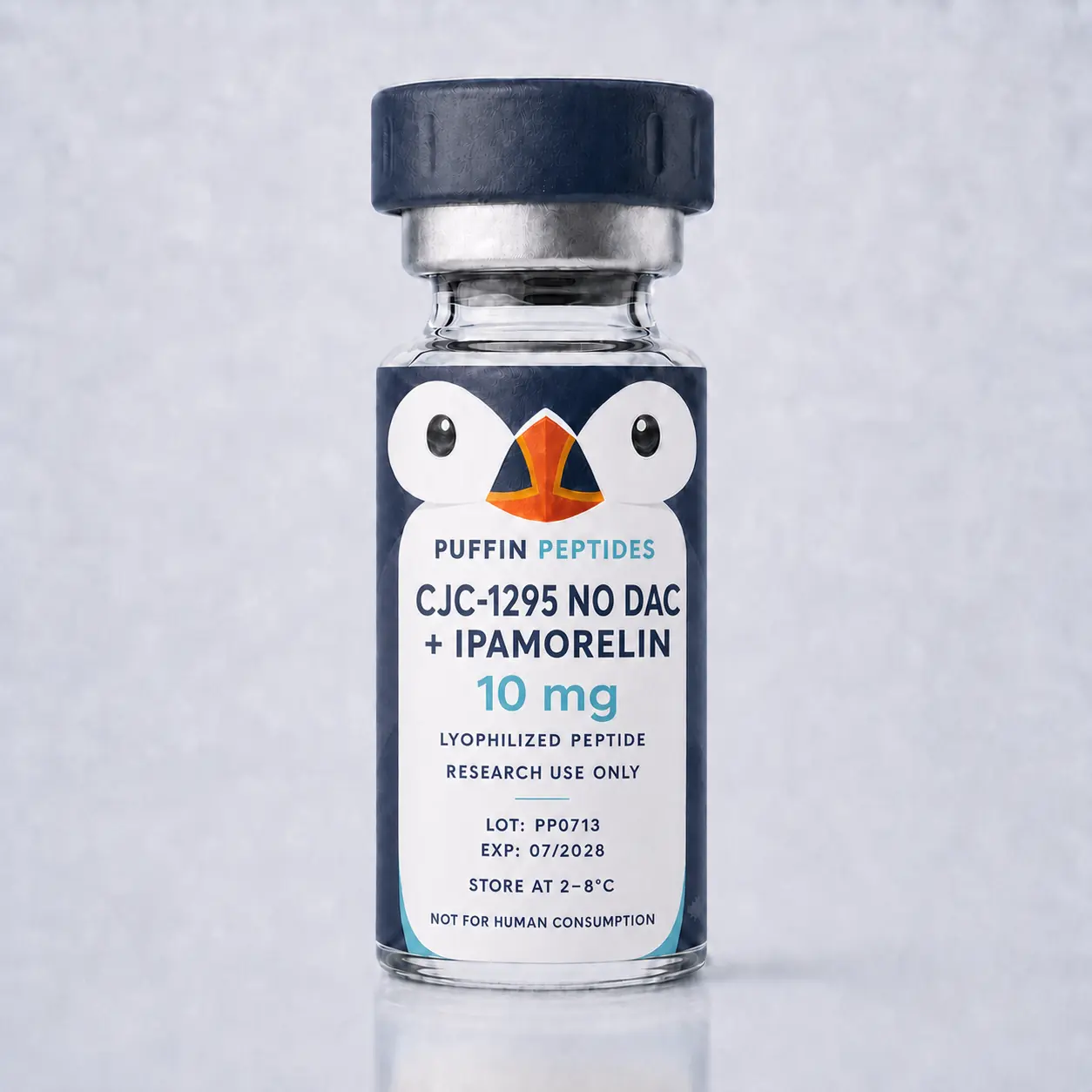
- This blend pairs two upstream routes into growth-hormone release. CJC-1295 without DAC is a short-acting GHRH analogue; ipamorelin is a ghrelin-receptor agonist. The combination is studied because both can reach pituitary GH release through different receptors.
- The fixed blend is not an approved combination medicine. Evidence for either component alone does not establish safety, efficacy, or an anti-aging or performance benefit for the mixture.
- Include CJC-1295 no DAC alone, ipamorelin alone, the blend, and vehicle to separate additive from interactive effects.
- Use time-resolved GH measurements because a release pulse can be missed or misread by a single end point.
What CJC-1295 NO DAC + IPAMORELIN is—and what the name does not establish
This blend pairs two upstream routes into growth-hormone release. CJC-1295 without DAC is a short-acting GHRH analogue; ipamorelin is a ghrelin-receptor agonist. The combination is studied because both can reach pituitary GH release through different receptors.
The GHRH receptor and the ghrelin receptor send complementary signals to pituitary somatotroph cells. In plain language, one component resembles the body’s GHRH signal while the other uses the ghrelin-receptor route; a combination study asks whether the timing or magnitude differs when both are present.
Questions to settle before interpreting a result
A useful CJC-1295 NO DAC + IPAMORELIN study begins with material identity, a defined model, a relevant comparator, and an endpoint chosen before the result is known. Broad catalogue language cannot replace those controls.
- Include CJC-1295 no DAC alone, ipamorelin alone, the blend, and vehicle to separate additive from interactive effects.
- Use time-resolved GH measurements because a release pulse can be missed or misread by a single end point.
- Track downstream IGF signalling separately from immediate pituitary release so the two levels are not treated as the same response.
How to read the CJC-1295 NO DAC + IPAMORELIN evidence
These evidence snapshots summarize the most important distinctions in the published record. They do not combine unlike models or turn an experimental signal into a human-use claim.
Mechanistic rationale
- Design
- Two receptors can converge on the same pituitary output
- Finding
- GHRH analogues and ghrelin-receptor agonists have both produced GH-release signals in experimental and early human work. That makes a controlled combination question plausible, but does not prove the blend is superior.
- Read with care
- This is an interpretation boundary, not a claim that a specific outcome has been established in people.
Best study design
- Design
- The single components are essential controls
- Finding
- Without each component alone, a larger signal from the blend could reflect dose, timing, assay variation, or one dominant ingredient rather than true pathway synergy.
- Read with care
- This is an interpretation boundary, not a claim that a specific outcome has been established in people.
Naming caution
- Design
- No-DAC and DAC versions are not interchangeable
- Finding
- The no-DAC peptide is a short-acting modified GRF design. Albumin-binding CJC-1295 with DAC has a different structure and exposure profile, even when both are casually called CJC-1295.
- Read with care
- This is an interpretation boundary, not a claim that a specific outcome has been established in people.
What the evidence does not establish
The fixed blend is not an approved combination medicine. Evidence for either component alone does not establish safety, efficacy, or an anti-aging or performance benefit for the mixture.
Mechanism, cell, animal, observational, and controlled human evidence answer different questions. A positive result at one level cannot be silently promoted to another, and evidence for a sponsor’s defined product does not establish equivalence for an independently sourced research material.
Keep the publication and the vial separate
A published paper identifies its own sequence or chemical identity, formulation, manufacturing context, analytical controls, exposure, and test system. Matching a familiar name on a label is not enough to show that a catalogue vial is the same study material.
For practical research planning, verify the lot-specific identity and documentation, then write the model, comparator, endpoint, and stopping criteria before testing. This guide does not provide preparation, dosing, injection, or human-use instructions.
Sources
Links lead to the paper, official registry, regulator page, or product label used for this guide. Registry records describe protocols and status; they are not treated as positive results.
- Human growth hormone-releasing factor (hGRF)1-29-albumin bioconjugates activate the GRF receptorJournal of Controlled Release · 2005
Component-level GHRH-analogue development paper. It did not test the no-DAC-plus-ipamorelin formulation.
- Ipamorelin, the first selective growth hormone secretagogueEuropean Journal of Endocrinology · 1998
Primary ipamorelin pharmacology. It does not establish synergy, compatibility, or a combined outcome for this blend.
- Think twice before injecting peptides bought online: unauthorized products can seriously harm youHealth Canada · 2026
Official Canadian advisory explaining that a research-use label does not establish authorization, safety, efficacy, or product quality for human use.
Vote for CJC-1295 NO DAC + IPAMORELIN
This compound is not currently stocked. Add it to your five-choice catalogue ballot.