
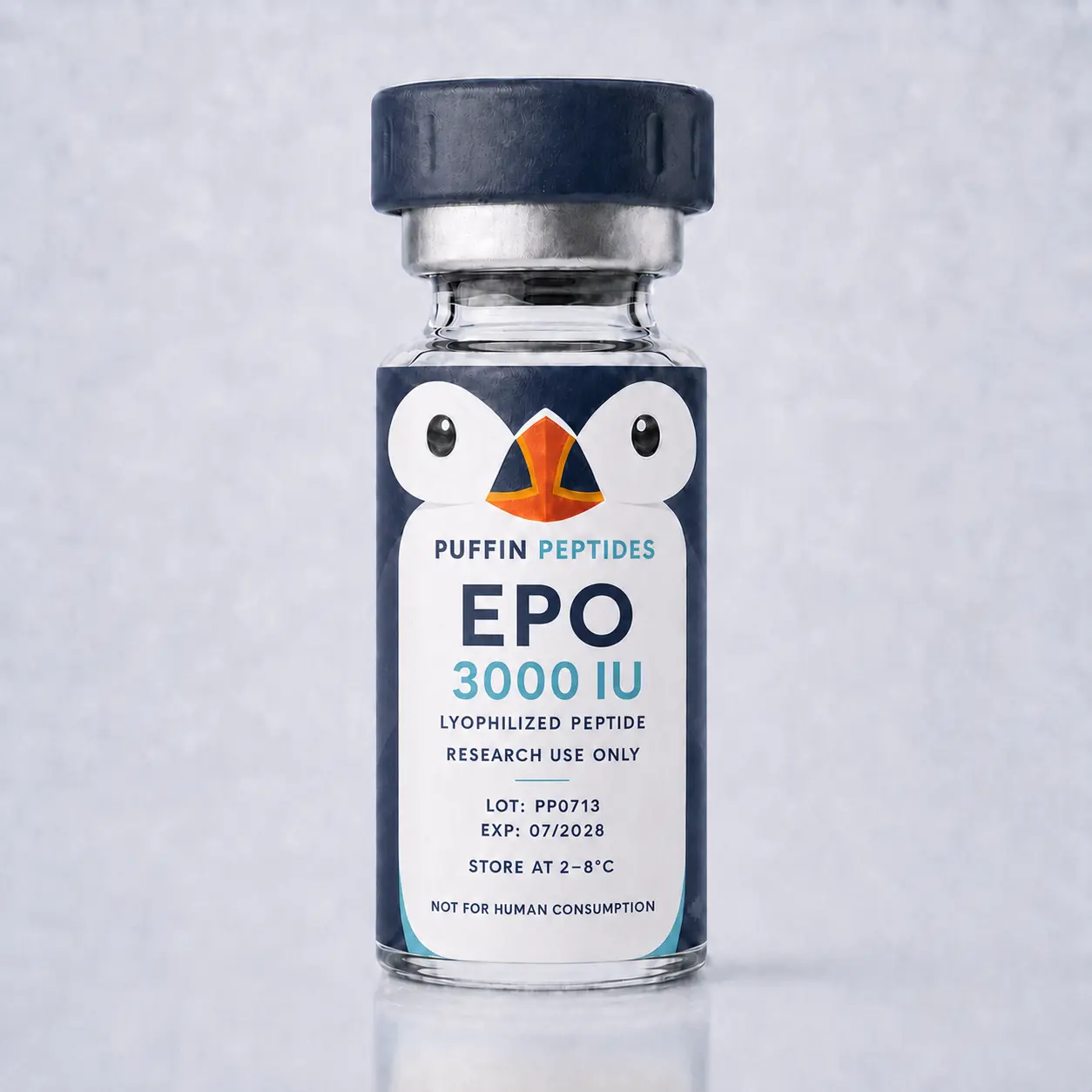
 Catalogue preview · final packaging and presentation may vary if stocked
Five choices across your ballotUse votes only for compounds you would consider ordering
One vote per compoundEach candidate can be selected once on this browser
Flexible interest signalRemove or reassign a vote whenever you like
EPO
EPO, or erythropoietin, is a glycoprotein hormone that controls red-blood-cell production through the erythropoietin receptor. It is a large, folded, glycosylated biologic—not a simple short peptide.
Loading your saved choices…
EPO is currently being evaluated through customer voting and is not available to order. Final product specifications and batch documentation will be published only if it joins the catalogue.
This page records catalogue interest only. If EPO is selected for supply, Puffin will publish the confirmed format, batch documentation, and laboratory preparation information on the product listing.
Storage and handling requirements depend on the final supplied format. Confirmed instructions will be provided with the batch details if this candidate is added to the catalogue.
Understanding EPO
Explore the science, research focus, and key information behind this compound.
What is EPO?+
EPO provides a well-characterized ligand for erythropoietin-receptor and hematopoietic signalling research.
What Researchers Study+
Researchers examine EPO-receptor activity, Hematopoietic signalling, and Cellular stress-response models.
How EPO Works+
EPO-receptor activation supports survival, proliferation, and maturation of erythroid precursor cells in bone marrow. In plain language, it signals the red-cell production system; glycosylation and protein folding strongly influence how a recombinant EPO material behaves.
Research at a Glance+
The erythropoiesis pathway is clinically validated. Regulated epoetin products have extensive clinical evidence in defined anaemia settings. That validates the biological target and those drug products—not a catalogue material with unverified comparability. Same amino-acid sequence can still behave differently. Glycosylation, aggregation, folding, host-cell process, and potency testing matter for EPO. Mass in a vial is not enough to establish biological or pharmaceutical equivalence. Non-erythroid effects remain context dependent. Tissue-protection findings outside bone marrow are an active research area. They should be separated from the established erythropoiesis pathway and from approved anaemia indications.
If this candidate is added to the catalogue, it would be offered for controlled laboratory research only. It is not for human consumption and is not represented as a medicine, treatment, supplement, or substitute for an approved product.