
At a glance
- EPO, or erythropoietin, is a glycoprotein hormone that controls red-blood-cell production through the erythropoietin receptor. It is a large, folded, glycosylated biologic—not a simple short peptide.
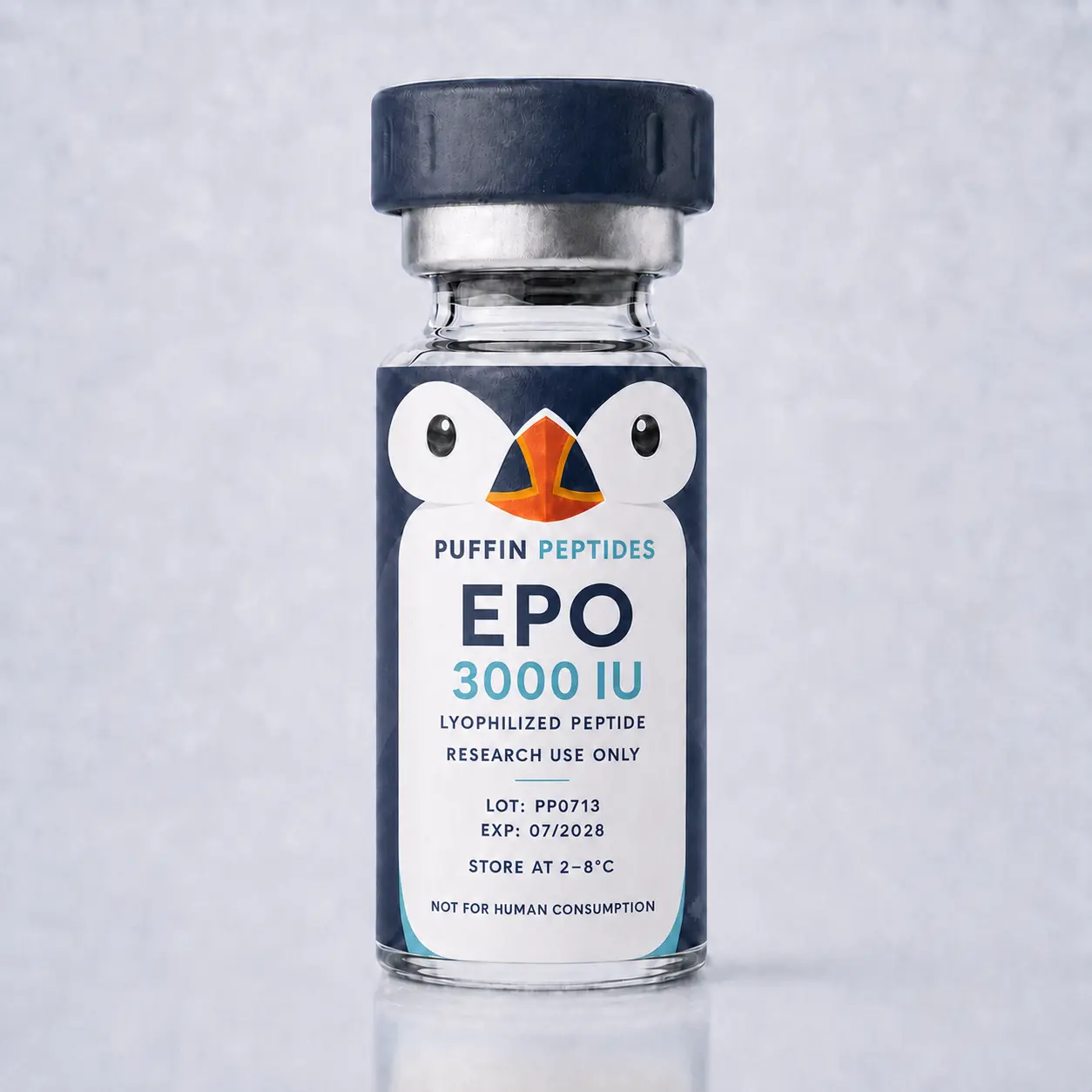
- Approved epoetin medicines exist for specific medical indications. This research vial is not a prescription epoetin product, and an EPO label alone does not establish glycoform profile, potency, sterility, dose equivalence, or clinical safety.
- Confirm biological potency and glycosylation rather than relying on protein mass alone.
- Use erythroid-lineage and EPO-receptor controls to distinguish receptor-specific effects from general cell-survival signals.
What EPO is—and what the name does not establish
EPO, or erythropoietin, is a glycoprotein hormone that controls red-blood-cell production through the erythropoietin receptor. It is a large, folded, glycosylated biologic—not a simple short peptide.
EPO-receptor activation supports survival, proliferation, and maturation of erythroid precursor cells in bone marrow. In plain language, it signals the red-cell production system; glycosylation and protein folding strongly influence how a recombinant EPO material behaves.
Questions to settle before interpreting a result
A useful EPO study begins with material identity, a defined model, a relevant comparator, and an endpoint chosen before the result is known. Broad catalogue language cannot replace those controls.
- Confirm biological potency and glycosylation rather than relying on protein mass alone.
- Use erythroid-lineage and EPO-receptor controls to distinguish receptor-specific effects from general cell-survival signals.
- Keep hematopoietic endpoints separate from exploratory tissue-protection claims reported in non-erythroid models.
How to read the EPO evidence
These evidence snapshots summarize the most important distinctions in the published record. They do not combine unlike models or turn an experimental signal into a human-use claim.
Human evidence · established
- Design
- The erythropoiesis pathway is clinically validated
- Finding
- Regulated epoetin products have extensive clinical evidence in defined anaemia settings. That validates the biological target and those drug products—not a catalogue material with unverified comparability.
- Read with care
- This is an interpretation boundary, not a claim that a specific outcome has been established in people.
Biologic complexity
- Design
- Same amino-acid sequence can still behave differently
- Finding
- Glycosylation, aggregation, folding, host-cell process, and potency testing matter for EPO. Mass in a vial is not enough to establish biological or pharmaceutical equivalence.
- Read with care
- This is an interpretation boundary, not a claim that a specific outcome has been established in people.
Mechanism caution
- Design
- Non-erythroid effects remain context dependent
- Finding
- Tissue-protection findings outside bone marrow are an active research area. They should be separated from the established erythropoiesis pathway and from approved anaemia indications.
- Read with care
- This is an interpretation boundary, not a claim that a specific outcome has been established in people.
What the evidence does not establish
Approved epoetin medicines exist for specific medical indications. This research vial is not a prescription epoetin product, and an EPO label alone does not establish glycoform profile, potency, sterility, dose equivalence, or clinical safety.
Mechanism, cell, animal, observational, and controlled human evidence answer different questions. A positive result at one level cannot be silently promoted to another, and evidence for a sponsor’s defined product does not establish equivalence for an independently sourced research material.
Keep the publication and the vial separate
A published paper identifies its own sequence or chemical identity, formulation, manufacturing context, analytical controls, exposure, and test system. Matching a familiar name on a label is not enough to show that a catalogue vial is the same study material.
For practical research planning, verify the lot-specific identity and documentation, then write the model, comparator, endpoint, and stopping criteria before testing. This guide does not provide preparation, dosing, injection, or human-use instructions.
Sources
Links lead to the paper, official registry, regulator page, or product label used for this guide. Registry records describe protocols and status; they are not treated as positive results.
- Epogen (epoetin alfa) official prescribing informationDailyMed · U.S. National Library of Medicine · Current label
Official label for a regulated erythropoiesis-stimulating biologic. It documents product-specific indications and risks rather than validating an unverified EPO research vial.
- Think twice before injecting peptides bought online: unauthorized products can seriously harm youHealth Canada · 2026
Official Canadian advisory explaining that a research-use label does not establish authorization, safety, efficacy, or product quality for human use.
Vote for EPO
This compound is not currently stocked. Add it to your five-choice catalogue ballot.