
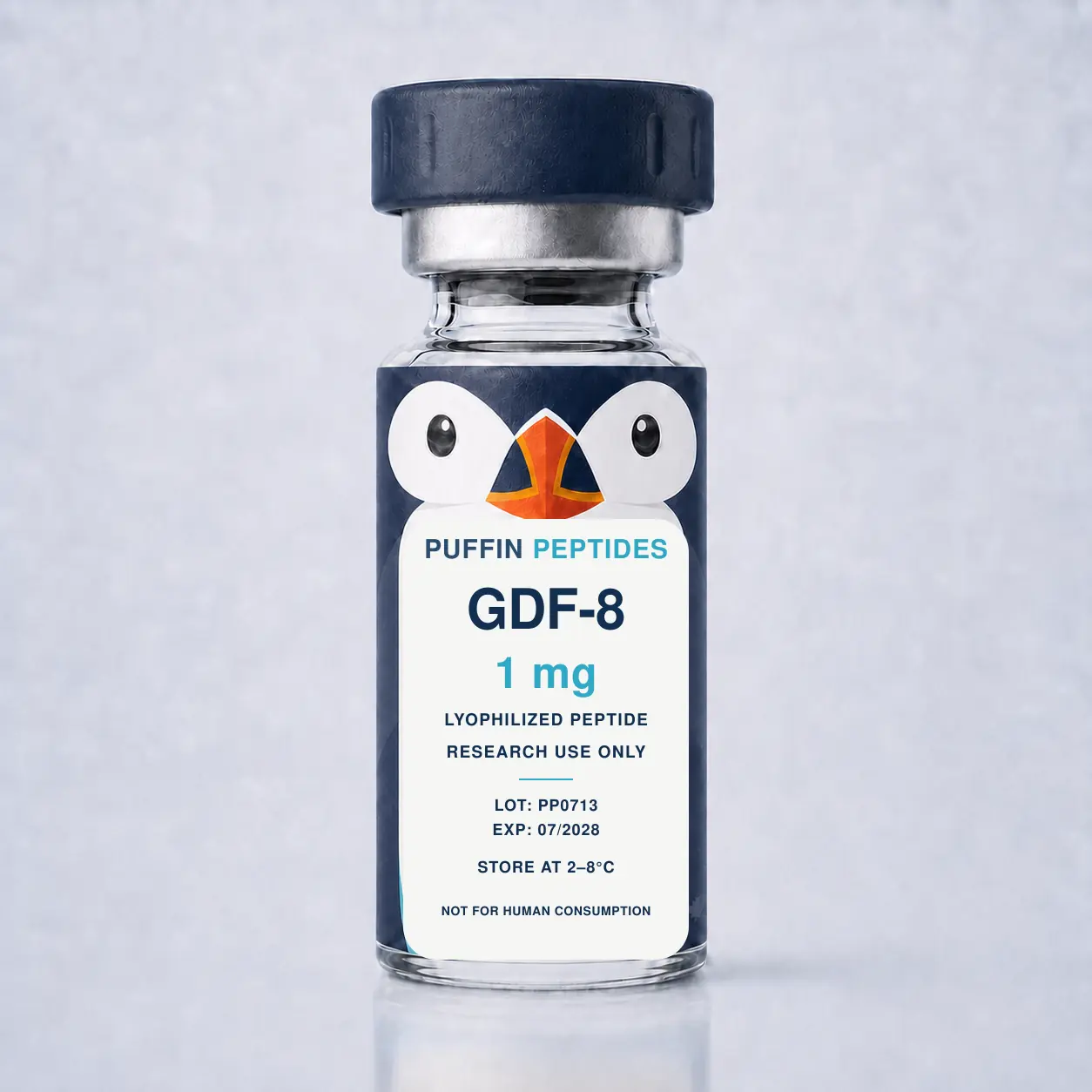
 Catalogue preview · final packaging and presentation may vary if stocked
Five choices across your ballotUse votes only for compounds you would consider ordering
One vote per compoundEach candidate can be selected once on this browser
Flexible interest signalRemove or reassign a vote whenever you like
GDF-8
GDF-8 is myostatin, an endogenous TGF-beta-family growth factor that limits skeletal-muscle growth. A vial of GDF-8 supplies the signalling ligand; it is not a myostatin blocker.
Loading your saved choices…
GDF-8 is currently being evaluated through customer voting and is not available to order. Final product specifications and batch documentation will be published only if it joins the catalogue.
This page records catalogue interest only. If GDF-8 is selected for supply, Puffin will publish the confirmed format, batch documentation, and laboratory preparation information on the product listing.
Storage and handling requirements depend on the final supplied format. Confirmed instructions will be provided with the batch details if this candidate is added to the catalogue.
Understanding GDF-8
Explore the science, research focus, and key information behind this compound.
What is GDF-8?+
GDF-8 is the direct growth-factor reference when myostatin and related SMAD-pathway questions drive the study.
What Researchers Study+
Researchers examine Myostatin activity, TGF-beta-related signalling, and Skeletal-muscle development models.
How GDF-8 Works+
Myostatin binds activin type II receptors and activates SMAD-related signalling that restrains muscle-cell growth and differentiation. In plain language, adding GDF-8 generally studies the brake, while antibodies, traps, or follistatin-related strategies study ways of reducing that brake.
Research at a Glance+
Loss of myostatin produced marked muscle growth in mice. The 1997 discovery study showed that disrupting the myostatin gene greatly increased skeletal-muscle mass in mice. It established myostatin as a negative regulator—not a reason to add GDF-8 for muscle gain. Read the foundational Nature paper. Ligand and inhibitor point opposite ways. GDF-8 activates the pathway; neutralizing antibodies, ligand traps, and follistatin-related approaches aim to reduce it. Marketing often blurs this central distinction. Maturation state changes activity. Myostatin is synthesized as a precursor and processed to an active dimer. Total protein mass does not reveal how much biologically active mature ligand is present.
If this candidate is added to the catalogue, it would be offered for controlled laboratory research only. It is not for human consumption and is not represented as a medicine, treatment, supplement, or substitute for an approved product.