
At a glance
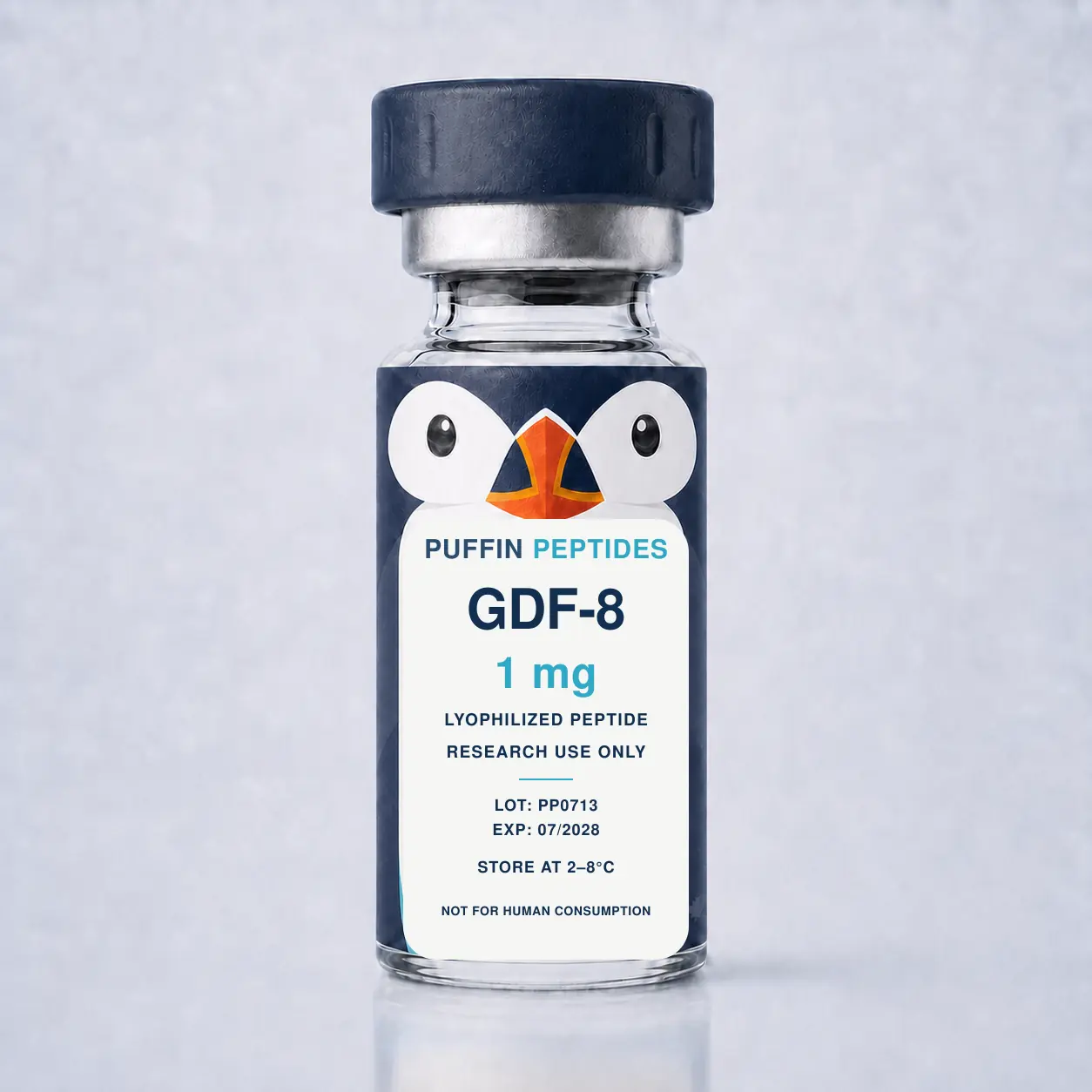
- GDF-8 is myostatin, an endogenous TGF-beta-family growth factor that limits skeletal-muscle growth. A vial of GDF-8 supplies the signalling ligand; it is not a myostatin blocker.
- Myostatin biology is well established in genetics and animal models, but recombinant GDF-8 is not an approved muscle therapy. Results from myostatin inhibitors cannot be presented as benefits of adding the GDF-8 ligand.
- Confirm whether the material is latent precursor, propeptide, mature dimer, or another form before selecting an assay.
- Measure activin-receptor and SMAD signalling alongside myoblast differentiation or muscle-cell endpoints.
What GDF-8 is—and what the name does not establish
GDF-8 is myostatin, an endogenous TGF-beta-family growth factor that limits skeletal-muscle growth. A vial of GDF-8 supplies the signalling ligand; it is not a myostatin blocker.
Myostatin binds activin type II receptors and activates SMAD-related signalling that restrains muscle-cell growth and differentiation. In plain language, adding GDF-8 generally studies the brake, while antibodies, traps, or follistatin-related strategies study ways of reducing that brake.
Questions to settle before interpreting a result
A useful GDF-8 study begins with material identity, a defined model, a relevant comparator, and an endpoint chosen before the result is known. Broad catalogue language cannot replace those controls.
- Confirm whether the material is latent precursor, propeptide, mature dimer, or another form before selecting an assay.
- Measure activin-receptor and SMAD signalling alongside myoblast differentiation or muscle-cell endpoints.
- Use follistatin or receptor-blockade controls only to test pathway inhibition—not as evidence that GDF-8 itself promotes growth.
How to read the GDF-8 evidence
These evidence snapshots summarize the most important distinctions in the published record. They do not combine unlike models or turn an experimental signal into a human-use claim.
Foundational genetics
- Design
- Loss of myostatin produced marked muscle growth in mice
- Finding
- The 1997 discovery study showed that disrupting the myostatin gene greatly increased skeletal-muscle mass in mice. It established myostatin as a negative regulator—not a reason to add GDF-8 for muscle gain.
- Read with care
- Keep the finding attached to the linked study’s exact material, design, population, exposure, and endpoint.
Direction matters
- Design
- Ligand and inhibitor point opposite ways
- Finding
- GDF-8 activates the pathway; neutralizing antibodies, ligand traps, and follistatin-related approaches aim to reduce it. Marketing often blurs this central distinction.
- Read with care
- This is an interpretation boundary, not a claim that a specific outcome has been established in people.
Material identity
- Design
- Maturation state changes activity
- Finding
- Myostatin is synthesized as a precursor and processed to an active dimer. Total protein mass does not reveal how much biologically active mature ligand is present.
- Read with care
- This is an interpretation boundary, not a claim that a specific outcome has been established in people.
What the evidence does not establish
Myostatin biology is well established in genetics and animal models, but recombinant GDF-8 is not an approved muscle therapy. Results from myostatin inhibitors cannot be presented as benefits of adding the GDF-8 ligand.
Mechanism, cell, animal, observational, and controlled human evidence answer different questions. A positive result at one level cannot be silently promoted to another, and evidence for a sponsor’s defined product does not establish equivalence for an independently sourced research material.
Keep the publication and the vial separate
A published paper identifies its own sequence or chemical identity, formulation, manufacturing context, analytical controls, exposure, and test system. Matching a familiar name on a label is not enough to show that a catalogue vial is the same study material.
For practical research planning, verify the lot-specific identity and documentation, then write the model, comparator, endpoint, and stopping criteria before testing. This guide does not provide preparation, dosing, injection, or human-use instructions.
Sources
Links lead to the paper, official registry, regulator page, or product label used for this guide. Registry records describe protocols and status; they are not treated as positive results.
- the foundational Nature paperPeer-reviewed publication · Linked record
The 1997 discovery study showed that disrupting the myostatin gene greatly increased skeletal-muscle mass in mice. It established myostatin as a negative regulator—not a reason to add GDF-8 for muscle gain. The result remains tied to the exact study material, design, population, and endpoint.
- Think twice before injecting peptides bought online: unauthorized products can seriously harm youHealth Canada · 2026
Official Canadian advisory explaining that a research-use label does not establish authorization, safety, efficacy, or product quality for human use.
Vote for GDF-8
This compound is not currently stocked. Add it to your five-choice catalogue ballot.