
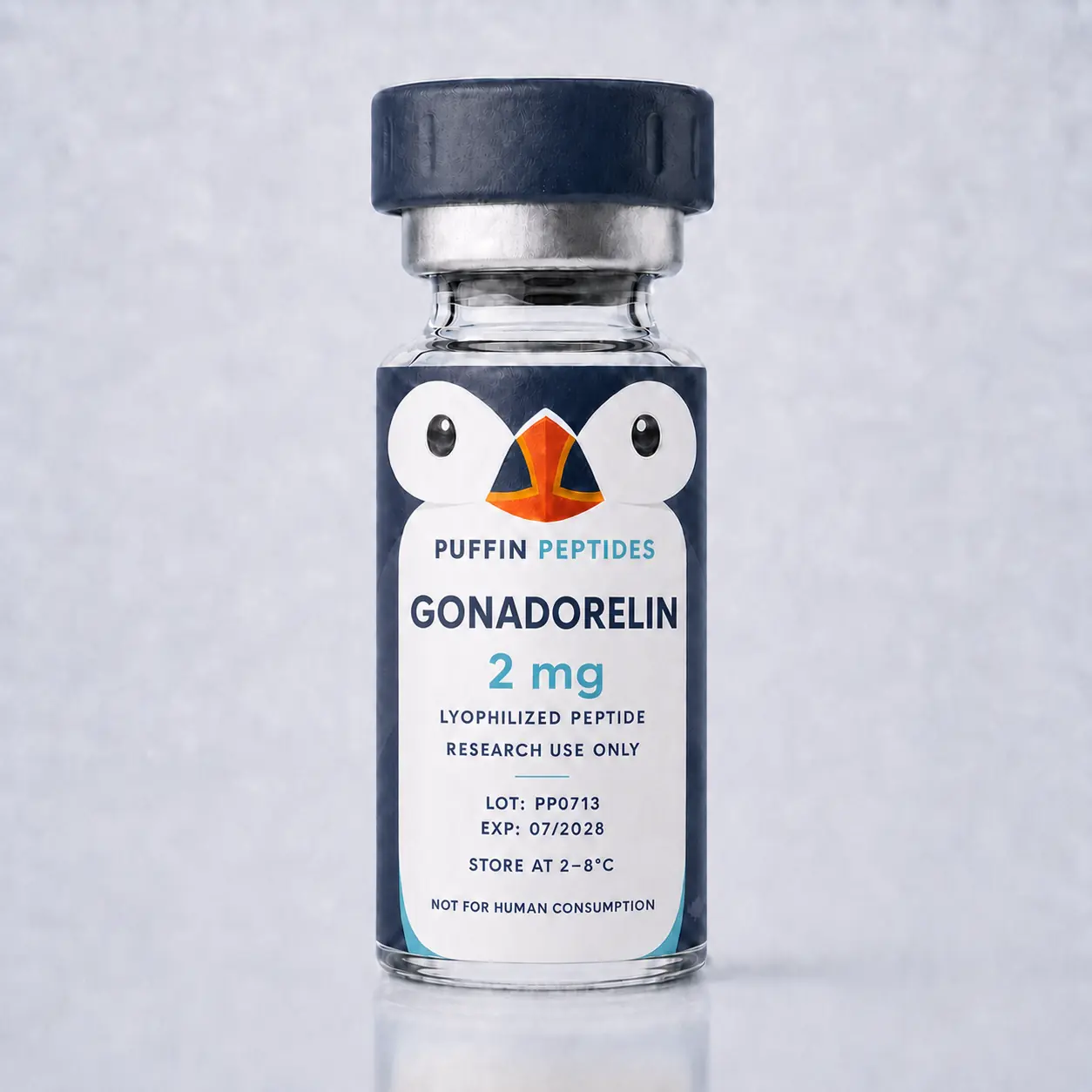
 Catalogue preview · final packaging and presentation may vary if stocked
Five choices across your ballotUse votes only for compounds you would consider ordering
One vote per compoundEach candidate can be selected once on this browser
Flexible interest signalRemove or reassign a vote whenever you like
GONADORELIN
Gonadorelin is synthetic human GnRH, a 10-amino-acid hormone that signals the pituitary to release LH and FSH. It is a direct reference for reproductive-neuroendocrine timing and receptor biology.
Loading your saved choices…
GONADORELIN is currently being evaluated through customer voting and is not available to order. Final product specifications and batch documentation will be published only if it joins the catalogue.
This page records catalogue interest only. If GONADORELIN is selected for supply, Puffin will publish the confirmed format, batch documentation, and laboratory preparation information on the product listing.
Storage and handling requirements depend on the final supplied format. Confirmed instructions will be provided with the batch details if this candidate is added to the catalogue.
Understanding Gonadorelin
Explore the science, research focus, and key information behind this compound.
What is Gonadorelin?+
Gonadorelin provides a direct reference for following GnRH-driven pituitary signalling.
What Researchers Study+
Researchers examine GnRH-receptor activity, Pituitary gonadotropin release, and Reproductive-endocrine models.
How Gonadorelin Works+
GnRH-receptor activation in the pituitary triggers gonadotropin release. Pulses and continuous exposure can produce very different responses: pulses support release, while sustained stimulation can desensitize the system. Timing is therefore part of the mechanism.
Research at a Glance+
Pulse timing is central to GnRH signalling. Decades of reproductive-endocrine research show that pulsatile and sustained GnRH exposure produce different pituitary responses. A single concentration without timing context can be misleading. Gonadorelin acts upstream of HCG and HMG. Gonadorelin asks the pituitary to release gonadotropins. HCG acts at the LH/CG receptor, while HMG supplies gonadotropin activity. These are different levels of the reproductive axis. The same molecule can stimulate or desensitize. Pulse frequency and continuous exposure can change receptor response and LH/FSH output. Timing is not a minor protocol detail—it is part of the biological mechanism.
If this candidate is added to the catalogue, it would be offered for controlled laboratory research only. It is not for human consumption and is not represented as a medicine, treatment, supplement, or substitute for an approved product.