
At a glance
- Gonadorelin is synthetic human GnRH, a 10-amino-acid hormone that signals the pituitary to release LH and FSH. It is a direct reference for reproductive-neuroendocrine timing and receptor biology.
- Regulated gonadorelin products have existed for diagnostic and reproductive uses. This research vial is not a prescription product, and approved-product evidence does not establish its potency, sterility, delivery, or clinical equivalence.
- Use time-controlled or pulsatile exposure when studying physiological GnRH signalling.
- Measure LH and FSH separately because the same GnRH input does not guarantee identical downstream responses.
What GONADORELIN is—and what the name does not establish
Gonadorelin is synthetic human GnRH, a 10-amino-acid hormone that signals the pituitary to release LH and FSH. It is a direct reference for reproductive-neuroendocrine timing and receptor biology.
GnRH-receptor activation in the pituitary triggers gonadotropin release. Pulses and continuous exposure can produce very different responses: pulses support release, while sustained stimulation can desensitize the system. Timing is therefore part of the mechanism.
Questions to settle before interpreting a result
A useful GONADORELIN study begins with material identity, a defined model, a relevant comparator, and an endpoint chosen before the result is known. Broad catalogue language cannot replace those controls.
- Use time-controlled or pulsatile exposure when studying physiological GnRH signalling.
- Measure LH and FSH separately because the same GnRH input does not guarantee identical downstream responses.
- Compare continuous and pulsed exposure only with a protocol designed to capture receptor desensitization.
How to read the GONADORELIN evidence
These evidence snapshots summarize the most important distinctions in the published record. They do not combine unlike models or turn an experimental signal into a human-use claim.
Human physiology · established
- Design
- Pulse timing is central to GnRH signalling
- Finding
- Decades of reproductive-endocrine research show that pulsatile and sustained GnRH exposure produce different pituitary responses. A single concentration without timing context can be misleading.
- Read with care
- This is an interpretation boundary, not a claim that a specific outcome has been established in people.
Best comparison
- Design
- Gonadorelin acts upstream of HCG and HMG
- Finding
- Gonadorelin asks the pituitary to release gonadotropins. HCG acts at the LH/CG receptor, while HMG supplies gonadotropin activity. These are different levels of the reproductive axis.
- Read with care
- This is an interpretation boundary, not a claim that a specific outcome has been established in people.
Timing lesson
- Design
- The same molecule can stimulate or desensitize
- Finding
- Pulse frequency and continuous exposure can change receptor response and LH/FSH output. Timing is not a minor protocol detail—it is part of the biological mechanism.
- Read with care
- This is an interpretation boundary, not a claim that a specific outcome has been established in people.
What the evidence does not establish
Regulated gonadorelin products have existed for diagnostic and reproductive uses. This research vial is not a prescription product, and approved-product evidence does not establish its potency, sterility, delivery, or clinical equivalence.
Mechanism, cell, animal, observational, and controlled human evidence answer different questions. A positive result at one level cannot be silently promoted to another, and evidence for a sponsor’s defined product does not establish equivalence for an independently sourced research material.
Keep the publication and the vial separate
A published paper identifies its own sequence or chemical identity, formulation, manufacturing context, analytical controls, exposure, and test system. Matching a familiar name on a label is not enough to show that a catalogue vial is the same study material.
For practical research planning, verify the lot-specific identity and documentation, then write the model, comparator, endpoint, and stopping criteria before testing. This guide does not provide preparation, dosing, injection, or human-use instructions.
Sources
Links lead to the paper, official registry, regulator page, or product label used for this guide. Registry records describe protocols and status; they are not treated as positive results.
- Hormonal responses to low-dose pulsatile administration of gonadotropin-releasing hormoneJournal of Clinical Endocrinology & Metabolism · 1980
Small human physiology study showing that pulse pattern is part of the intervention. Its protocol and population cannot be generalized to every GnRH exposure.
- Think twice before injecting peptides bought online: unauthorized products can seriously harm youHealth Canada · 2026
Official Canadian advisory explaining that a research-use label does not establish authorization, safety, efficacy, or product quality for human use.
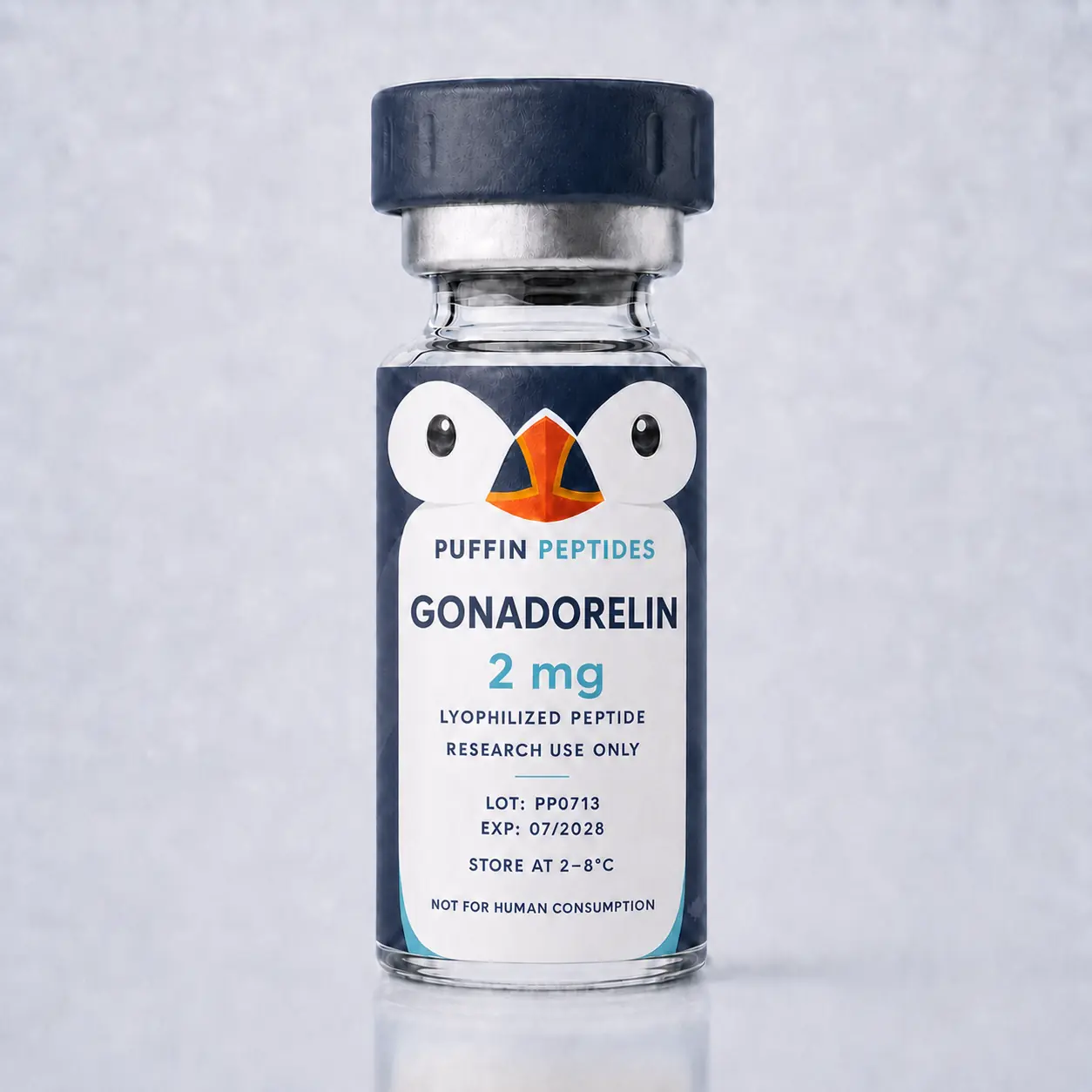
Vote for GONADORELIN
This compound is not currently stocked. Add it to your five-choice catalogue ballot.