
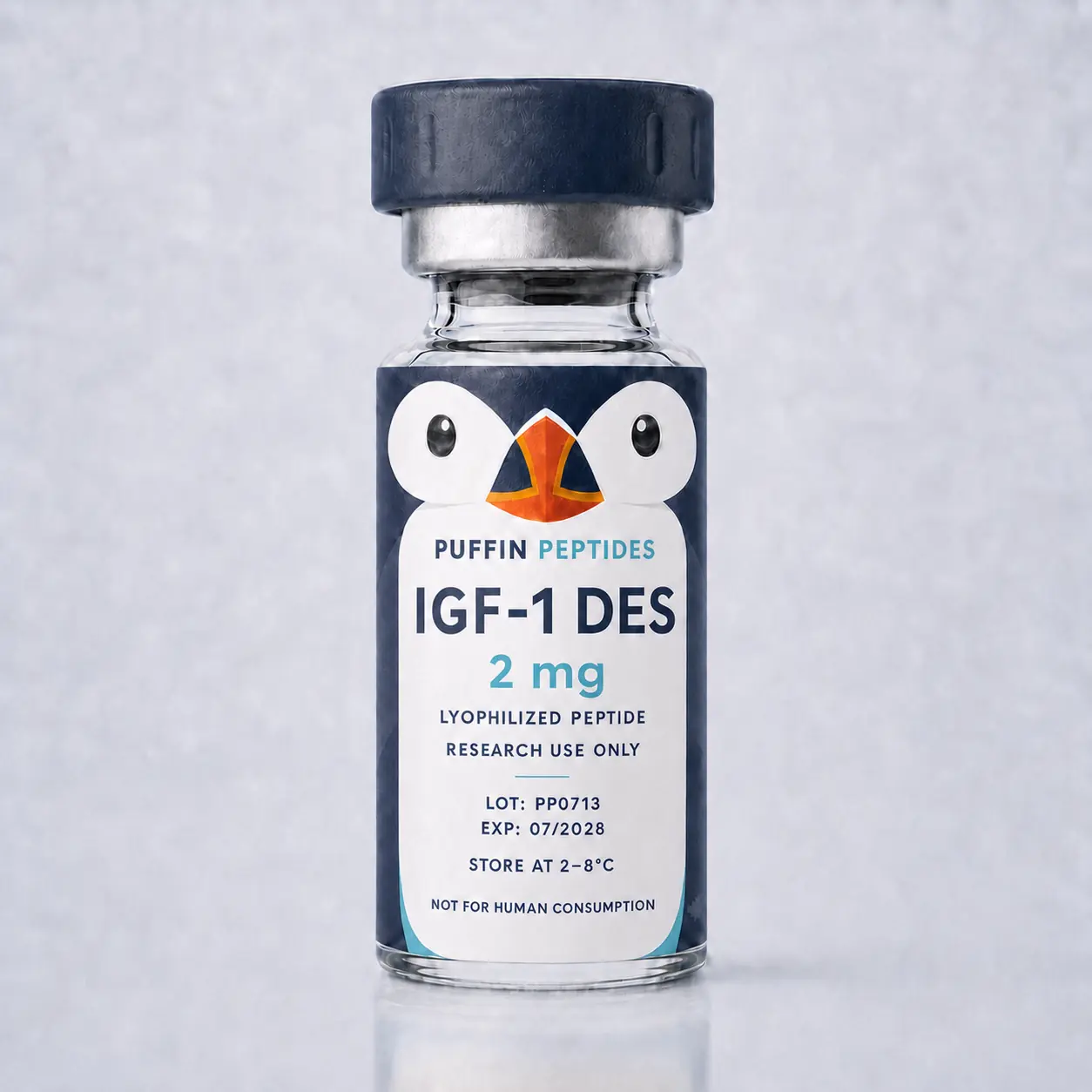
 Catalogue preview · final packaging and presentation may vary if stocked
Five choices across your ballotUse votes only for compounds you would consider ordering
One vote per compoundEach candidate can be selected once on this browser
Flexible interest signalRemove or reassign a vote whenever you like
IGF-1 DES
IGF-1 DES, more precisely des(1–3)IGF-1, is IGF-1 without its first three amino acids. The truncation reduces binding to several IGF-binding proteins and can increase apparent activity in some tissues and assays.
Loading your saved choices…
IGF-1 DES is currently being evaluated through customer voting and is not available to order. Final product specifications and batch documentation will be published only if it joins the catalogue.
This page records catalogue interest only. If IGF-1 DES is selected for supply, Puffin will publish the confirmed format, batch documentation, and laboratory preparation information on the product listing.
Storage and handling requirements depend on the final supplied format. Confirmed instructions will be provided with the batch details if this candidate is added to the catalogue.
Understanding IGF-1 DES
Explore the science, research focus, and key information behind this compound.
What is IGF-1 DES?+
Researchers choose the DES form when the study calls for a shorter IGF-1 analogue and a localized signalling lens.
What Researchers Study+
Researchers examine Localized IGF signalling, IGF-1 receptor binding, and Cell-growth response.
How IGF-1 DES Works+
Like native IGF-1, the DES analogue activates the IGF-1 receptor. Its lower binding-protein affinity changes how much peptide is free to reach that receptor. That makes it useful for localized or binding-protein-sensitive comparisons, not automatically a more effective version in every model.
Research at a Glance+
Three missing residues change binding-protein interaction. Des(1–3)IGF-1 has long been used to study how IGF-binding proteins regulate access to the IGF-1 receptor. Enhanced activity in one assay does not establish higher activity across every tissue or exposure condition. DES, LR3, and native IGF-1 answer different questions. DES is a truncated analogue; LR3 is extended and substituted; native IGF-1 is the physiological sequence. Their receptor activity overlaps, but their binding-protein behaviour and experimental handling differ. Lower binding-protein affinity is not universal potency. The DES analogue can look more active in a binding-protein-rich system without being intrinsically stronger at every receptor, tissue, or exposure condition.
If this candidate is added to the catalogue, it would be offered for controlled laboratory research only. It is not for human consumption and is not represented as a medicine, treatment, supplement, or substitute for an approved product.