
At a glance
- IGF-1 DES, more precisely des(1–3)IGF-1, is IGF-1 without its first three amino acids. The truncation reduces binding to several IGF-binding proteins and can increase apparent activity in some tissues and assays.
- Des(1–3)IGF-1 is not an approved therapeutic product. Most evidence is biochemical, cellular, or animal work, and results for native IGF-1, LR3, or mecasermin should be kept separate.
- Compare DES with native IGF-1 under the same IGF-binding-protein conditions to test the effect of truncation.
- Use receptor-phosphorylation and downstream signalling measurements before interpreting cell-growth endpoints.
What IGF-1 DES is—and what the name does not establish
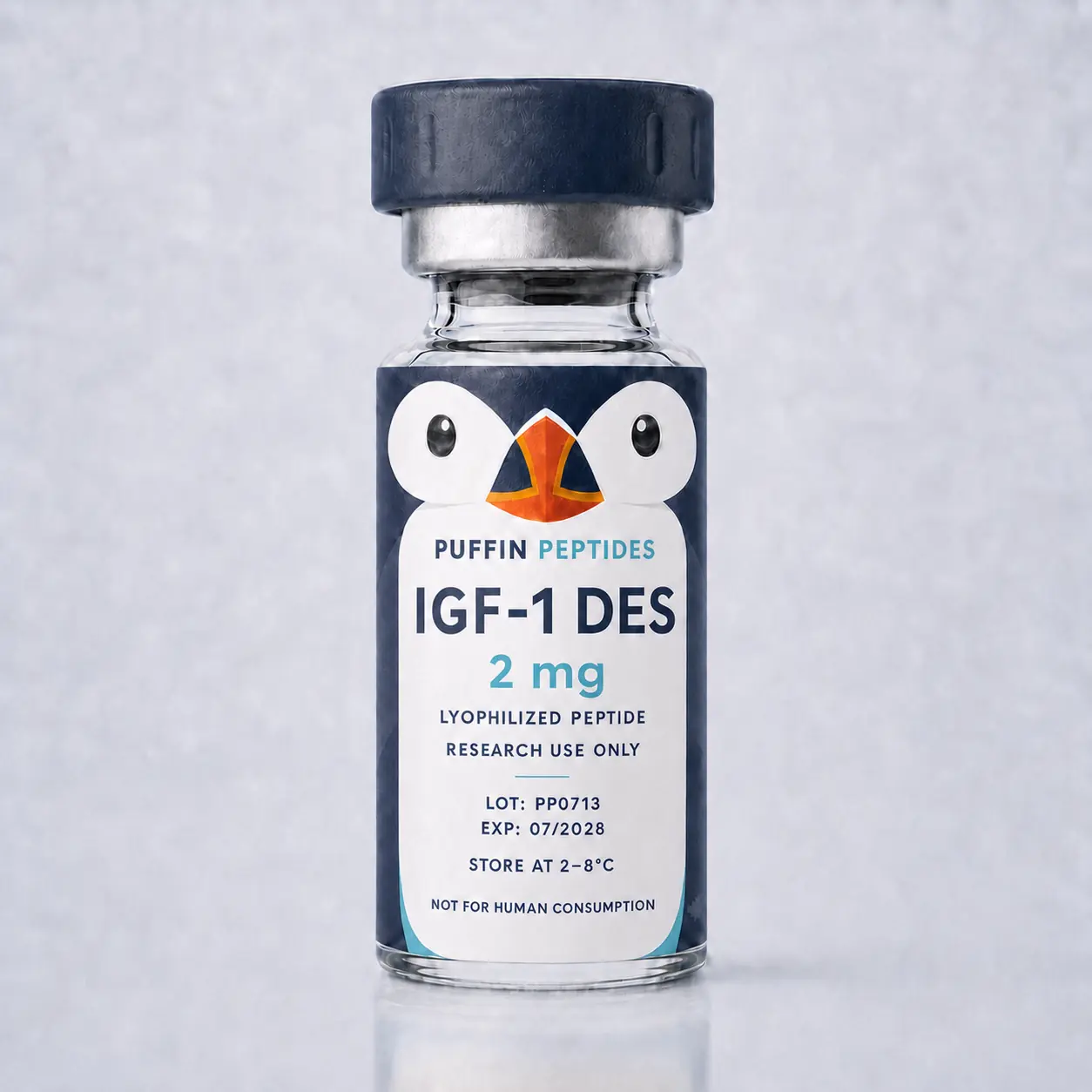
IGF-1 DES, more precisely des(1–3)IGF-1, is IGF-1 without its first three amino acids. The truncation reduces binding to several IGF-binding proteins and can increase apparent activity in some tissues and assays.
Like native IGF-1, the DES analogue activates the IGF-1 receptor. Its lower binding-protein affinity changes how much peptide is free to reach that receptor. That makes it useful for localized or binding-protein-sensitive comparisons, not automatically a more effective version in every model.
Questions to settle before interpreting a result
A useful IGF-1 DES study begins with material identity, a defined model, a relevant comparator, and an endpoint chosen before the result is known. Broad catalogue language cannot replace those controls.
- Compare DES with native IGF-1 under the same IGF-binding-protein conditions to test the effect of truncation.
- Use receptor-phosphorylation and downstream signalling measurements before interpreting cell-growth endpoints.
- State whether a localized tissue response, systemic exposure, or binding-protein interaction is the actual research question.
How to read the IGF-1 DES evidence
These evidence snapshots summarize the most important distinctions in the published record. They do not combine unlike models or turn an experimental signal into a human-use claim.
Biochemical evidence
- Design
- Three missing residues change binding-protein interaction
- Finding
- Des(1–3)IGF-1 has long been used to study how IGF-binding proteins regulate access to the IGF-1 receptor. Enhanced activity in one assay does not establish higher activity across every tissue or exposure condition.
- Read with care
- This is an interpretation boundary, not a claim that a specific outcome has been established in people.
Best comparator
- Design
- DES, LR3, and native IGF-1 answer different questions
- Finding
- DES is a truncated analogue; LR3 is extended and substituted; native IGF-1 is the physiological sequence. Their receptor activity overlaps, but their binding-protein behaviour and experimental handling differ.
- Read with care
- This is an interpretation boundary, not a claim that a specific outcome has been established in people.
What not to assume
- Design
- Lower binding-protein affinity is not universal potency
- Finding
- The DES analogue can look more active in a binding-protein-rich system without being intrinsically stronger at every receptor, tissue, or exposure condition.
- Read with care
- This is an interpretation boundary, not a claim that a specific outcome has been established in people.
What the evidence does not establish
Des(1–3)IGF-1 is not an approved therapeutic product. Most evidence is biochemical, cellular, or animal work, and results for native IGF-1, LR3, or mecasermin should be kept separate.
Mechanism, cell, animal, observational, and controlled human evidence answer different questions. A positive result at one level cannot be silently promoted to another, and evidence for a sponsor’s defined product does not establish equivalence for an independently sourced research material.
Keep the publication and the vial separate
A published paper identifies its own sequence or chemical identity, formulation, manufacturing context, analytical controls, exposure, and test system. Matching a familiar name on a label is not enough to show that a catalogue vial is the same study material.
For practical research planning, verify the lot-specific identity and documentation, then write the model, comparator, endpoint, and stopping criteria before testing. This guide does not provide preparation, dosing, injection, or human-use instructions.
Sources
Links lead to the paper, official registry, regulator page, or product label used for this guide. Registry records describe protocols and status; they are not treated as positive results.
- Effects of IGF-I, IGF-II, and des(1-3)IGF-I on growth-hormone secretionPubMed-indexed primary study · 1991
Primary comparative study of defined IGF materials. It supports an assay-specific potency distinction, not a general human-use or tissue-growth claim.
- Think twice before injecting peptides bought online: unauthorized products can seriously harm youHealth Canada · 2026
Official Canadian advisory explaining that a research-use label does not establish authorization, safety, efficacy, or product quality for human use.
Vote for IGF-1 DES
This compound is not currently stocked. Add it to your five-choice catalogue ballot.