
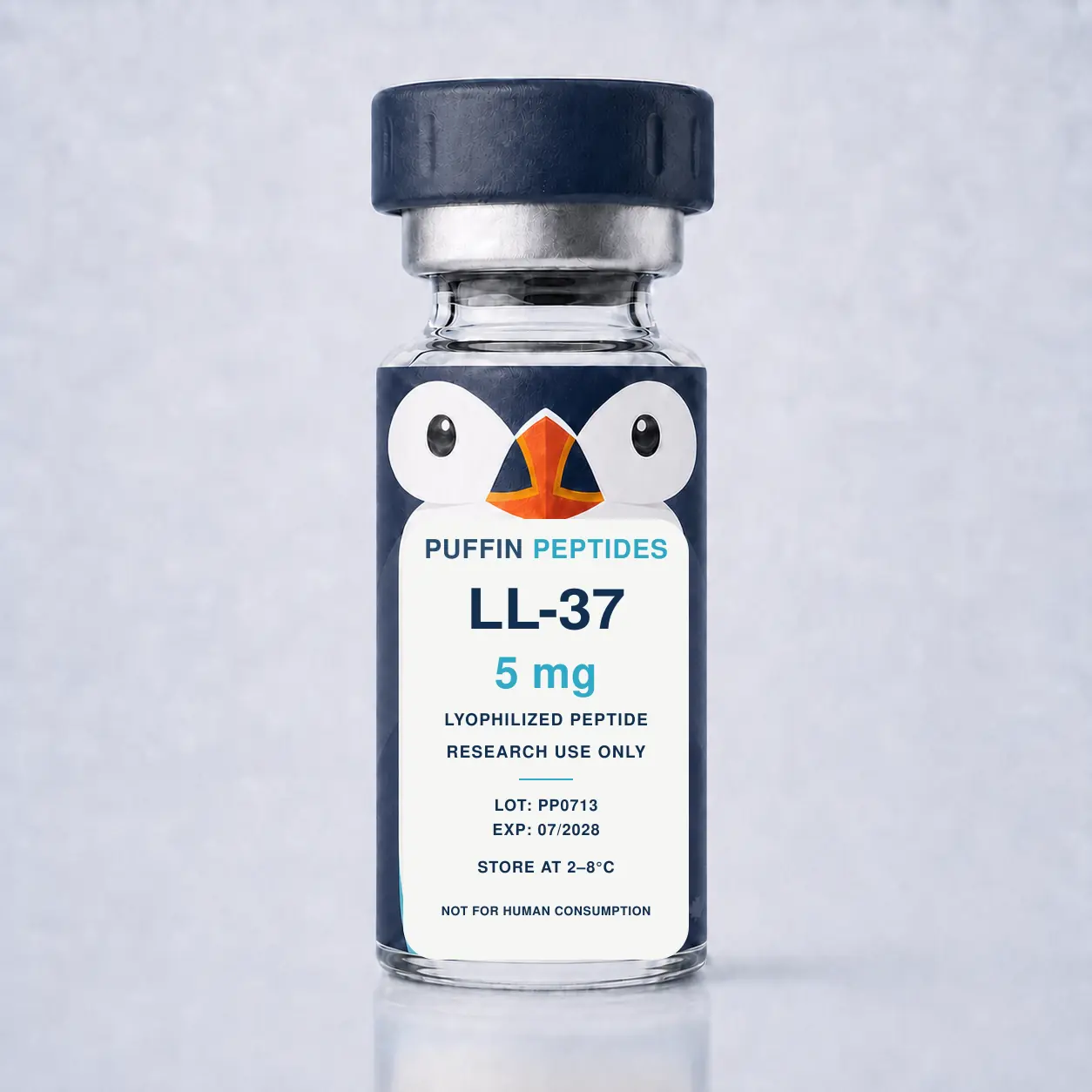
 Catalogue preview · final packaging and presentation may vary if stocked
Five choices across your ballotUse votes only for compounds you would consider ordering
One vote per compoundEach candidate can be selected once on this browser
Flexible interest signalRemove or reassign a vote whenever you like
LL-37
LL-37 is the only human cathelicidin-derived antimicrobial peptide. It is studied in microbial membranes, chemotaxis, innate immune signalling, wound response, angiogenesis, and inflammation.
Loading your saved choices…
LL-37 is currently being evaluated through customer voting and is not available to order. Final product specifications and batch documentation will be published only if it joins the catalogue.
This page records catalogue interest only. If LL-37 is selected for supply, Puffin will publish the confirmed format, batch documentation, and laboratory preparation information on the product listing.
Storage and handling requirements depend on the final supplied format. Confirmed instructions will be provided with the batch details if this candidate is added to the catalogue.
Understanding LL-37
Explore the science, research focus, and key information behind this compound.
What is LL-37?+
LL-37 offers a direct antimicrobial-peptide reference for host-defence and microbial-interaction studies.
What Researchers Study+
Researchers examine Innate-immune signalling, Microbial-interaction models, and Inflammatory-response research.
How LL-37 Works+
Its positively charged, amphipathic structure can disrupt some microbial membranes, while the peptide also interacts with host receptors, nucleic acids, and immune pathways. In plain language, LL-37 is both membrane-active and immune-active—so its effects are highly context dependent.
Research at a Glance+
LL-37 can recruit immune cells through FPRL1. A foundational study showed chemotactic activity through a formyl-peptide receptor-like pathway, helping establish LL-37 as more than a simple membrane antibiotic. Read the primary chemotaxis study. Angiogenic activity has also been reported. LL-37 promoted angiogenesis in experimental models, illustrating why one peptide can be relevant to wound response yet potentially problematic in other disease settings. Read the primary angiogenesis study. Antimicrobial does not mean broadly infection-treating. Activity in a buffer or cell system may fall in serum or salt and can coincide with host-cell effects. Delivery, concentration, organism, biofilm, and tissue context are decisive.
If this candidate is added to the catalogue, it would be offered for controlled laboratory research only. It is not for human consumption and is not represented as a medicine, treatment, supplement, or substitute for an approved product.