
At a glance
- LL-37 is the only human cathelicidin-derived antimicrobial peptide. It is studied in microbial membranes, chemotaxis, innate immune signalling, wound response, angiogenesis, and inflammation.
- LL-37 is not an approved systemic medicine. It can be antimicrobial in some settings but also pro-inflammatory, cytotoxic, angiogenic, or disease-promoting in others; “natural human peptide” does not mean universally safe.
- Run microbial-killing and host-cell-toxicity assays in parallel because selectivity changes with salt, serum, concentration, and membrane composition.
- Measure chemotaxis, cytokine, nucleic-acid-complex, and receptor responses separately from direct membrane disruption.
What LL-37 is—and what the name does not establish
LL-37 is the only human cathelicidin-derived antimicrobial peptide. It is studied in microbial membranes, chemotaxis, innate immune signalling, wound response, angiogenesis, and inflammation.
Its positively charged, amphipathic structure can disrupt some microbial membranes, while the peptide also interacts with host receptors, nucleic acids, and immune pathways. In plain language, LL-37 is both membrane-active and immune-active—so its effects are highly context dependent.
Questions to settle before interpreting a result
A useful LL-37 study begins with material identity, a defined model, a relevant comparator, and an endpoint chosen before the result is known. Broad catalogue language cannot replace those controls.
- Run microbial-killing and host-cell-toxicity assays in parallel because selectivity changes with salt, serum, concentration, and membrane composition.
- Measure chemotaxis, cytokine, nucleic-acid-complex, and receptor responses separately from direct membrane disruption.
- Use disease- and tissue-specific models because LL-37 can support repair in one context and inflammation or angiogenesis in another.
How to read the LL-37 evidence
These evidence snapshots summarize the most important distinctions in the published record. They do not combine unlike models or turn an experimental signal into a human-use claim.
Innate-immune mechanism
- Design
- LL-37 can recruit immune cells through FPRL1
- Finding
- A foundational study showed chemotactic activity through a formyl-peptide receptor-like pathway, helping establish LL-37 as more than a simple membrane antibiotic.
- Read with care
- Keep the finding attached to the linked study’s exact material, design, population, exposure, and endpoint.
Context-dependent signal
- Design
- Angiogenic activity has also been reported
- Finding
- LL-37 promoted angiogenesis in experimental models, illustrating why one peptide can be relevant to wound response yet potentially problematic in other disease settings.
- Read with care
- Keep the finding attached to the linked study’s exact material, design, population, exposure, and endpoint.
What not to assume
- Design
- Antimicrobial does not mean broadly infection-treating
- Finding
- Activity in a buffer or cell system may fall in serum or salt and can coincide with host-cell effects. Delivery, concentration, organism, biofilm, and tissue context are decisive.
- Read with care
- This is an interpretation boundary, not a claim that a specific outcome has been established in people.
What the evidence does not establish
LL-37 is not an approved systemic medicine. It can be antimicrobial in some settings but also pro-inflammatory, cytotoxic, angiogenic, or disease-promoting in others; “natural human peptide” does not mean universally safe.
Mechanism, cell, animal, observational, and controlled human evidence answer different questions. A positive result at one level cannot be silently promoted to another, and evidence for a sponsor’s defined product does not establish equivalence for an independently sourced research material.
Keep the publication and the vial separate
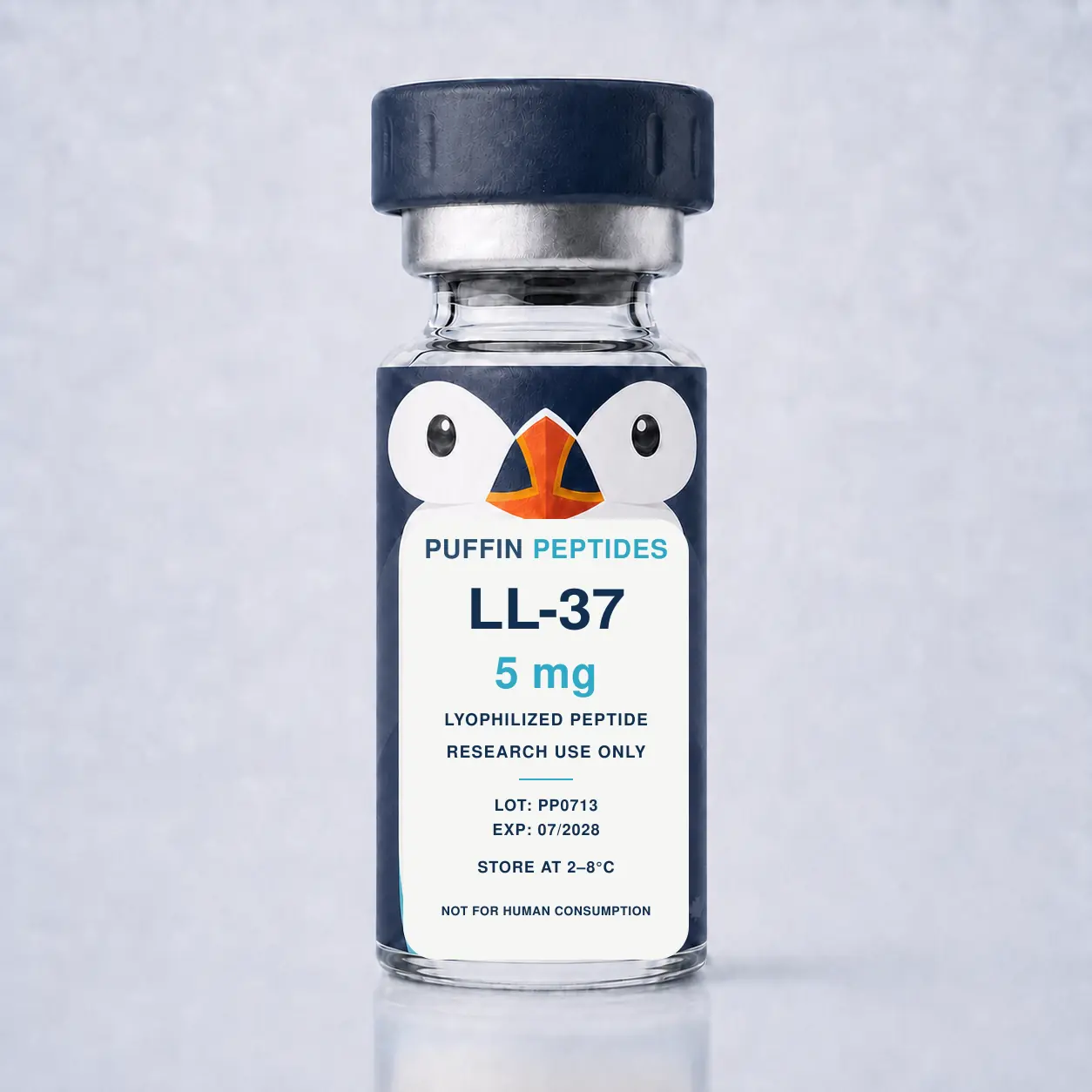
A published paper identifies its own sequence or chemical identity, formulation, manufacturing context, analytical controls, exposure, and test system. Matching a familiar name on a label is not enough to show that a catalogue vial is the same study material.
For practical research planning, verify the lot-specific identity and documentation, then write the model, comparator, endpoint, and stopping criteria before testing. This guide does not provide preparation, dosing, injection, or human-use instructions.
Sources
Links lead to the paper, official registry, regulator page, or product label used for this guide. Registry records describe protocols and status; they are not treated as positive results.
- the primary chemotaxis studyPeer-reviewed publication · Linked record
A foundational study showed chemotactic activity through a formyl-peptide receptor-like pathway, helping establish LL-37 as more than a simple membrane antibiotic. The result remains tied to the exact study material, design, population, and endpoint.
- the primary angiogenesis studyPeer-reviewed publication · Linked record
LL-37 promoted angiogenesis in experimental models, illustrating why one peptide can be relevant to wound response yet potentially problematic in other disease settings. The result remains tied to the exact study material, design, population, and endpoint.
- Think twice before injecting peptides bought online: unauthorized products can seriously harm youHealth Canada · 2026
Official Canadian advisory explaining that a research-use label does not establish authorization, safety, efficacy, or product quality for human use.
Vote for LL-37
This compound is not currently stocked. Add it to your five-choice catalogue ballot.