
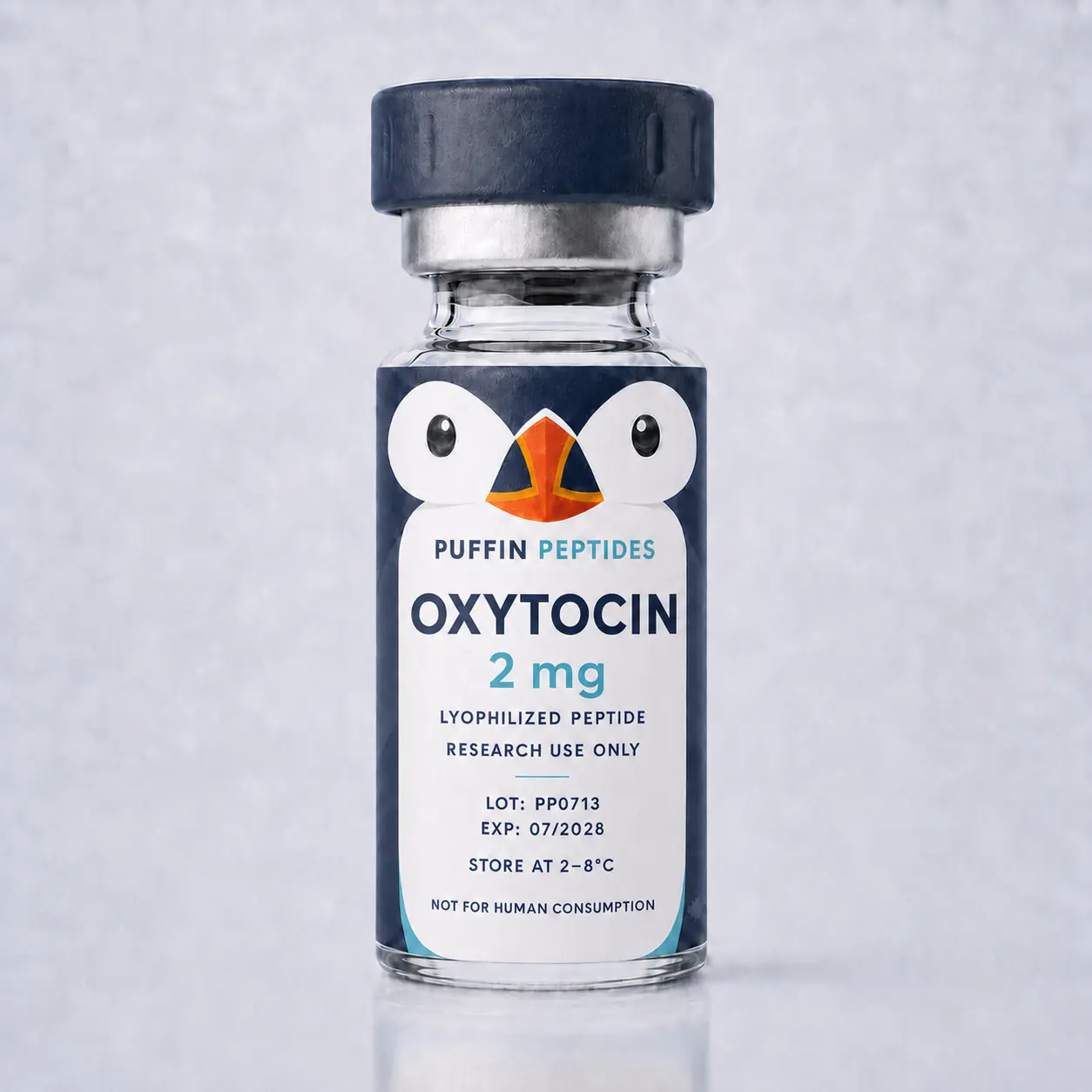
 Catalogue preview · final packaging and presentation may vary if stocked
Five choices across your ballotUse votes only for compounds you would consider ordering
One vote per compoundEach candidate can be selected once on this browser
Flexible interest signalRemove or reassign a vote whenever you like
OXYTOCIN
Oxytocin is a nine-amino-acid hormone and neurotransmitter studied in reproductive smooth muscle, milk ejection, social behaviour, stress, and neural-network models. Its popular “bonding hormone” nickname captures only a small and oversimplified part of the biology.
Loading your saved choices…
OXYTOCIN is currently being evaluated through customer voting and is not available to order. Final product specifications and batch documentation will be published only if it joins the catalogue.
This page records catalogue interest only. If OXYTOCIN is selected for supply, Puffin will publish the confirmed format, batch documentation, and laboratory preparation information on the product listing.
Storage and handling requirements depend on the final supplied format. Confirmed instructions will be provided with the batch details if this candidate is added to the catalogue.
Understanding Oxytocin
Explore the science, research focus, and key information behind this compound.
What is Oxytocin?+
Oxytocin offers a defined ligand for studies spanning receptor activity, behavioural signalling, and smooth-muscle response.
What Researchers Study+
Researchers examine Oxytocin-receptor activity, Social-behaviour models, and Smooth-muscle signalling.
How Oxytocin Works+
Oxytocin activates a G-protein-coupled receptor whose effect depends on tissue, receptor density, hormonal context, and timing. It also interacts with vasopressin-receptor systems at some concentrations. In plain language, the same peptide can produce different signals in uterus, mammary tissue, brain, and laboratory cells.
Research at a Glance+
Peripheral reproductive actions are well characterized. Oxytocin’s roles in uterine contraction and milk ejection are supported by human physiology and approved products. Those established actions should not be used as proof of simplified behavioural claims. “Bonding hormone” is too simple. Intranasal and social-behaviour studies vary with context, population, outcome, and replication. Oxytocin can change salience or social processing without producing a universal prosocial effect. Route and formulation shape the evidence. An approved injectable uterotonic, an intranasal research protocol, and a lyophilized catalogue vial are not interchangeable experimental or clinical products.
If this candidate is added to the catalogue, it would be offered for controlled laboratory research only. It is not for human consumption and is not represented as a medicine, treatment, supplement, or substitute for an approved product.