
At a glance
- Oxytocin is a nine-amino-acid hormone and neurotransmitter studied in reproductive smooth muscle, milk ejection, social behaviour, stress, and neural-network models. Its popular “bonding hormone” nickname captures only a small and oversimplified part of the biology.
- Approved oxytocin drug products exist for specific obstetric uses. This research vial is not one of those medicines, and evidence for regulated intravenous products or intranasal behavioural studies does not establish equivalence or a general social benefit.
- Use tissue- and receptor-specific models because uterine, neural, and mammary responses answer different questions.
- Control for vasopressin-receptor cross-activity when using higher concentrations or receptor-poor systems.
What OXYTOCIN is—and what the name does not establish
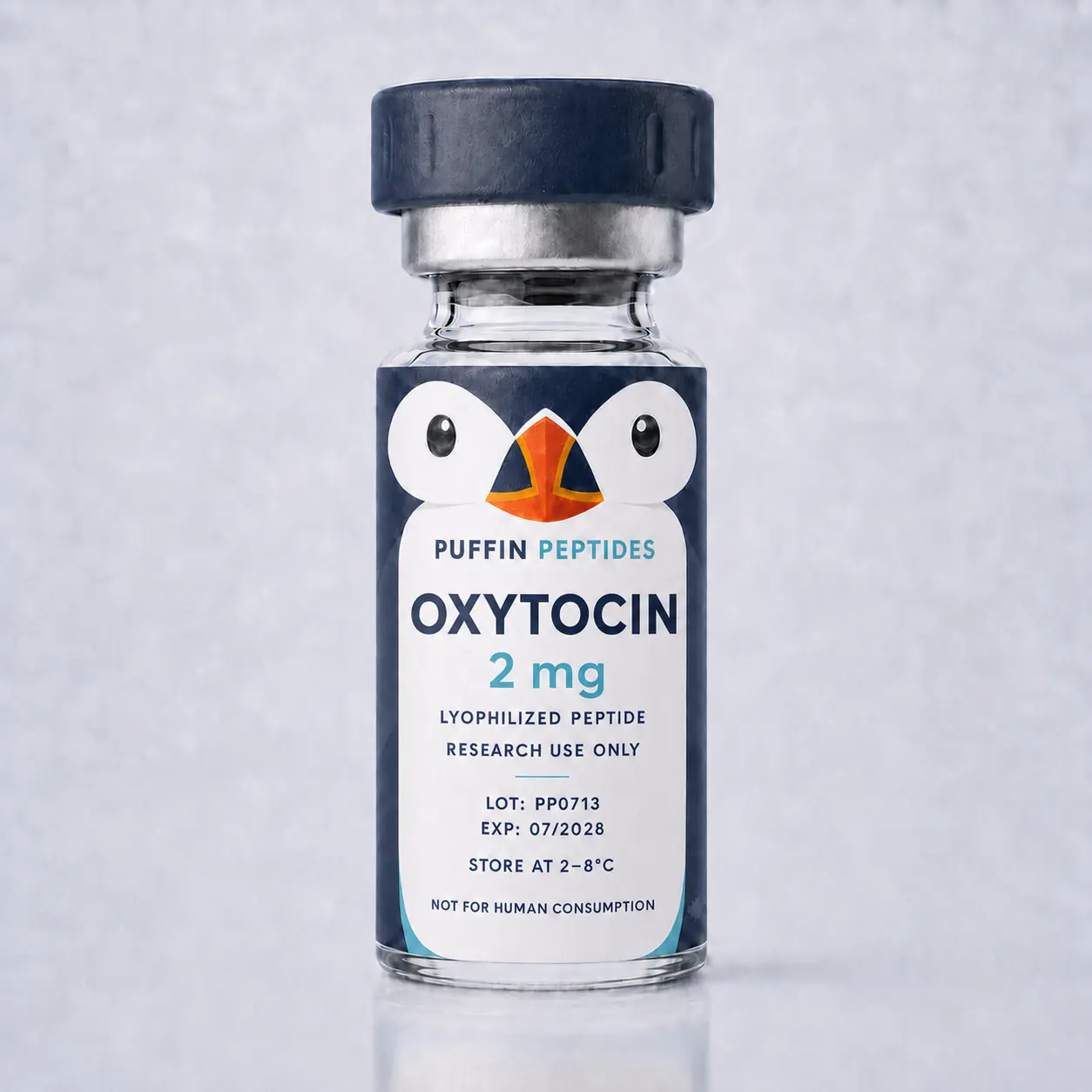
Oxytocin is a nine-amino-acid hormone and neurotransmitter studied in reproductive smooth muscle, milk ejection, social behaviour, stress, and neural-network models. Its popular “bonding hormone” nickname captures only a small and oversimplified part of the biology.
Oxytocin activates a G-protein-coupled receptor whose effect depends on tissue, receptor density, hormonal context, and timing. It also interacts with vasopressin-receptor systems at some concentrations. In plain language, the same peptide can produce different signals in uterus, mammary tissue, brain, and laboratory cells.
Questions to settle before interpreting a result
A useful OXYTOCIN study begins with material identity, a defined model, a relevant comparator, and an endpoint chosen before the result is known. Broad catalogue language cannot replace those controls.
- Use tissue- and receptor-specific models because uterine, neural, and mammary responses answer different questions.
- Control for vasopressin-receptor cross-activity when using higher concentrations or receptor-poor systems.
- In behavioural work, pre-register outcomes and account for sex, context, baseline state, and route of exposure.
How to read the OXYTOCIN evidence
These evidence snapshots summarize the most important distinctions in the published record. They do not combine unlike models or turn an experimental signal into a human-use claim.
Established physiology
- Design
- Peripheral reproductive actions are well characterized
- Finding
- Oxytocin’s roles in uterine contraction and milk ejection are supported by human physiology and approved products. Those established actions should not be used as proof of simplified behavioural claims.
- Read with care
- This is an interpretation boundary, not a claim that a specific outcome has been established in people.
Behavioural evidence · mixed
- Design
- “Bonding hormone” is too simple
- Finding
- Intranasal and social-behaviour studies vary with context, population, outcome, and replication. Oxytocin can change salience or social processing without producing a universal prosocial effect.
- Read with care
- This is an interpretation boundary, not a claim that a specific outcome has been established in people.
Product distinction
- Design
- Route and formulation shape the evidence
- Finding
- An approved injectable uterotonic, an intranasal research protocol, and a lyophilized catalogue vial are not interchangeable experimental or clinical products.
- Read with care
- This is an interpretation boundary, not a claim that a specific outcome has been established in people.
What the evidence does not establish
Approved oxytocin drug products exist for specific obstetric uses. This research vial is not one of those medicines, and evidence for regulated intravenous products or intranasal behavioural studies does not establish equivalence or a general social benefit.
Mechanism, cell, animal, observational, and controlled human evidence answer different questions. A positive result at one level cannot be silently promoted to another, and evidence for a sponsor’s defined product does not establish equivalence for an independently sourced research material.
Keep the publication and the vial separate
A published paper identifies its own sequence or chemical identity, formulation, manufacturing context, analytical controls, exposure, and test system. Matching a familiar name on a label is not enough to show that a catalogue vial is the same study material.
For practical research planning, verify the lot-specific identity and documentation, then write the model, comparator, endpoint, and stopping criteria before testing. This guide does not provide preparation, dosing, injection, or human-use instructions.
Sources
Links lead to the paper, official registry, regulator page, or product label used for this guide. Registry records describe protocols and status; they are not treated as positive results.
- Pitocin (oxytocin) official prescribing informationDailyMed · U.S. National Library of Medicine · Current label
Official label for a regulated oxytocin formulation and established peripheral indications. It is not evidence for simplified behavioural claims or for a separate research vial.
- Think twice before injecting peptides bought online: unauthorized products can seriously harm youHealth Canada · 2026
Official Canadian advisory explaining that a research-use label does not establish authorization, safety, efficacy, or product quality for human use.
Vote for OXYTOCIN
This compound is not currently stocked. Add it to your five-choice catalogue ballot.